Skip to content

AI tools

What An MBA Didn’t Teach You About Sales

The sales profession is challenging. You need to work hard at it to succeed. You need to learn from the best. You need to improve your skills continuously. If you think you can sell since you are a hit at parties and have a lot of friends, you may soon find that you are a failure as a salesperson. Blunt truth:

because the sales profession is so hard, you have to focus on doing everything in sales very well, or you will be considered a failure.

I call this blog, Skinned Knees because I try to relate all of the learning that I have done over the past 4+ decades (while skinning my knees in the learning process).

I hope that you learn from my mistakes so that your business will grow!


AI Prospecting Agents: Build More Pipeline Without Adding More SDRs

One of the more frustrating realities in modern sales is that a company can invest heavily in technology and still leave its best salespeople doing work that should never require their time.

The CRM is open. So is LinkedIn. There is an intent-data platform in another tab, a contact database in another, a sales engagement platform somewhere else, and perhaps a conversation intelligence tool running in the background.

The company has a technology stack. What it may not have is a prospecting system.

That distinction matters.

A collection of tools still depends on someone remembering which accounts matter, noticing when a former champion changes jobs, deciding which buying signals deserve attention, researching the account, moving information between systems, writing the message, and following up. When people are the integration layer connecting all those systems, the company has not really automated prospecting. It has simply given its salespeople more software to operate.

The Prospecting Advantage Has Changed

Traditional outbound sales was built around scarcity. Finding contact information, researching a company, and uncovering a credible reason to approach someone required significant effort. That made volume difficult and valuable.

Artificial intelligence changed those economics.

Today, generating another email is nearly free. Finding another prospect is relatively easy. AI can produce hundreds or thousands of messages faster than a sales team could ever review them. That does not make those messages valuable.

When volume becomes inexpensive, volume stops being a competitive advantage. Relevance becomes the scarce resource.

We need to evolve our systems away from asking, “How can we send more outreach?” Rather, we need to be thinking of, “How can we identify the people who deserve our attention right now and give our salespeople something useful to say when they contact them?”

A modern prospecting system therefore has to answer five questions continuously:

  1. Who should we pursue?
  2. Why should we pursue them now?
  3. What should we say?
  4. Which channel and timing gives us the best chance of engagement?
  5. When should a human salesperson enter the conversation?

The fifth question is particularly important.

Read the rest of the article…
Your Sales Compensation Plan Is Quietly Managing Your Sales Team

A salesperson reaches the final week of the quarter with a major opportunity ready to close. Legal has approved the agreement. The customer is prepared to move forward but asks for a 15 percent discount.

The salesperson understands what the discount does to margin. So does the sales manager. Finance knows as well. Yet the salesperson is measured on revenue, the manager needs the deal to make the quarterly forecast, and neither is directly rewarded for protecting margin.

The discount is approved. The deal closes. The commission increases. Everyone celebrates.

The company may have just paid someone extra to give away its profit.

No one acted dishonestly. The compensation plan worked precisely as designed. That is the problem.

Compensation Is a Management System

Most companies treat sales compensation as an administrative process. Leadership creates a plan, finance calculates payments, and managers resolve disputes when the numbers do not match expectations.

That view misses the strategic role compensation plays.

A compensation plan influences which customers salespeople pursue, how aggressively they discount, whether they favor one-year or multi-year agreements, how they collaborate, and whether they prioritize new business, renewals, margin, or market share.

What the company pays for will eventually outweigh what its leaders say they value.

Many sales leaders inherited plans that accumulated years of exceptions, temporary accelerators, regional variations, product overlays, split-credit rules, and special arrangements. The resulting spreadsheet may be technically functional while being strategically incoherent.

The warning signs are familiar:

Salespeople maintain private spreadsheets because they do not trust their commission statements.

Managers spend time resolving payout disputes instead of coaching pipeline.

Quotas are created by adding a percentage to last year’s number rather than analyzing territory potential.

A handful of top performers benefit from every contest while most of the team decides the competition is irrelevant.

These are not motivation problems. They are design problems that consume selling time, reduce margin, and erode trust.

Read the rest of the article…

The Buyer’s Clock Starts Before Your Sales Team Notices

A buyer does not become urgent when your CRM creates a record. The buyer became urgent earlier; at that moment, they decided the problem was worth interrupting their day for.

That distinction matters because too many B2B companies design their inbound process around internal workflow rather than buyer momentum. A prospect searches, compares, reads, evaluates, talks to a peer, visits your site, reviews your proof, and finally raises their hand. Then the company they contacted responds as though the buyer has agreed to wait patiently while marketing automation, CRM routing, territory logic, rep availability, and inbox notifications sort themselves out.

That is not a speed problem. It is a revenue system problem.

The real issue is not whether a sales rep should call faster. Of course they should. The deeper question is whether the business can detect, interpret, prioritize, enrich, route, and respond to buyer intent while the buyer still cares. When the answer is no, the company loses revenue without realizing it. The lost buyer does not announce their departure. They simply book with someone else, cool off, or decide the issue can wait.

This is why inbound orchestration deserves executive attention. High-intent inbound activity is not a generic lead flow. A demo request from a target-fit company is not the same as a newsletter signup. A pricing inquiry is not the same as a content download. Treating all of them as “leads” may simplify reporting, but it destroys commercial judgment.

When every lead looks the same, nothing feels urgent.

Read the rest of the article…

Revenue Forecasting Should Be Built on Evidence, Not Hope

Most sales forecasts are not really forecasts. They are seller opinions, manager adjustments, CRM fields, historical averages, and optimism packaged into a number that leadership is expected to trust.

That may have been acceptable when forecasting was mostly an internal sales exercise. It is not acceptable when the board, finance, hiring plans, customer success capacity, and investor expectations are all tied to the revenue number.

The core problem is not that sales leaders are careless. The problem is that many revenue teams are still using an architecture that cannot produce predictability. Spreadsheets, commit calls, and stage rollups organize information, but they do not necessarily reveal the buyer’s truth.

The better question is not, “How confident is the rep?”

The better question is, “What did the buyer actually do?”

That shift changes the entire operating model. Forecasting moves from hope-based to evidence-based. Deals are no longer judged by the confidence in a seller’s voice but by observable buyer behavior: recent engagement, executive involvement, mutual action plans, legal or procurement movement, real next steps, and date-driven urgency.

This is where artificial intelligence and revenue intelligence become useful, but only if the management system is ready for them. AI can identify patterns, detect risk, surface stalled deals, and compare buyer behavior against historical outcomes. But it cannot compensate for weak sales processes, vague stage definitions, poor CRM hygiene, or managers who refuse to inspect the evidence.

Read the rest of the article…

How Bad CRM Data Breaks AI, Sales Processes, and Pipeline Growth

Most sales leaders do not have a prospecting problem. They have a data-confidence problem disguised as a prospecting problem.

The team is working. Reps are calling, emailing, sequencing, researching, and updating the CRM. But when the data is stale, duplicated, incomplete, or legally questionable, every downstream motion becomes weaker. Outreach gets slower. Messaging becomes less precise. Sales processes become harder to manage. Forecasts become less reliable. AI recommendations become faster, but not necessarily smarter.

That is the real issue with B2B sales intelligence today. Too many companies still evaluate data providers with a phonebook mentality. They ask who has the most contacts, the biggest database, the broadest coverage, or the lowest cost per seat. Those questions are easy to compare, but they rarely answer the question that matters: will this data perform against our ICP, in our market, inside our sales stack?

Artificial intelligence raises the standard. AI tools depend on clean, structured, identity-resolved data. If the CRM has three versions of the same person, five versions of the same account, outdated titles, invalid email addresses, disconnected phone numbers, and inconsistent fields, AI will not fix the problem. It will operationalize the problem.

Identity resolution is the missing discipline. It is the ability to recognize that the same person or company appears across multiple systems and create one authoritative record. Without it, lead scoring, personalization, enrichment, intent data, pipeline analysis, and Revenue management all become suspect.

This is why sales management must treat data infrastructure as a strategic operating issue, not a software-administration issue. Bad data burns money in several directions at once. You pay for the data subscription. You pay reps to manually verify what the subscription should have solved. You pay sales operations to clean up the mess. Then you lose revenue because your team is working on bad records while competitors are already in the right relationships.

Read the rest of the article…

AI Will Not Fix Sales Problems Built on Fragmented CRM Data

Most sales leaders are asking the wrong question about artificial intelligence.

They ask which AI tool to buy, which platform has the best features, which automation will save the most time, or which sales technology will help their reps move faster. Those questions matter, but they are downstream from the real issue.

The more important question is: Does your CRM provide AI with enough trusted context to make useful recommendations?

If the answer is no, the next tool will not solve the problem. It will accelerate the confusion.

AI cannot reason well from fractured data. If account history lives in email, proposal tools, LinkedIn messages, spreadsheets, call notes, support tickets, and half-completed CRM fields, the AI is not operating from a complete commercial picture. It is guessing from fragments. A faster guess is still a guess.

That is why the CRM must evolve from a passive system of record into an active system of action. The old CRM was built to store yesterday’s activity. The modern CRM has to help shape tomorrow’s decisions.

A strong CRM foundation gives sellers a complete account context before a call. It helps managers understand pipeline risk without relying only on rep opinion. It allows AI to recommend next steps because the recommendation is grounded in actual customer history, not generic sales theory. It gives the organization leverage because the patterns learned in one deal can improve the next similar deal.

Read the rest of the article…

Instant Follow-Up in Field Sales: How AI Eliminates Post-Meeting Lag

Field sales doesn’t lose deals in the meeting. It loses deals after the meeting when a buyer asks a high-stakes question, you promise to “get back to them,” and the response shows up after the moment has passed. That delay kills momentum and quietly downgrades you from advisor to administrator.

In 2026, the buyer often has access to comparable information. Your differentiation is contextual insight delivered with speed. If your follow-up arrives hours later (or worse, it arrives days later), you’re not doing value selling, you’re doing cleanup. That’s the Administrative Tax: notes, recap emails, CRM updates, and retrieval work that should not be done manually by your highest-paid revenue generator.

Artificial intelligence changes the operating model. The goal isn’t “better summaries.” It’s an Instant Field Response: capture what matters in the room, retrieve the right internal assets, and draft a precise follow-up while you’re still in the parking lot. When AI handles the science (capture, entity recognition, semantic search, and drafting), you reclaim the art: listening, reading intent, and leading the decision.

Read the rest of the article…

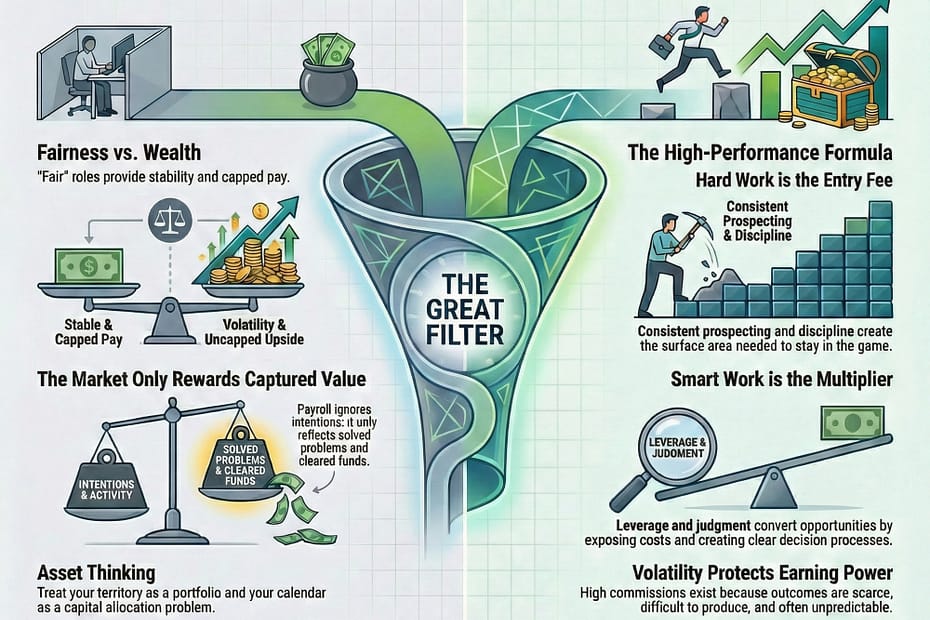
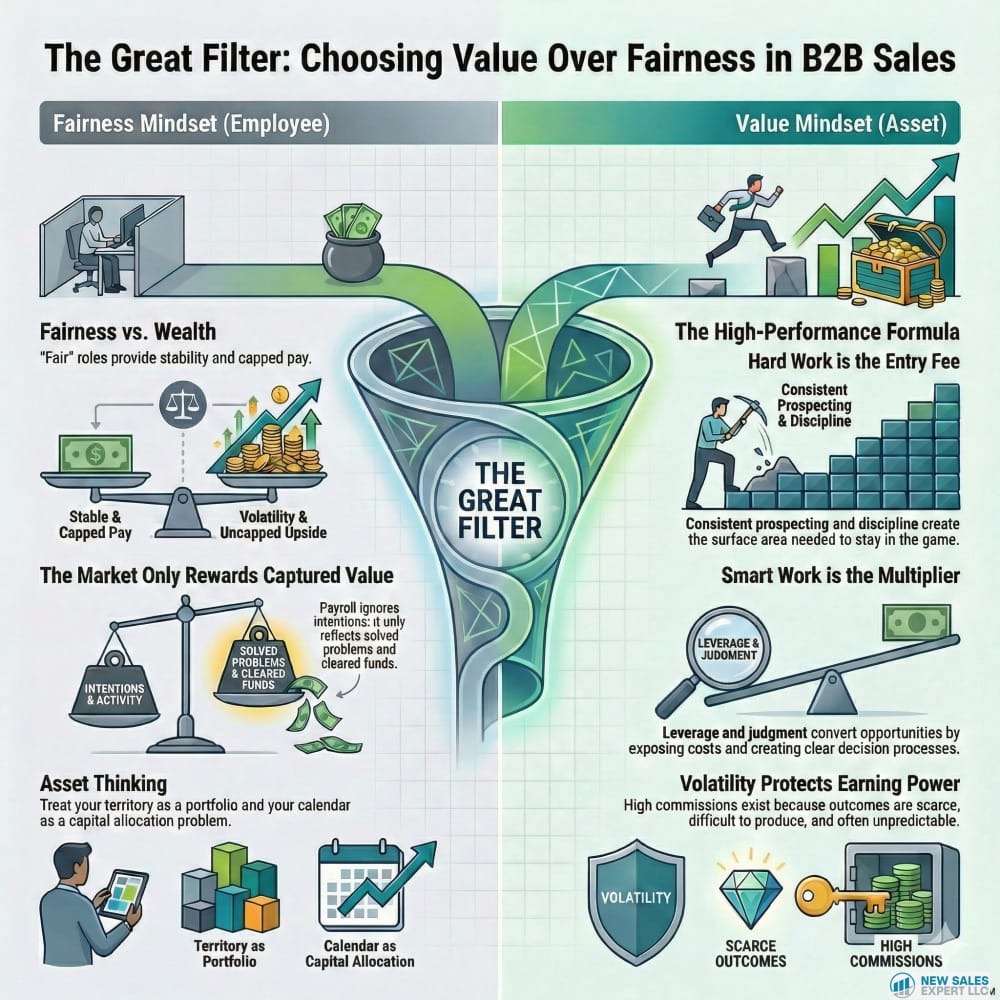
The Great Filter – Why Most People Should Quit B2B Sales Today

If you want fairness, choose a role where performance is measured by compliance and consistency. If you want wealth, stay in sales and accept the only rule that matters: compensation follows captured value.

Walk into any growth-stage B2B sales organization, and you see two populations immediately:

  • One group is stuck in grievance. They stare at the CRM, explain shortfalls with lead quality, territory math, product gaps, or “unrealistic quota.” They want a manager to prescribe the playbook and then validate the effort. Their mindset is hourly, even when they’re paid a salary plus commission.
  • The other group is operating a different model. They talk about leverage, pipeline physics, conversion rates, deal control, and enterprise value. They create their own opportunities. They build customer confidence and earn the right to ask for a decision. They are not looking for comfort. They are looking for the wire.

If you identify with the first group, here’s the most respectful advice I can give you: exit sales on purpose. Move into HR, operations, finance, project management, enablement, customer success, analytics, or any role where the exchange is stable and the scorecard is predictable. Those functions matter. They are important and critical to most companies. They keep companies alive. They are also structurally designed to be fairer.

Sales is designed to be variable, value-based, and exposed. That’s the point.

The safety-net trap

Most people walk into sales carrying the wrong conditioning. School teaches that effort should correlate with reward. Show up, do the work, get the grade. Many corporate functions reinforce it. Do the tasks, hit the process metrics, stay inside the lines, and get the raise.

That conditioning becomes a trap the moment you step into a quota role.

In “fair” roles, compensation tracks your cost and your consistency. Your output is capped by your time, so your income is capped by a band. It’s stable, and it’s a ceiling.

Sales is different because it’s one of the few places left where pay can scale with impact. You are not paid for effort. You are paid for outcomes. That makes it feel brutal to people who want certainty, and it feels like freedom to people who want upside.

The moment you need the world to be fair, sales will punish you. The moment you accept the model, sales becomes one of the most rational games in business.

B2B Sales is rewarding because it isn’t easy or fair
Read the rest of the article…

Admin Drag Is Killing Your Sales Capacity: How to Reclaim Selling Time With AI

Episode 23 of “AI Tools for Sales Pros” is built around a reality most leadership teams have started to feel in their gut. Buying AI does not increase revenue. It might increase activity, content volume, and dashboard noise, but revenue generation improves only when you reclaim selling time and redeploy it into the actions that move deals forward.

The executive version of the problem is simple. Your tech stack cost keeps rising. Your board wants proof that those investments translate into pipeline quality, cycle-time reduction, win-rate improvement, and improved margins. “Are we getting value?” is the polite question. “Where is the revenue?” is what they ask when patience runs out. This is a revenue management problem, not a software problem.

Most B2B companies are operating with a hidden productivity ceiling. Salespeople spend roughly a third of their time on revenue-producing work. The rest disappears into administrative drag: CRM updates, transcript cleanup, internal coordination, re-entering data across tools, searching for collateral, chasing security documentation, fixing records, and managing handoffs. None of that is value selling. Most of it is friction disguised as “process.”

A useful way to see it is the Tollbooth Effect. One approval feels reasonable. One form feels harmless. One handoff feels like good governance. Together, they turn selling into paperwork. The rep has a strong discovery call and a clear hypothesis. Momentum is real. Then they hit the toll plaza: systems require updates, internal teams need briefings, fields need to be filled, and the same information gets retyped because two systems disagree on the truth. By the time the rep finishes paying the tolls, urgency has cooled, follow-up becomes generic, and the deal loses its edge.

Read the rest of the article…

Building a Zero-Cost AI Sales Stack: How to Validate Value Before You Spend a Dollar

Most sales leaders today feel the tension between innovation and fiscal responsibility. You know artificial intelligence can accelerate productivity, clarify messaging, and drive revenue generation. You also know your competitors are implementing AI-driven sales processes and reaping the benefits. Yet you are expected to somehow produce results without the budget to experiment, test, or validate new technology.

This pressure creates the classic chicken-and-egg dilemma. You cannot get budget approval without demonstrating value, but you cannot demonstrate value without access to capable tools. That tension often leaves sales leaders paralyzed, observing advancements but unable to participate. It is an exhausting cycle that erodes confidence and slows down organizational progress.

The good news is that modern software economics have shifted. You no longer need an enterprise-level budget to run meaningful AI pilots. Instead, today’s freemium models allow teams to build real workflows, automate real processes, and create real sales success with no financial risk. These free tiers exist because vendors want you to become reliant on the workflow, meaning you can use that dynamic to your advantage as you design early-stage pilots.

A practical approach for sales management is to treat free AI tools as validation engines rather than long-term solutions. You begin with lightweight experimentation, focusing on a single friction point that slows your team. Whether the issue involves pre-call research, drafting follow-up emails, or scoring inbound leads, AI can automate repetitive tasks, freeing your sellers to focus on value selling. The goal is not perfection; it is measurement.

Read the rest of the article…