Skip to content

ChatGPT

What An MBA Didn’t Teach You About Sales

The sales profession is challenging. You need to work hard at it to succeed. You need to learn from the best. You need to improve your skills continuously. If you think you can sell since you are a hit at parties and have a lot of friends, you may soon find that you are a failure as a salesperson. Blunt truth:

because the sales profession is so hard, you have to focus on doing everything in sales very well, or you will be considered a failure.

I call this blog, Skinned Knees because I try to relate all of the learning that I have done over the past 4+ decades (while skinning my knees in the learning process).

I hope that you learn from my mistakes so that your business will grow!


How to Use AI to Handle Price Objections Without Discounting

Four months into a major B2B sales opportunity, things seem to be lining up for a successful close. The technical evaluation is complete, your champion is enthusiastic, and the buying committee agrees that your solution addresses the company’s operational challenges.

Then procurement schedules a meeting.

“The CFO reviewed your proposal, and you’re simply too expensive. We need fifteen percent off before we can move forward.” For many salespeople, the instinctive response is familiar: “Let me see what I can do.”

Those seven words can cost your company tens of thousands of dollars. More importantly, they point to a fundamental gap in how many companies prepare their sales teams for negotiations.

The salesperson has started negotiating before understanding what problem the buyer is trying to solve.

Artificial intelligence offers a practical way to help change that behavior. Rather than simply generating stronger sales pitches, AI can help salespeople better understand the financial impact of discounting, build customer business cases they can confidently stand behind, and practice challenging negotiations before real money is on the line.

The Hidden Financial Damage of Discounting

Consider a $400,000 annual subscription with an 80% gross margin. The company spends $80,000 each year to deliver and support the service, leaving $320,000 in gross profit.

A 15% discount lowers the subscription price by $60,000. Since delivery costs stay the same, gross profit drops from $320,000 to $260,000.

That’s an 18.75% reduction in gross profit dollars, not just a 15% discount.

Now consider a manufacturer or distributor with a 40% gross margin. The same $400,000 sale generates $160,000 in gross profit, and a $60,000 discount brings that profit down to $100,000.

The company has sacrificed 37.5% of its gross profit to give the customer a 15% price reduction.

To recover the lost profit at the discounted unit economics, the company would need to increase sales volume by 60%.

Most salespeople never see these calculations. Their CRM tracks bookings, their compensation plans often reward revenue, and management celebrates closed opportunities. The resulting margin damage shows up elsewhere in the financial statements. AI can help close this gap, but only if sales management makes financial understanding part of the sales process.

Read the rest of the article…

The CFO Demands 15% Off. Use AI Before You Give In

Episode Summary

When a CFO says your solution is too expensive, an automatic discount can destroy margin without addressing the real objection. In this episode of AI Tools for Sales Pros, Sean O’Shaughnessey introduces the Margin Rehearsal, a practical way to use generative AI, customer discovery, and a spreadsheet to prepare for high-stakes B2B negotiations. Learn to measure both the gross profit at risk and the buyer’s cost of delay, then practice against an AI procurement director or CFO. The objective is not to refuse every discount; it is to make financially sound decisions that protect customer ROI and long-term revenue generation.

Major Highlights

  • The true cost of discounting: On a $400,000 subscription with an 80% gross margin, a 15% discount removes $60,000 in gross profit, a decline of 18.75%. At a 40% margin, the same discount wipes out 37.5% of gross profit.
  • Diagnose the objection: “Too expensive” may mean limited budget, cash-flow timing, competitive pressure, unproven ROI, implementation risk, or a procurement savings target. Each requires a different sales strategy.
  • Build a defensible value case: Use ChatGPT, Claude, or Gemini to challenge assumptions in discovery notes, then use spreadsheet formulas to calculate conservative, expected, and underperforming scenarios. AI assists with judgment; formulas handle arithmetic.
  • Quantify cost of inaction: In the episode’s illustrative industrial deal, $876,000 of annual operational costs translates to about $525,600 of benefits at 60% realization. A three-month delay could forgo $131,400 of those benefits, subject to buyer validation.
  • Trade rather than concede: Consider multi-year commitments, payment timing, or reduced scope while protecting the economics. Establish pricing floors and approval rules as part of sales management.
  • Rehearse with AI: Use AI-powered sales coaching and role-play with ChatGPT, Hyperbound, Second Nature, or Mindtickle to practice handling procurement pressure and a skeptical buying committee.
Read the rest of the article…

How to Find Hidden Risks in Your B2B Sales Pipeline

It’s 4:40 on a Thursday afternoon. Your best salesperson receives an email from a prospective customer three weeks before a major deal is supposed to close.

“Can we find time early next week? Our CFO has a few questions before this goes to the capital committee.”

Capital committee? Nobody has mentioned a capital committee during the previous seven months.

Imagine you’re the owner of a $35 million industrial automation company. Your salesperson has been working a $620,000 equipment deal with an additional $80,000 in annual service revenue. You’ve had six demonstrations, enthusiastic engineering discussions, pricing negotiations, and implementation planning. Your salesperson says you’re the preferred vendor. The opportunity sits in your CRM with an 85% probability of closing.

Then everything changes.

The CFO has never reviewed the projected $480,000 in annual savings. IT has unresolved integration concerns. Procurement has a vendor onboarding process nobody investigated. And your supposed champion has never personally navigated a major capital expenditure through the company’s executive approval process.

The deal doesn’t disappear. It slips into the next quarter, taking your revenue forecast with it.

Here’s the uncomfortable question: Did this deal suddenly develop problems, or did those problems exist for months while everyone ignored them?

Sales Forecasting Has an Evidence Problem

Most sales leaders believe they are inspecting opportunities when they conduct pipeline reviews. Too often, they’re actually asking salespeople to explain why they remain optimistic. The salesperson has invested months in the opportunity. The sales manager has already committed the revenue. Both believe the deal will close.

The problem isn’t dishonesty. It’s that confidence, buyer enthusiasm, and sales activity have become substitutes for evidence.

A customer requesting another demonstration doesn’t prove that finance will approve the investment. A friendly executive isn’t necessarily a champion. And a proposed decision date doesn’t prove that the customer’s purchasing process can support your close date. For complex B2B deals, the most important information is often held by people your salesperson hasn’t met.

That is exactly where artificial intelligence can help.

Introducing the Pre-Commit Red Team

Military planners and cybersecurity teams use red teams to challenge plans and expose weaknesses before they cause failure. Sales organizations should adopt the same discipline. I call the approach the Pre-Commit Red Team. Before an important opportunity enters the commit forecast, use AI to challenge the deal from the perspective of the customer’s buying committee.

The objective isn’t to prove that the salesperson is wrong. It’s to uncover what the salesperson doesn’t know while there’s still time to do something about it. This works especially well when combined with MEDDPICCC, the qualification methodology I have used throughout my sales leadership career. The framework forces us to examine Metrics, Economic Buyer, Decision Criteria, Decision Process, Paper Process, Identification of Goal, Competition, Champion, and Coach.

Notice that I emphasize the customer’s goals, not simply their pain. The existence of a problem doesn’t mean the company will spend money solving it. The investment must support an organizational objective that someone with budget authority cares about.

AI can help identify where each qualification element is supported by actual buyer behavior and where your team is operating on assumptions.

Read the rest of the article…

Two Tall Guys Talking Sales Podcast – Lost a B2B Sales Deal? Here’s What the Best Salespeople Do Next – Episode 215

In B2B sales, yesterday’s win won’t fill tomorrow’s pipeline, and yesterday’s loss doesn’t have to define your future. Whether you’ve just closed a multimillion-dollar opportunity or watched a competitor walk away with a deal you spent 18 months pursuing, your next move matters more than your last result. In this episode of Two Tall Guys Talking Sales, hosts Kevin Lawson and Sean O’Shaughnessey tackle one of the most overlooked drivers of sales success: the ability to recover, learn, and move forward. From conducting meaningful win-loss reviews to rebuilding prospecting momentum and strengthening customer relationships, Kevin and Sean share practical sales strategies to turn every outcome into an opportunity for improvement.

Key Topics Discussed

  • 00:17 – Forget the Win, Forget the Loss, and Keep Selling: Sean explains why successful salespeople must develop the discipline to move past both disappointing losses and major victories. Celebrate or regroup, but don’t let either outcome interfere with the sales activities that drive future revenue.

  • 01:22 – Sales Resilience Is a Skill, Not a Personality Trait: Kevin discusses the relentless pressure of sales management and the reality that quotas reset regardless of past accomplishments. Discover why your next activity—not your last achievement—is the strongest indicator of future sales success.

  • 03:30 – Lose the Deal, Not the Customer Relationship: A competitor’s victory doesn’t necessarily mean the relationship is over. Kevin explains how graciously handling rejection, supporting customer transitions, and maintaining professional relationships can position you for another opportunity when circumstances change.

  • 04:06 – Conduct Win-Loss Reviews That Actually Improve Sales Performance: Sean introduces a straightforward approach to evaluating every opportunity, whether you won or lost. Learn why asking customers what you did right, what you did wrong, and what you should change can uncover weaknesses in your messaging, value selling, and sales processes that even successful deals can conceal.

  • 08:04 – Rebuild Pipeline Momentum Through Relationships and Better Workflows: Kevin offers practical advice for evaluating prospecting activity, reconnecting with your network, and making customer conversations more productive. He also examines how workflow automation, stronger customer engagement, and smarter allocation of time can help companies scale without simply demanding longer working hours.

  • 11:23 – Practice Before the Next Opportunity Is on the Line: Sean challenges salespeople to seek constructive criticism before making important presentations or delivering critical value propositions. Discover how peer feedback, sales coaching, and the B2B Sales Lab community can expose weaknesses early and help sellers improve their performance in complex B2B deals.

Key Quotes

Sean O’Shaughnessey (00:58):

“You also have to forget about your wins. Just because you closed that really big deal that you’ve been working on for 15 months doesn’t mean the next customer that you talk to, the next prospect, is instantly gonna be the same size of a deal that you worked on for 18 months.”

Kevin Lawson (02:21):

“You are only as good as your next activity, ’cause your next activity is your execution. Your past activities are your scorecard. You have got to keep moving.”

Sean O’Shaughnessey (04:27):

“You screwed things up and they bought anyway. You said the wrong thing and they bought anyway. So what did you do right and what did you do wrong?”

Sean O’Shaughnessey (07:03):

“It doesn’t matter too much what your boss says. It matters what your customer says.”

Kevin Lawson (10:53):

“Growth is finding the things that you can subordinate, automate, or workflow to get better results at a lower cost.”

Additional Resources

  • B2B Sales Lab: A community created by Kevin Lawson and Sean O’Shaughnessey where B2B sales professionals and sales leaders exchange ideas, critique presentations, test value propositions, and help one another solve real sales challenges. The episode highlights a free 30-day trial that allows members to experience collaborative sales coaching and peer feedback.

  • ChatGPT: Sean mentions using ChatGPT as a simple way to dictate and record the lessons learned from sales wins and losses. This practical use of AI can make documenting observations easier and help salespeople retain insights for future opportunities.

  • Two Tall Guys Talking Sales: Continue learning from Kevin and Sean through their weekly conversations about selling, sales leadership, and improving business performance.

A Significant Actionable Item from this Podcast

Conduct a customer-driven win-loss review after your next closed opportunity—regardless of whether you win or lose.

Most salespeople conduct informal deal reviews, but too often those conversations focus on internal opinions rather than the buyer’s actual experience. Sean challenges sellers to go directly to the source.

After your next win or loss, schedule a brief conversation with the customer or prospect. If you lost, allow a few days for the decision to settle before reaching out. Make it clear that you’re not attempting to reverse their decision; you’re trying to improve.

Ask three specific questions:

  1. What did I do well? Identify the sales activities, business acumen, communication, or value propositions that positively influenced the buying process.

  2. What did I do poorly? Ask where your approach, responsiveness, messaging, or understanding of the customer’s needs fell short. Don’t settle for a polite answer that everything was fine.

  3. What one thing should I change? Select a single, meaningful improvement and implement it in your next opportunity.

Document the feedback, thank the customer, and follow through. You can even use AI to organize your notes and identify recurring opportunities for improvement over time.

The objective isn’t to overhaul your entire sales methodology after every deal. It’s to make one deliberate improvement, reinforce it through practice, and then address the next weakness.

The added benefit? A professional, gracious follow-up can strengthen the relationship with a lost prospect, increasing the likelihood they’ll remember you when another buying opportunity emerges.

Read the rest of the article…

AI Found 3 Reasons Your Biggest Deal Won’t Close

Episode Summary

Your biggest B2B opportunity may be the least reliable deal in your forecast if confidence has replaced buyer evidence. Sean O’Shaughnessey introduces the Pre-Commit Red Team, a practical way to use artificial intelligence to challenge assumptions before complex deals slip. Using a $620,000 industrial automation sale, he shows how MEDDPICCC, AI simulations of the buying committee, and a disciplined champion test improve sales management and B2B sales pipeline predictability. The goal is better revenue generation through verified facts, not prettier AI forecasts.

Major Highlights

  • Why an active deal can still be fragile: the CFO never validated the ROI, IT concerns went unanswered, and procurement’s paper process was never mapped.
  • Use MEDDPICCC to inspect Metrics, Economic Buyer, Decision Criteria, Decision Process, Paper Process, Identification of Goal, Competition, Champion, and Coach. Separate buyer-verified evidence from inference and unsupported assumptions.
  • Build an anonymized deal dossier, run an AI evidence audit, simulate objections from finance, IT, and procurement, and produce a one-page Pre-Commit Red Team briefing.
  • Ask three questions: Has the economic buyer accepted the business case? Who can block the purchase? What has the champion done when the salesperson was absent?
  • Distinguish a true champion from a helpful coach. A practical test: will the contact arrange a working session with the CFO or controller?
  • Compare general Generative AI tools such as ChatGPT, Claude, and Gemini with Gong, Clari, People.ai, and MEDDICC’s Winni for deal inspection, conversational intelligence, and revenue management.
  • Consider vendor-reported customer outcomes cautiously; AI-generated objections are hypotheses that must be verified with actual buyers.
Read the rest of the article…

Your Buyer Has AI. You Have AI. Who Wins the Sale?

Episode Summary

AI-powered B2B buyers can research vendors, compare pricing, and challenge your offering before the first sales meeting. In this episode of AI Tools for Sales Pros, Sean O’Shaughnessey explains why artificial intelligence has ended the salesperson’s information advantage but increased the need for judgment, trust, and decision confidence. Learn the four-part Validation Conversation, how to correct questionable Generative AI research without alienating buyers, and which sales enablement tools help navigate complex deals. The result is stronger value selling, better business acumen, and more effective revenue generation.

Major Highlights

  • The buyer has a 200-row AI-generated comparison: why defending features or continuing a product pitch makes the sale harder.
  • Gartner research cited in the episode: 45% of surveyed B2B buyers used Generative AI for a recent purchase, yet 69% want to validate AI insights with a sales rep.
  • Four AI research failure patterns: outdated or invented pricing, confused features, unrealistic implementation assumptions, and accurate answers to the wrong business question.
  • The Validation Conversation: acknowledge the research, trace sources and assumptions, narrow the decision to the factors driving ROI, and co-create a business case with the buying committee.
  • Use ChatGPT, Claude, and Deep Research to role-play the CFO, operations leader, and IT director; treat the findings as hypotheses, not facts.
  • Compare competitive intelligence tools Klue, Crayon, and Kompyte; real-time guidance from Clari Copilot and Aircover; and conversational intelligence from Gong for MEDDPICCC deal reviews.
  • Equip champions with co-authored business cases and digital sales rooms using tools such as Fluint and Dock; monitor what AI says about your firm with Profound or PageCrawl.
  • For sales management and RevOps, measure whether AI-driven productivity gains create more buyer conversations, stronger pipeline velocity, and better sales processes—not just more activity.
Read the rest of the article…

How to Win When AI-Powered B2B Buyers Already Know Your Product

Imagine walking into a major prospect meeting after two days of preparation. You have reviewed the account, refined your presentation, and rehearsed your opening. Three minutes into your presentation, the vice president of operations interrupts.

“We already know what your product does. We compared you with five competitors using AI.”

She turns her laptop around. On the screen is a spreadsheet with 200 rows of features, prices, reviews, and implementation claims. Some entries are accurate. Others are questionable. Every entry has already influenced how her team thinks about your solution. Your instinct might be to continue the presentation, challenge the inaccuracies, or defend your product feature by feature. All three responses surrender control of the business conversation. The buyer does not need another source of product information. She needs help making a decision.

The Salesperson’s Information Advantage Is Gone

Artificial intelligence has changed what B2B buyers can accomplish before they speak to a salesperson. Generative AI tools can summarize technical documents, compare competing products, model pricing scenarios, identify perceived weaknesses, and develop vendor shortlists in a fraction of the time those activities once required.

According to Gartner’s May 2026 research, 45% of surveyed B2B buyers used generative AI during a recent purchase. Sixty-seven percent said they preferred a sales-rep-free experience. Yet 69% wanted to validate AI-generated insights with a sales representative. Those numbers are not contradictory. Buyers increasingly prefer to gather information independently, then turn to someone who can help them assess its reliability, apply it to their business, and reduce the risk of a bad decision.

This changes the definition of value selling. A salesperson’s value is no longer primarily access to information. It is the ability to translate evidence into business judgment and confidence in decisions.

Your Most Dangerous Competitor Is No Decision

An AI-assisted buying committee may be more informed individually and less aligned collectively. The CFO asks an AI assistant to identify the cheapest alternative. Operations prioritizes reliability and throughput. IT investigates integration and cybersecurity. Procurement scores the vendors against another set of criteria. Each stakeholder arrives with an apparently objective answer. The answers do not necessarily agree. More information creates more debate, more validation requests, and more reasons to defer the decision.

This is how information paralysis becomes a revenue problem. The salesperson who responds with another 40-slide deck adds information without resolving uncertainty. The stronger seller identifies the few factors that determine whether the investment produces a measurable business result.

For a manufacturing automation purchase, those factors might be unplanned downtime, production throughput, and integration costs. The other 197 spreadsheet rows may be informative without being decisive.

Read the rest of the article…

AI Sales Automation: Why Your Chatbot Is Not a Sales Process

Imagine preparing for an important customer meeting. You open your favorite AI assistant, give it the prospect’s name, and ask for a summary of the company’s business challenges and the questions you should ask. Within seconds, you receive a beautifully written briefing. The assistant identifies potential operational problems, competitive pressures, and several opportunities to demonstrate the value of your solution.

There’s just one problem. One of those impressive insights concerns an acquisition the prospect supposedly completed last year.

Except the acquisition never happened.

The artificial intelligence fabricated a plausible business event and presented it as fact. Had you trusted the briefing, you might have opened your meeting with a question that immediately damaged your credibility.

This scenario illustrates a much larger problem with how B2B sales organizations use AI.

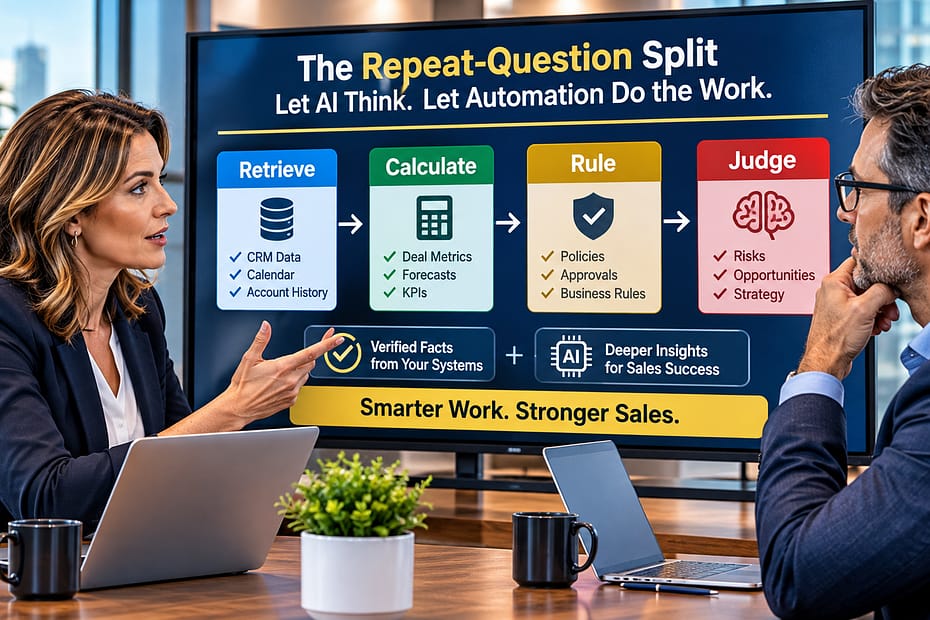
We’re asking artificial intelligence to perform too many different kinds of work without distinguishing which tasks require intelligence and which require reliable execution.

That distinction matters more than the sophistication of the AI model you choose.

The Problem Isn’t Just Hallucinations. It’s Process Design.

Salespeople increasingly rely on ChatGPT, Claude, Gemini, and other Generative AI applications to prepare for meetings, research prospects, write follow-up messages, and analyze opportunities. Those are legitimate applications of AI. In fact, I’d question why a salesperson with access to these capabilities wouldn’t use them. But consider what happens before the salesperson receives a useful answer.

They retrieve information from their CRM, gather previous meeting notes, identify stakeholders, check pricing, and reconstruct details from previous conversations. They paste everything into their AI assistant, ask a question, verify the response, and correct any mistakes.

Tomorrow, they repeat the process for another customer.

The AI may have improved the quality of their analysis, but the underlying sales process remains largely manual.

When twenty salespeople independently reconstruct the same process every day, you don’t have an AI adoption problem. You have a sales management problem.

You’re paying experienced professionals to repeatedly assemble information that your existing systems should already provide.

The solution isn’t necessarily better prompting. It’s better workflow design.

Read the rest of the article…

Stop Using the Corporate Deck: Build Sales Presentations Around the Buyer

Episode Summary

Most B2B sales presentations are still built around the seller instead of the customer. This episode explains how artificial intelligence and Generative AI can change that by replacing static corporate decks with governed Narrative Briefs that turn discovery, approved messaging, and customer intelligence into relevant presentations. The goal is not faster slides; it is better sales conversations, stronger business acumen, improved sales productivity gains, and more disciplined value selling. AI amplifies good selling, but only when strong discovery, sales processes, and human judgment come first.

Major Highlights

  • Why adding a prospect logo to a corporate deck is not personalization and often wastes executive attention.
  • The new sales enablement model: marketing governs the story framework, approved claims, proof points, brand standards, and messaging while the seller customizes the customer narrative.
  • How a Narrative Brief can structure goals, obstacles, business consequences, required capabilities, proof, and next steps for complex deals and enterprise sales.
  • Why AI cannot compensate for weak discovery. Poor inputs create polished fabrication, while strong MEDDPICCC-style discovery gives AI the raw material to support a buying committee and build a credible business case.
  • The five-layer model: customer intelligence, company knowledge, the Narrative Brief, design governance, and human review.
  • How tools such as Microsoft Copilot, Gemini, Beautiful.ai, Gamma, Pitch, Plus AI, Prezent, Storydoc, ChatGPT, and Claude fit into a modern Sales Tech Stack.
  • Why human-in-the-loop automation matters: the salesperson must still decide what matters, challenge assumptions, verify accuracy, and protect credibility.
  • Why the real opportunity is reducing sales administrative burden and eliminating non-selling activities so AEs, SDRs, sales management, RevOps, and Sales Enablement can focus on revenue generation and deal acceleration.
Read the rest of the article…