Skip to content

Decision Criteria

What An MBA Didn’t Teach You About Sales

The sales profession is challenging. You need to work hard at it to succeed. You need to learn from the best. You need to improve your skills continuously. If you think you can sell since you are a hit at parties and have a lot of friends, you may soon find that you are a failure as a salesperson. Blunt truth:

because the sales profession is so hard, you have to focus on doing everything in sales very well, or you will be considered a failure.

I call this blog, Skinned Knees because I try to relate all of the learning that I have done over the past 4+ decades (while skinning my knees in the learning process).

I hope that you learn from my mistakes so that your business will grow!


How to Find Hidden Risks in Your B2B Sales Pipeline

It’s 4:40 on a Thursday afternoon. Your best salesperson receives an email from a prospective customer three weeks before a major deal is supposed to close.

“Can we find time early next week? Our CFO has a few questions before this goes to the capital committee.”

Capital committee? Nobody has mentioned a capital committee during the previous seven months.

Imagine you’re the owner of a $35 million industrial automation company. Your salesperson has been working a $620,000 equipment deal with an additional $80,000 in annual service revenue. You’ve had six demonstrations, enthusiastic engineering discussions, pricing negotiations, and implementation planning. Your salesperson says you’re the preferred vendor. The opportunity sits in your CRM with an 85% probability of closing.

Then everything changes.

The CFO has never reviewed the projected $480,000 in annual savings. IT has unresolved integration concerns. Procurement has a vendor onboarding process nobody investigated. And your supposed champion has never personally navigated a major capital expenditure through the company’s executive approval process.

The deal doesn’t disappear. It slips into the next quarter, taking your revenue forecast with it.

Here’s the uncomfortable question: Did this deal suddenly develop problems, or did those problems exist for months while everyone ignored them?

Sales Forecasting Has an Evidence Problem

Most sales leaders believe they are inspecting opportunities when they conduct pipeline reviews. Too often, they’re actually asking salespeople to explain why they remain optimistic. The salesperson has invested months in the opportunity. The sales manager has already committed the revenue. Both believe the deal will close.

The problem isn’t dishonesty. It’s that confidence, buyer enthusiasm, and sales activity have become substitutes for evidence.

A customer requesting another demonstration doesn’t prove that finance will approve the investment. A friendly executive isn’t necessarily a champion. And a proposed decision date doesn’t prove that the customer’s purchasing process can support your close date. For complex B2B deals, the most important information is often held by people your salesperson hasn’t met.

That is exactly where artificial intelligence can help.

Introducing the Pre-Commit Red Team

Military planners and cybersecurity teams use red teams to challenge plans and expose weaknesses before they cause failure. Sales organizations should adopt the same discipline. I call the approach the Pre-Commit Red Team. Before an important opportunity enters the commit forecast, use AI to challenge the deal from the perspective of the customer’s buying committee.

The objective isn’t to prove that the salesperson is wrong. It’s to uncover what the salesperson doesn’t know while there’s still time to do something about it. This works especially well when combined with MEDDPICCC, the qualification methodology I have used throughout my sales leadership career. The framework forces us to examine Metrics, Economic Buyer, Decision Criteria, Decision Process, Paper Process, Identification of Goal, Competition, Champion, and Coach.

Notice that I emphasize the customer’s goals, not simply their pain. The existence of a problem doesn’t mean the company will spend money solving it. The investment must support an organizational objective that someone with budget authority cares about.

AI can help identify where each qualification element is supported by actual buyer behavior and where your team is operating on assumptions.

Read the rest of the article…

AI Found 3 Reasons Your Biggest Deal Won’t Close

Episode Summary

Your biggest B2B opportunity may be the least reliable deal in your forecast if confidence has replaced buyer evidence. Sean O’Shaughnessey introduces the Pre-Commit Red Team, a practical way to use artificial intelligence to challenge assumptions before complex deals slip. Using a $620,000 industrial automation sale, he shows how MEDDPICCC, AI simulations of the buying committee, and a disciplined champion test improve sales management and B2B sales pipeline predictability. The goal is better revenue generation through verified facts, not prettier AI forecasts.

Major Highlights

  • Why an active deal can still be fragile: the CFO never validated the ROI, IT concerns went unanswered, and procurement’s paper process was never mapped.
  • Use MEDDPICCC to inspect Metrics, Economic Buyer, Decision Criteria, Decision Process, Paper Process, Identification of Goal, Competition, Champion, and Coach. Separate buyer-verified evidence from inference and unsupported assumptions.
  • Build an anonymized deal dossier, run an AI evidence audit, simulate objections from finance, IT, and procurement, and produce a one-page Pre-Commit Red Team briefing.
  • Ask three questions: Has the economic buyer accepted the business case? Who can block the purchase? What has the champion done when the salesperson was absent?
  • Distinguish a true champion from a helpful coach. A practical test: will the contact arrange a working session with the CFO or controller?
  • Compare general Generative AI tools such as ChatGPT, Claude, and Gemini with Gong, Clari, People.ai, and MEDDICC’s Winni for deal inspection, conversational intelligence, and revenue management.
  • Consider vendor-reported customer outcomes cautiously; AI-generated objections are hypotheses that must be verified with actual buyers.
Read the rest of the article…

Two Tall Guys Talking Sales Podcast – Find the Real Decision-Makers With Smarter Sales Discovery Questions – Episode 211

Discovery calls can determine whether a B2B sales opportunity advances or stalls, but too many salespeople rely on generic questions that reveal little about the prospect’s business. In this episode of Two Tall Guys Talking Sales, hosts Kevin Lawson and Sean O’Shaughnessey explore how to build a discovery question bank that uncovers business challenges, identifies decision-makers, and positions salespeople as credible business advisors. From hypothesis-driven questioning and the PESTEL framework to understanding financial pressures and navigating the buying committee, Kevin and Sean share practical sales strategies that can make your very next discovery meeting more productive. Whether you’re an individual salesperson looking to improve your sales success or a sales leader strengthening your team’s sales processes, this episode delivers questions you can put to work immediately.

Key Topics Discussed

  • (00:00) Building a Discovery Question Bank That Improves Sales Performance: Kevin introduces the discovery question bank as a practical sales enablement resource, similar to battle cards but focused on the early stages of the buyer journey. Sean explains how individual salespeople can use it to sharpen their skills, while sales managers can develop a shared question bank during team meetings to improve discovery consistency and effectiveness.

  • (03:41) Demonstrating Business Acumen Instead of Pitching Products: Sean challenges salespeople to stop asking questions that could be answered by visiting the prospect’s website. Instead, ask how the company goes to market, acquires customers, and generates revenue. These conversations expose organizational challenges, internal dynamics, and opportunities for value selling while establishing the salesperson as a business partner rather than another vendor.

  • (05:35) Using Hypothesis-Driven Discovery and the PESTEL Framework: Kevin explains how researching industry pressures, company priorities, and market conditions helps salespeople formulate intelligent hypotheses before meeting a prospect. Using an example involving professional services and financial compliance, he shows how carefully crafted questions can uncover real business needs. Even when a hypothesis proves incorrect, the discovery process can reveal opportunities that generic questioning would miss.

  • (09:09) Identifying Decision-Makers and Navigating the Buying Committee: What happens when your initial contact cannot answer an important business question? Sean explains why that knowledge gap may be your best opportunity to reach additional stakeholders. By asking who else in the organization understands a particular issue, salespeople can expand their relationships, identify decision-makers, and better navigate complex B2B buying decisions.

  • (11:00) Understanding How Prospects Lose Money and Where You Can Create Value: Sean encourages salespeople to investigate the economic pressures affecting their prospects, including supply chain disruptions, tariffs, and changing operating costs. Understanding where a company loses money creates opportunities to connect solutions to meaningful financial outcomes. These conversations help shift discovery toward business value, profitability, and potential ROI.

  • (12:42) Practical Discovery Questions You Can Use in Your Next Sales Meeting: Kevin closes with a collection of questions covering success metrics, budget authority, decision criteria, consequences of inaction, previous solutions, and internal stakeholders. Learn how questions such as “What happens if you don’t solve this problem in the next six to 12 months?” help reveal urgency, establish priorities, and improve the quality of your sales opportunities.

Key Quotes

Kevin Lawson (02:45):

“It’s gotta be effective, not just efficient.”

Sean O’Shaughnessey (04:00):

“I try to talk about business, because I want to be perceived as being a business partner.”

Kevin Lawson (08:46):

“You’ve actually gotten them to tell you what their pain point is, what their goal is, and how you can help them solve it.”

Sean O’Shaughnessey (09:40):

“When the customer doesn’t know the answer to your discovery question, that allows you to say, ‘Is there somebody else in the organization that might know the answer to that question'”

Sean O’Shaughnessey (12:33):

“Because when a CFO finds out that you can stop them from losing money, life will be better for you.”

Additional Resources

The hosts reference several frameworks and sales enablement resources that can help structure more effective discovery conversations:

  • PESTEL Framework: A strategic analysis approach for identifying political, economic, social, technological, environmental, and legal factors affecting a prospect’s industry. Kevin explains how this type of research helps salespeople develop hypotheses and prepare better discovery questions.

  • Sales Battle Cards: Sales enablement tools that organize competitive positioning, messaging, and product information. Kevin compares these resources to the discovery question bank discussed in the episode.

  • Product FAQs and Company Websites: Existing sources of customer and product information that salespeople should review before discovery meetings, so they can focus on insights not found through basic research.

A Significant Actionable Item from this Podcast

Create a Five-Question Discovery Bank Before Your Next Prospect Meeting

Before your next discovery conversation with a new prospect, research the company’s website, business model, and the external pressures affecting its industry. Develop a hypothesis about a business challenge your solution might address.

Then prepare five questions that explore different dimensions of the opportunity:

  1. Business performance: “How are you measuring success today, and what KPIs are you accountable for?”

  2. Financial consequences: “What happens if you don’t solve this problem in the next six to 12 months?”

  3. Decision authority: “Who ultimately signs off on the budget for this type of initiative?”

  4. Evaluation process: “When you have evaluated solutions before, what criteria mattered most to the decision team or you?”

  5. Previous attempts: “Have you ever tried to solve this before? Have you tried any other solutions? How did that work?”

Adapt these questions to your prospect’s business rather than reading them mechanically. Listen for answers that challenge your assumptions, reveal additional stakeholders, or expose a financial problem worth investigating further.

If you lead a sales team, turn this into a collaborative sales management exercise. Ask each salesperson to contribute questions that have produced meaningful discoveries, then assemble a shared question bank your team can refine over time.

The objective is to leave every discovery meeting knowing something important about the prospect’s business that you did not know when you entered.

Read the rest of the article…

Two Tall Guys Talking Sales Podcast – Why Qualified B2B Deals Still Fall Apart: MEDDPICC, Economic Buyers, and Buying Committees – Episode 206

Filling every box in MEDDPICC does not mean you actually understand the deal. In this episode of Two Tall Guys Talking Sales, Kevin Lawson and Sean O’Shaughnessey dig into one of the most dangerous problems in B2B sales: confidently believing you have identified the economic buyer, decision process, decision criteria, and business impact—only to discover late in the cycle that your assumptions were wrong. From complex deals and buying committees to stalled proposals and hidden influencers, Sean and Kevin explain why qualification is not a CRM exercise. It is an ongoing discipline that demands business acumen, better questions, and the willingness to challenge what you think you know.

Key Topics Discussed

  • MEDDPICC Is Only as Good as the Answers You Put Into It — 00:23
    Sean explains why qualification frameworks such as MEDDPICCC, BANT, and SPICED can create false confidence. Completing the fields is not the same as validating them. In Enterprise Sales and other complex deals, getting one critical assumption wrong—especially the economic buyer or decision process—can derail the entire opportunity.

  • The Economic Buyer vs. the Person Managing the Budget — 04:59
    Kevin explores the distinction between someone who manages a budget and someone who can actually authorize a purchase. Using examples ranging from fleet fuel to professional services, he shows why strong sales strategies require follow-up questions about authority, contracting, procurement, and how decisions actually get made.

  • Discovery Does Not End When the CRM Stage Changes — 08:20
    Sean challenges the conventional sales process assumption that discovery is an early-stage activity. Effective salespeople keep testing their assumptions throughout the opportunity. The goal is to continually verify that the information remains accurate as the buying committee and deal evolve.

  • Follow the Business Impact to Find the Real Power — 08:58
    The economic buyer may control the money, but the executive or department receiving the business benefit can have enormous influence over the purchase. Sean explains how metrics such as reduced selling time, increased deal size, lower supply-chain costs, or stronger ROI can show which stakeholders need to join the conversation. This is where value selling and business acumen become essential.

  • When the Deal Stalls, Reopen Qualification — 12:05
    A proposal has been sent. A week passes. Then another. Silence. Kevin explains why being ghosted should trigger a review of the opportunity rather than another generic follow-up email. Reassess the person, the impact, and the decision process—and have the courage to admit that you may have missed something.

  • Getting Better Sales Coaching Outside the Forecast Call — 13:11
    Sean discusses the value of having experienced salespeople and sales leaders available to challenge assumptions before a deal falls apart. For AEs, sales managers, and VPs of Sales, stronger coaching can improve qualification discipline, pipeline velocity, and ultimately sales success.

Key Quotes

Sean O’Shaughnessey — 01:16

“If you know the correct answer, you almost always will know if you can win the deal, if you will win the deal, and also if you shouldn’t win the deal because you’re not a good fit.”

Kevin Lawson — 07:41

“Mastering it can take a lifetime.”

Kevin compares professional selling to golf: the basic mechanics are easy to understand, but consistently executing the right sales processes and asking the next question takes years of disciplined practice.

Sean O’Shaughnessey — 08:20

“Discovery happens throughout the sales process.”

That distinction matters. Discovery is not something you complete and leave behind. In complex B2B opportunities, every new stakeholder, metric, objection, and approval step can change your understanding of the deal.

Kevin Lawson — 13:05

“Take the 30 seconds of courage and ask the question.”

Sometimes deal acceleration does not require another sales tool or a more sophisticated message. It requires asking the uncomfortable question that exposes what you missed.

Additional Resources

  • MEDDPICCC — A qualification methodology frequently used in Enterprise Sales and complex deals to examine metrics, the economic buyer, decision criteria, decision process, pain, champions, competition, and other critical elements of an opportunity.

  • BANT — A simpler qualification framework focused on budget, authority, need, and timing.

  • SPICED — Another structured approach to understanding customer situations, pain, impact, critical events, and decision-making.

  • B2B Sales Lab — A community where sales professionals and sales leaders can discuss real opportunities, sales management challenges, sales strategies, and execution issues with other practitioners. Visit b2b-sales-lab.com.

  • September 22 B2B Sales Lab Office Hours — Sean and Kevin invite listeners to attend this session without becoming a member, giving salespeople and sales leaders an opportunity to bring real questions into the discussion. You can join at https://b2b-sales-lab.circle.so/c/live-events-w-two-tall-guys/sean-kevin-office-hours-bring-your-challenge-and-let-s-work-on-it-6-23-26-820b44-56a8a6-1bbbaa-e6a739-92888c-7cd4d454-33e8-44fd-a8a6-f43b8196c5f9

A Significant Actionable Item from this Podcast

Take one meaningful opportunity in your pipeline and conduct a qualification audit without looking at the answers already entered in your CRM.

For each major qualification point, ask yourself: What evidence do I actually have that this is true?

Pay particular attention to three questions: Do I know who can actually authorize the purchase? Do I understand every meaningful step between my proposal and a signed agreement? Do I know which executive or department owns the business result my solution is supposed to improve?

If any answer rests primarily on assumption, reopen discovery. Ask the additional question now—before the opportunity becomes another mysteriously stalled deal in the forecast.

Read the rest of the article…

Two Tall Guys Talking Sales Podcast – Stop Chasing More Pipeline: How to Win More B2B Sales Deals – Episode 204

Most salespeople do not lose because they cannot make the spectacular play. They lose because they miss the layups. In this episode of Two Tall Guys Talking Sales, Kevin Lawson and Sean O’Shaughnessey challenge the conventional wisdom that sales success requires ever-larger pipelines and more activity. Instead, they make the case for disciplined sales processes, tighter qualification, faster follow-up, stronger business acumen, and a relentless focus on the opportunities you should actually win. If your sales management system assumes that closing 20% or 30% of your pipeline is normal, this conversation may force you to rethink the math.

Key Topics Discussed

00:25 – Stop Missing the Sales “Gimmes”
Sean uses basketball free throws and layups to illustrate one of the simplest—and most expensive—problems in B2B sales: failing to execute the obvious fundamentals. Responding quickly to a prospect, writing a compelling follow-up email, providing requested information, and introducing the right customer reference are not advanced sales strategies. They are basic execution. Consistently missing them creates unnecessary friction, slows pipeline velocity, and costs revenue generation.

03:04 – Build Your Pipeline Around High-Probability Opportunities
Kevin introduces an 80%, 90%, and 95% framework for thinking about ICP fit and opportunity quality. Salespeople often become enamored with “whale” opportunities that resemble half-court shots while neglecting the prospects with strong product-market fit, clear buying signals, and obvious need. Whether you are an AE, SDR, VP of Sales, or working inside RevOps, the question is the same: how much of your pipeline consists of deals you genuinely have a right to win?

06:27 – Rationalize the Pipeline and Get Out of Bad Deals
Pipeline management should not be an exercise in protecting inflated opportunity counts. Kevin argues for something more disciplined: determine whether you belong in each deal. Do you understand the economic buyer, the decision process, the decision criteria, the goals, and the fit? If not, either develop that understanding or leave the opportunity. Better sales management means removing bad deals rather than pretending weak opportunities will somehow convert.

08:28 – Why 3X, 4X, and 5X Pipeline Coverage Can Hide a Bigger Problem
Sean challenges one of the most common assumptions in revenue management: that every salesperson needs three, four, or even five times quota sitting in the pipeline. Five-times coverage implies an expected close rate of roughly 20%. Instead of celebrating pipeline volume, sales leaders should ask why such a low conversion rate is considered acceptable. Better qualification, value selling, messaging, and ICP discipline can create a smaller but dramatically more productive pipeline.

11:26 – A 90% Close Rate Is Not Fantasy—If You Measure It Correctly
Kevin draws an important distinction: the close-rate calculation should begin after meaningful discovery and qualification. A prospect should not move into proposal or scoping simply because someone wants a quote. If you do not understand the economic buyer, business goal, impact, and buying conditions, the deal has not earned advancement. This is where sales enablement and process discipline become more valuable than simply increasing activity.

12:40 – Improve Your Close Rate Before Lunch Tomorrow
The episode finishes with highly practical execution. Define the next step. Prepare properly for the next meeting. Document customer goals. Brief internal participants. Send the buyer an agenda. Clarify what must happen next. In complex deals involving a buying committee or an Enterprise Sales environment, seemingly small actions build trust, surface weak opportunities earlier, reduce non-selling activities later, and improve B2B sales pipeline predictability.

Key Quotes

Sean O’Shaughnessey – 02:25
“Are you doing the simple things well?”

That question cuts through a tremendous amount of sales-tech noise. Artificial intelligence, workflow automation, conversational intelligence, predictive analytics, and an increasingly complicated sales tech stack can improve sales productivity—but none of them compensate for poor execution of the fundamentals.

Kevin Lawson – 06:27
“Am I in the right deals or am I in the wrong deals?”

That may be one of the most important questions in pipeline management. Better revenue management begins by distinguishing real opportunities from deals that merely make the CRM look healthy.

Sean O’Shaughnessey – 08:28
“I like lazy salespeople.”

Sean’s point is deliberately provocative: great salespeople should not have to brute-force their way to quota. They know what they sell, who should buy it, the value it creates, and which opportunities deserve their time. That clarity creates a better ROI from every hour sold.

Kevin Lawson – 12:02
“What we’re talking about here is discipline to the selling process, not trying to rush to the quote.”

That distinction separates professional sales processes from quote generation. Discovery should determine whether the buyer and seller are sufficiently aligned to justify the next stage.

Additional Resources

B2B Sales Lab
Kevin and Sean discuss the B2B Sales Lab as a place where salespeople and sales leaders can bring real questions about close rates, qualification, messaging, pipeline conversion, and quota performance to experienced peers. The community includes office hours and an open forum designed to extend the practical conversations that begin on Two Tall Guys Talking Sales.

A Significant Actionable Item from this Podcast

Audit every qualified opportunity in your pipeline and assign it a probability based on actual deal quality—not the stage currently displayed in your CRM.

For each opportunity, ask whether you clearly understand the customer’s goal, economic buyer, decision process, decision criteria, next step, timing, and reason to change. Then make a decision. Advance the opportunities where you have earned the right to win. Develop the gaps that can realistically be closed. Remove the deals that should never have survived discovery.

Do not measure the success of this exercise by how much pipeline remains. Measure it by how much confidence you gain in the opportunities that remain.

For sales leaders, this can completely change pipeline conversations. Instead of asking, “Do we have 3X coverage?” ask, “What percentage of these deals should we actually win?” That is a far more useful question for forecasting, coaching, sales enablement, RevOps, and revenue generation.

Read the rest of the article…

Two Tall Guys Talking Sales Podcast – Sindre Haaland Coaches on Managing the Game, Not the Scoreboard: Building Predictable Sales Performance – Episode 199

Sales teams rarely fail because the quota was unclear. They fail because the daily behaviors required to reach it were never defined, measured, or reinforced. In this episode of Two Tall Guys Talking Sales, hosts Kevin Lawson and Sean O’Shaughnessey speak with Sindre Haaland, founder and CEO of SalesScreen, about why effective sales management requires leaders to manage the game, not merely watch the scoreboard. The conversation explores sales gamification, revenue architecture, CRM adoption, qualification discipline, and how AI can support more predictable B2B revenue generation without removing the human motivation that drives consistent execution.

Key Topics Discussed

Why sales leaders must manage the game, not the scoreboard — 01:19
Revenue targets tell salespeople where they are expected to finish, but they do not explain how to get there. Sindre argues that sales success begins by translating the quota into controllable, revenue-generating activities: calls, meetings, qualified opportunities, pipeline creation, and consistent execution throughout the quarter.

Using gamification to change behavior—not merely celebrate outcomes — 02:19
Most sales contests reward closed business, but a salesperson cannot always control when a complex deal closes. Effective gamification focuses instead on meaningful behaviors that sellers can execute every day. Applied correctly, it can improve motivation, consistency, pipeline velocity, and performance among the middle of the sales team, not just recognize the top performers.

Connecting activity metrics to conversion quality — 04:07
More activity is not automatically better activity. Measuring calls without examining results can produce meaningless behavior and distorted data. Sean, Kevin, and Sindre discuss the importance of combining activity targets with conversion rates, opportunity progression, and clear definitions of what good execution looks like.

Building energy, recognition, and teamwork across the sales organization — 05:25
Sindre describes the moment SalesScreen demonstrated how software could create excitement throughout a sales floor when a deal closed. The larger lesson goes beyond celebration: real-time recognition helps managers reinforce productive behavior, improve engagement, and ensure individual accomplishments are not overlooked inside large sales organizations.

Reverse-engineering the quota through revenue architecture — 08:15
Many sales teams know their targets but have never calculated how many calls, meetings, opportunities, and conversions are required to reach them. Without that basic revenue management discipline, prospecting becomes inconsistent, and the pipeline follows a predictable boom-and-bust cycle. Strong sales processes create continuity before pipeline weakness becomes a forecasting crisis.

Gamifying qualification and opportunity progression in complex B2B sales — 09:25
In enterprise sales, closed deals may occur too infrequently to serve as useful daily performance signals. Teams can instead quantify progress through qualification frameworks such as MEDDPICC and SPICED, including CRM completeness, opportunity advancement, metric validation, and buying committee coverage. This creates better sales coaching data while reinforcing the behaviors that move complex deals forward.

Key Quotes

Sindre Haaland — 01:25
“Managers get one thing wrong: they’re managing the scoreboard versus managing the game.”

Sindre Haaland — 04:07
“If you want to change behavior, you need to be in control of those behaviors.”

Sean O’Shaughnessey — 03:13
“The things you do at the beginning are going to affect the things that you do two, three, four, six, or ten months from now.”

Sindre Haaland — 08:27
“You need to understand how to get to goal and what real activity you need to put in, day in and day out, to get there.”

Kevin Lawson — 13:44
“Managing the game, not the scoreboard, is a key behavior.”

Additional Resources

Sindre Haaland
CEO and Founder at SalesScreen can be contacted on LinkedIn at linkedin.com/in/shaaland/

SalesScreen
A sales performance management and gamification platform designed to quantify sales processes, reinforce productive activity, increase CRM engagement, and create more predictable sales performance.

MEDDPICCC
A qualification framework commonly used in enterprise sales and complex deals to evaluate metrics, the economic buyer, decision criteria, decision process, paperwork process, goal identification, coaches, champions, and competition.

SPICED
A sales qualification and discovery framework that helps sellers understand a buyer’s situation, pain, impact, critical event, and decision process.

A Significant Actionable Item from this Podcast

Choose one sales role and reverse-engineer its quarterly quota into a weekly activity model.

Start with the revenue target, then calculate the required number of closed deals, qualified opportunities, first meetings, and prospecting activities based on actual conversion rates. Do not stop at activity volume. Add at least one quality measure at each stage, such as meeting-to-opportunity conversion, MEDDPICC completion, stakeholder engagement, or opportunity progression.

Once the model is built, ask a harder question: Are managers coaching these controllable behaviors every week, or are they simply reviewing the forecast after the damage has already been done?

That distinction determines whether the organization is practicing sales management or merely reporting revenue history.

Read the rest of the article…

Two Tall Guys Talking Sales Podcast – Stop Asking Bad Discovery Questions: How Top B2B Sellers Earn Buyer Trust – Episode 198

Most sales discovery questions fail before the buyer even answers them. Questions such as “What keeps you up at night?” and “What challenges are you facing?” have been used so often that buyers respond almost automatically, giving sellers little useful insight. In this episode of Two Tall Guys Talking Sales, Kevin Lawson and Sean O’Shaughnessey challenge sales professionals to replace generic scripts with informed, business-specific questions that improve discovery, uncover operational consequences, and help buyers think differently about their problems. They also explain how artificial intelligence and Generative AI can help sellers prepare deeper question paths, navigate Complex Deals, and establish themselves as trusted advisors rather than interchangeable vendors.

Key Topics Discussed

Why generic discovery questions produce generic answers — 00:00
Kevin and Sean open by dismantling familiar questions such as “What are your goals?” and “What keeps you up at night?” Buyers have heard these questions hundreds of times. Strong discovery must demonstrate Business acumen, industry knowledge, and a genuine understanding of the customer’s operating environment.

Researching the customer’s business before discovery — 01:51
Public information about industries, competitors, economic pressures, and business trends is readily available. Sellers should use frameworks such as PESTEL and the Business Model Canvas to understand what drives the prospect’s economics, how the company creates value, and where a proposed solution might improve Revenue generation, ROI, or operational performance.

Using operational questions to expose real business problems — 03:11
Kevin illustrates how questions about month-end close procedures, manual spreadsheets, reporting delays, and disconnected Sales processes can produce a meaningful conversation. The goal is not merely to identify which system a prospect uses. It is to uncover the consequences, workarounds, handoffs, and hidden costs that make change valuable.

Using AI to create better discovery question paths — 05:58
Sean presents a practical method for using ChatGPT, Claude, Gemini, Copilot, or another AI platform to develop branching discovery questions. Instead of asking an AI tool for one generic question list, sellers can ask it to anticipate several possible buyer answers and then generate the appropriate follow-up questions for each response. This turns AI prompts for B2B sales prospecting into preparation for a real business conversation rather than superficial personalization.

Teaching the customer how to buy — 07:00
In Enterprise Sales, buyers often understand their current situation better than they understand the process of selecting and implementing a new solution. Sellers must guide the Buying Committee through workflow changes, implementation tradeoffs, user concerns, and expected outcomes. This is where Value selling becomes practical: the seller connects the solution to the customer’s processes, risks, and desired business results.

Improving questions through sales management and peer coaching — 10:03
Kevin explains how a VP of Sales or sales manager can improve discovery without simply criticizing the team’s existing questions. Questions should be evaluated based on whether they advance the next step, increase deal value, improve Pipeline Velocity, or strengthen the seller’s competitive position. Sales Enablement can also become more effective when AEs, SDRs, and sales leaders exchange successful questions and discuss the order in which they should be asked.

Key Quotes

Kevin Lawson — 00:00
“Buyers have heard these questions hundreds of times, and they answer them on autopilot.”

Sean O’Shaughnessey — 00:45
“Questions that show that you understand the business… force your customer or your prospect to have a clearer thought process.”

Sean O’Shaughnessey — 09:00
“You know more about selling your product than they know about buying your product. You have to lead them through the way.”

Kevin Lawson — 12:03
“Stop asking questions the buyer has already heard. Start asking the questions that get the buyer to say, ‘I’ve never thought about that.’”

Additional Resources

  • PESTEL analysis: A framework for examining the political, economic, social, technological, environmental, and legal forces influencing an industry.

  • Business Model Canvas: A tool for understanding how a company creates, delivers, and captures value.

  • The Challenger Sale: A sales methodology centered on teaching customers something valuable, tailoring the conversation, and leading the buying process.

  • Generative AI platforms: ChatGPT, Claude, Gemini, and Microsoft Copilot can help sellers research industries, anticipate buyer responses, and develop stronger discovery questions.

  • B2B Sales Lab: A community where sales professionals and sales leaders can develop their sales acumen, discuss active opportunities, and improve their approach to B2B sales.

A Significant Actionable Item from this Podcast

Create a branching discovery question bank for one customer segment or active opportunity.

Begin with five questions you currently ask during discovery. Eliminate any question the buyer could answer without thinking. Then use an AI tool to generate five plausible responses to each remaining question and develop two or three follow-up questions for every response.

Do not treat the resulting output as a script. Review it for business relevance, arrange the questions in a logical sequence, and identify which questions reveal operational impact, financial consequences, organizational resistance, and decision criteria. Then compare the question bank with a successful AE, SDR, sales manager, or industry peer.

This is a practical form of AI-powered sales coaching and human-in-the-loop automation. AI expands the seller’s preparation, but the seller must still apply judgment, listen carefully, and decide which path to pursue. Done well, the exercise improves Sales success, supports B2B sales pipeline predictability, and helps accelerate Complex Deals without replacing the human conversation.

Read the rest of the article…

The Great Filter – Why Most People Should Quit B2B Sales Today

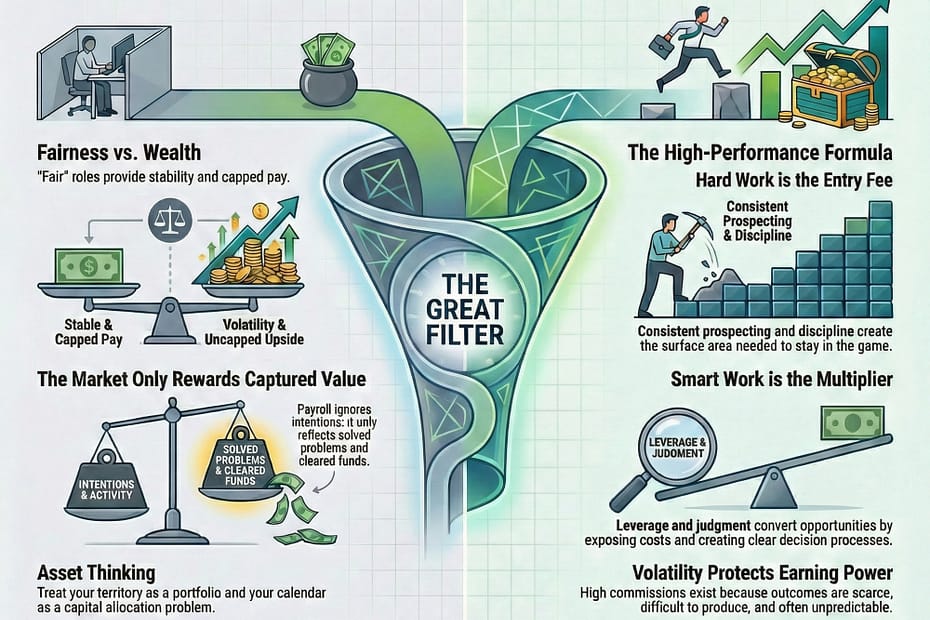
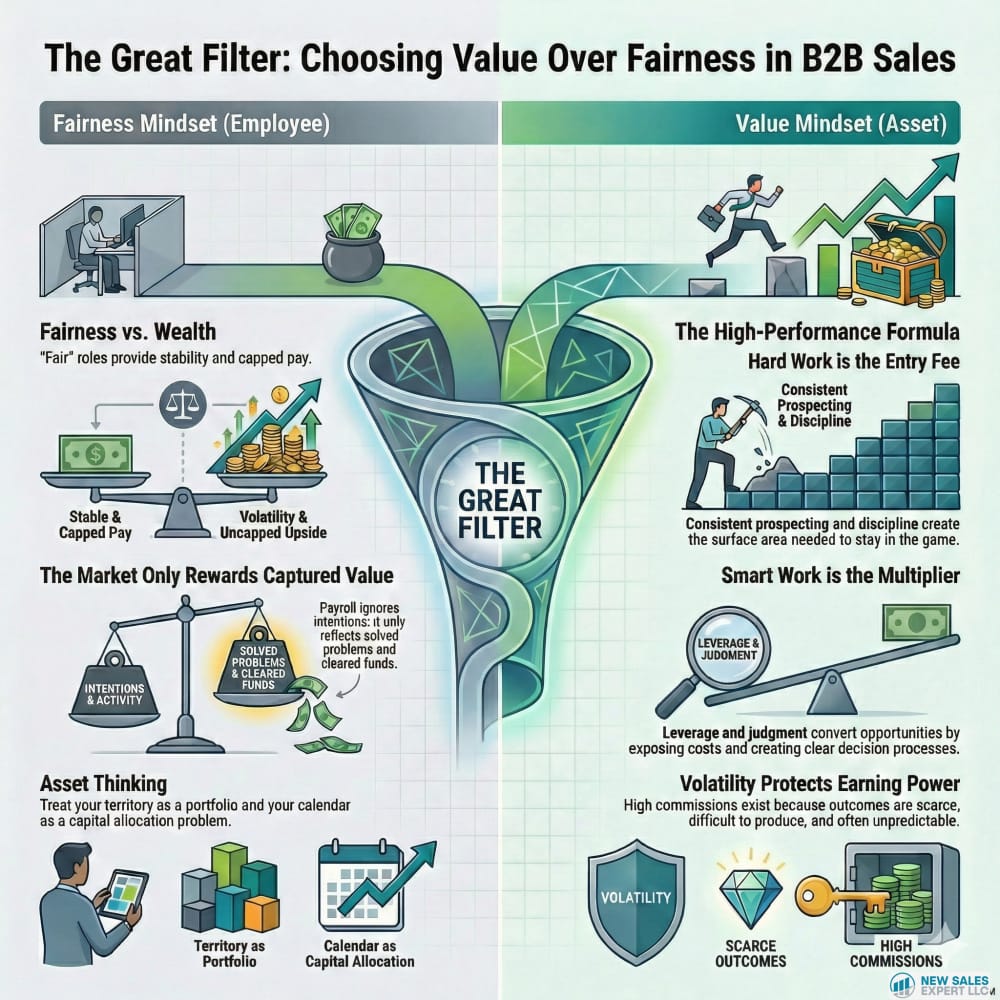
If you want fairness, choose a role where performance is measured by compliance and consistency. If you want wealth, stay in sales and accept the only rule that matters: compensation follows captured value.

Walk into any growth-stage B2B sales organization, and you see two populations immediately:

  • One group is stuck in grievance. They stare at the CRM, explain shortfalls with lead quality, territory math, product gaps, or “unrealistic quota.” They want a manager to prescribe the playbook and then validate the effort. Their mindset is hourly, even when they’re paid a salary plus commission.
  • The other group is operating a different model. They talk about leverage, pipeline physics, conversion rates, deal control, and enterprise value. They create their own opportunities. They build customer confidence and earn the right to ask for a decision. They are not looking for comfort. They are looking for the wire.

If you identify with the first group, here’s the most respectful advice I can give you: exit sales on purpose. Move into HR, operations, finance, project management, enablement, customer success, analytics, or any role where the exchange is stable and the scorecard is predictable. Those functions matter. They are important and critical to most companies. They keep companies alive. They are also structurally designed to be fairer.

Sales is designed to be variable, value-based, and exposed. That’s the point.

The safety-net trap

Most people walk into sales carrying the wrong conditioning. School teaches that effort should correlate with reward. Show up, do the work, get the grade. Many corporate functions reinforce it. Do the tasks, hit the process metrics, stay inside the lines, and get the raise.

That conditioning becomes a trap the moment you step into a quota role.

In “fair” roles, compensation tracks your cost and your consistency. Your output is capped by your time, so your income is capped by a band. It’s stable, and it’s a ceiling.

Sales is different because it’s one of the few places left where pay can scale with impact. You are not paid for effort. You are paid for outcomes. That makes it feel brutal to people who want certainty, and it feels like freedom to people who want upside.

The moment you need the world to be fair, sales will punish you. The moment you accept the model, sales becomes one of the most rational games in business.

B2B Sales is rewarding because it isn’t easy or fair
Read the rest of the article…