Skip to content

Make.com

What An MBA Didn’t Teach You About Sales

The sales profession is challenging. You need to work hard at it to succeed. You need to learn from the best. You need to improve your skills continuously. If you think you can sell since you are a hit at parties and have a lot of friends, you may soon find that you are a failure as a salesperson. Blunt truth:

because the sales profession is so hard, you have to focus on doing everything in sales very well, or you will be considered a failure.

I call this blog, Skinned Knees because I try to relate all of the learning that I have done over the past 4+ decades (while skinning my knees in the learning process).

I hope that you learn from my mistakes so that your business will grow!


Building a Zero-Cost AI Sales Stack: How to Validate Value Before You Spend a Dollar

Most sales leaders today feel the tension between innovation and fiscal responsibility. You know artificial intelligence can accelerate productivity, clarify messaging, and drive revenue generation. You also know your competitors are implementing AI-driven sales processes and reaping the benefits. Yet you are expected to somehow produce results without the budget to experiment, test, or validate new technology.

This pressure creates the classic chicken-and-egg dilemma. You cannot get budget approval without demonstrating value, but you cannot demonstrate value without access to capable tools. That tension often leaves sales leaders paralyzed, observing advancements but unable to participate. It is an exhausting cycle that erodes confidence and slows down organizational progress.

The good news is that modern software economics have shifted. You no longer need an enterprise-level budget to run meaningful AI pilots. Instead, today’s freemium models allow teams to build real workflows, automate real processes, and create real sales success with no financial risk. These free tiers exist because vendors want you to become reliant on the workflow, meaning you can use that dynamic to your advantage as you design early-stage pilots.

A practical approach for sales management is to treat free AI tools as validation engines rather than long-term solutions. You begin with lightweight experimentation, focusing on a single friction point that slows your team. Whether the issue involves pre-call research, drafting follow-up emails, or scoring inbound leads, AI can automate repetitive tasks, freeing your sellers to focus on value selling. The goal is not perfection; it is measurement.

Read the rest of the article…

How to Use ChatGPT to Write Custom Cold Emails at Scale

Episode Summary

In this episode of AI Tools for Sales Pros, we explore the modern seller’s biggest dilemma: scale versus relevance. Too often, sales professionals are forced to choose between sending high-volume, low-quality emails or crafting handcrafted messages one at a time. This episode reveals how artificial intelligence, specifically ChatGPT, eliminates that false choice by enabling “one-to-one-at-scale” communication. You’ll learn how to move from being a sales rep to becoming a sales strategist, using AI as your mechanical assistant and freeing your time for true sales success.

Major Highlights

  • The central productivity crisis in modern sales: choosing between efficiency and effectiveness.
  • The concept of “one-to-one-at-scale” and how AI redefines personalization in outreach.
  • The three components of the Strategic Brief: Voice Profile, Prospect Context, and Mission.
  • Why sales professionals must transition from “writer” to “editor-in-chief” of their own AI SDR.
  • Real-world results showing 20–30% better reply rates and up to 70% faster email generation.
  • How to safely and effectively integrate AI tools like Make.com, Zapier, and HubSpot into your sales processes.
  • The crucial “generate and review” philosophy—maintaining quality and compliance while scaling personalization.
  • How peer-driven learning in communities like B2B Sales Lab accelerates adoption and prevents common mistakes.


Read the rest of the article…

Reclaiming Hours of Selling Time with AI – Lessons from MAICON 2025

You just checked your team’s dashboard. Activity looks fine. But deep down, you know that the numbers don’t tell the whole story.

Every salesperson loses time to the same unseen burden: administrative drag. After each successful discovery call, there’s a 20-minute grind with CRM updates, email summaries, and internal handoffs. This “sales tax” cuts into selling time, hurts momentum, and costs your company thousands weekly in lost productivity.

I just returned from MAICON 2025, and I was so inspired that I wanted to share some of the biggest lessons. At the MAICON 2025 conference in Cleveland, the message was clear: artificial intelligence is changing sales management, not by replacing people, but by empowering them. The winning teams are using AI to eliminate “digital grunt work” through orchestration, not standardization.

Orchestration, Not Standardization

MAICON’s main message was that sales leaders should stop searching for the “one magical platform.” Instead, the most successful organizations coordinate several top-tier tools. Their AI ecosystems are modular, flexible, and collaborative.

It starts with three pieces:

  1. a transcription tool like Fireflies,
  2. an automation hub like Make.com or Zapier,
  3. your existing CRM and communication systems.
Read the rest of the article…

Special report: MAICON 2025 – Automate Sales AI Admin & Stop “Copy-Paste” Workflows

Episode Summary

In this episode, we dive into one of the biggest productivity killers in modern sales management: the “sales tax” of manual data entry and follow-up after every successful discovery call. Drawing from insights at MAICON 2025, Sean O’Shaughnessey explores how artificial intelligence (AI) is reshaping sales operations through orchestration, not standardization. You’ll learn how the right mix of tools—like transcription apps, automation platforms, and CRMs—can reclaim hours of productive selling time and enhance overall revenue generation.

This episode redefines the way leaders should view AI in sales. It’s not about replacing human connection but amplifying it—turning manual processes into seamless automations that accelerate sales success and improve business acumen across teams.


Major Highlights

  • The real cost of "sales tax"—how manual data entry after calls drags down your team’s performance and revenue management.
  • Key takeaways from MAICON 2025: “Human plus AI” as the new standard for high-performing sales organizations.
  • Why orchestration of AI tools is more powerful than trying to standardize on one single platform.
  • The three-part workflow that automates the entire post-call process—from transcription to CRM updates to follow-up emails.
  • The “30-Second Review” technique that transforms reps from authors to producers, freeing hours of time per week.
  • How to identify the “digital grunt work” in your sales processes and convert it into automated workflows that scale.


Read the rest of the article…

Stop Researching, Start Connecting: An AI-Powered System for Warm Introductions

Most sales teams begin the week by opening a dozen browser tabs and grinding through scattered research, LinkedIn, Google News, company websites, and databases. Hours later, they emerge with a few generic talking points and a cold list that still feels cold. The deeper issue isn’t inefficiency; it’s invisibility. Warm introductions already exist across your company’s network, in email histories, calendars, and executives’ LinkedIn connections, but you can’t see them on Monday morning.

The Relationship-First approach changes that default. Before a single cold call or email, you perform a deliberate “Warm Path Check.” You ask, “Who do we know who knows them?” This question transforms prospecting from random outreach into a repeatable, data-driven process that prioritizes relationships. When you start as a referred conversation rather than an interruption, skepticism drops, credibility rises, and the sales cycle compresses dramatically.

The Hidden Network You’re Not Using

Every organization has an untapped network, a web of past colleagues, vendors, and clients who could open doors to your dream accounts. The problem is that this network is hidden in plain sight. It lives in the collective memory of your company’s communication patterns, but there’s no easy way to access it manually. That’s where KnowledgeNet comes in.

KnowledgeNet serves as your organization’s “relationship intelligence” layer. It analyzes communication data (emails, meetings, messages) to reveal who knows whom, and how strong those connections really are. Instead of guessing, you can instantly see that a colleague in engineering once worked closely with the CFO of a target account. That’s a warm path waiting to be used.

Read the rest of the article…

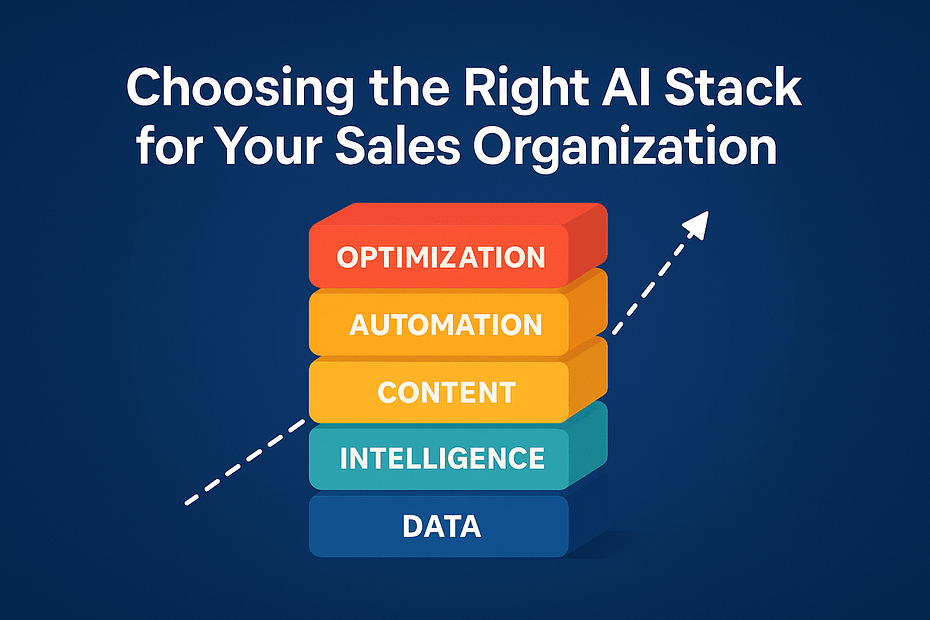
Choosing the Right AI Stack for Your Sales Organization

A VP of Sales recently confided in me: “We have six different AI tools, but our reps are still doing manual work. What went wrong?”

This is the AI tool proliferation problem. Sales leaders often collect tools without a strategy, mistaking a pile of features for a cohesive system. It’s like buying a hammer, screwdriver, saw, and drill without realizing you’re actually trying to build a house. An effective AI stack means integration. When tools work together, they amplify each other’s value. When they don’t, they add complexity, confusion, and wasted money.

Why Strategy Beats Random Adoption

Random tool adoption is rampant across sales organizations. Teams chase shiny new software, often ending up with overlapping features, siloed data, and productivity lost to tool-switching. Instead of solving problems, the stack itself becomes the problem.

But when built strategically, the benefits are profound. Integrated systems reduce manual data entry, accelerate response times, and deliver actionable insights for reps. Three well-chosen, well-connected tools can outperform six isolated ones. Integrated stacks also improve adoption rates by providing consistent interfaces and reducing training overhead.

The Five-Layer AI Stack Framework

To avoid the chaos of random adoption, I use a five-layer framework for structuring sales AI tools:

  1. Data Foundation – Your CRM and data management system, enriched and maintained for accuracy.
  2. Intelligence & Analytics – AI-driven insights, lead scoring, forecasting, and market intelligence.
  3. Automation & Workflow – Sequences, task automation, and cross-platform orchestration.
  4. Content & Communication – AI writing, proposal generation, and customer-facing tools.
  5. Optimization & Learning – Conversation analysis, performance tracking, and continuous improvement.
Read the rest of the article…

Intro to Automation: Make.com, Zapier, n8n, and String from Pipedream for Sales Pros

In this episode of AI Tools for Sales Pros, we dive into the critical decision of selecting the right automation platform for your sales organization. From Zapier’s simplicity to Make.com’s visual workflow design, from n8n’s open-source flexibility to Pipedream’s developer-friendly tools, each platform offers unique advantages—and pitfalls—for sales teams. We examine how team skills, budget, and complexity influence the right choice and share real-world results from companies that achieved dramatic efficiency gains. By the end, you’ll know how to align platform capabilities with your team’s technical comfort and long-term automation strategy.


Major Highlights

  • Why choosing the right automation platform is one of the most important technology decisions for sales teams.
  • The hidden costs of mismatched platforms include budget waste, abandoned projects, and migration headaches.
  • A breakdown of the four leading automation tools:
  • Zapier: User-friendly pioneer with the largest integration library.
  • Make.com: Visual workflow builder for advanced, high-volume automation.
  • n8n: An open-source powerhouse offering unlimited flexibility and cost efficiency.
  • Pipedream (including String): Developer-friendly with real-time processing power.
  • Key criteria to consider: team technical comfort, use case complexity, budget, scale, and integration requirements.
  • Practical implementation strategies for each platform, including quick wins and longer-term adoption.
  • How multi-platform strategies can be deployed and when they make sense.

  • Read the rest of the article…

    From Manual to Automated: A Sales Pro’s Guide to Zapier, Make.com, n8n, and Pipedream

    A sales manager recently told me something that stuck: “We went from twenty hours per week of manual work to two hours. Our lead response time dropped from four hours to four minutes.” That dramatic transformation wasn’t magic—it was automation. The reality is that sales teams today have more automation tools available than ever before. But with options like Zapier, Make.com, n8n, and Pipedream, the real challenge isn’t whether you should automate—it’s choosing the right… 

    APIs 101: What They Are and Why Sales Should Care

    Sales teams are wasting hours each week copying data between disconnected systems. This manual work drains productivity, creates errors, and frustrates your top performers. In this episode, Sean explains how APIs, those invisible bridges between software tools, can eliminate repetitive tasks, improve data accuracy, and give sales teams back valuable selling time. You’ll hear practical definitions, real-world use cases, and a step-by-step approach for getting started with sales automation.


    Major Highlights:

    • Why disconnected sales tools create wasted time, errors, and lost productivity
    • Simple, sales-friendly definition of APIs and how they work behind the scenes
    • Real-world sales use cases:
    • Lead generation and enrichment with data pulled directly into CRMs
    • Automated email sequences triggered by prospect behaviors
    • Real-time deal tracking and forecasting with pipeline integrations
    • Customer success workflows for retention and expansion
  • No-code integration platforms (Zapier, Make.com, Power Automate, Pipedream) that make APIs accessible to non-technical teams
  • Key questions to ask vendors about API capabilities before investing in sales tools
  • Security, compliance, and best practices for managing API integrations safely
  • A beginner-friendly framework for launching your first sales API workflow

  • Read the rest of the article…

    APIs Explained for Sales Leaders: Drive Growth Without Extra Headcount

    A sales manager recently told me, “I have to copy the same prospect data into five different tools. There has to be a better way.” That frustration is more common than most sales leaders realize, and fortunately, there is a better way. The reality is that sales teams are hemorrhaging productivity due to disconnected systems. Top performers spend hours manually entering data, bouncing between platforms, and correcting inevitable errors. This administrative overhead steals time from…