Skip to content

sales intelligence

What An MBA Didn’t Teach You About Sales

The sales profession is challenging. You need to work hard at it to succeed. You need to learn from the best. You need to improve your skills continuously. If you think you can sell since you are a hit at parties and have a lot of friends, you may soon find that you are a failure as a salesperson. Blunt truth:

because the sales profession is so hard, you have to focus on doing everything in sales very well, or you will be considered a failure.

I call this blog, Skinned Knees because I try to relate all of the learning that I have done over the past 4+ decades (while skinning my knees in the learning process).

I hope that you learn from my mistakes so that your business will grow!


Two Tall Guys Talking Sales Podcast – The Sales Management Metric That Reveals Whether Your Pipeline Is Real – Episode 190

In complex B2B sales, the best opportunities rarely move forward because of a single perfect conversation with a single perfect buyer. They move because the seller creates enough meaningful customer interaction to uncover problems, build internal consensus, reduce the risk of being ghosted, and increase the odds of winning larger deals. In this episode of Two Tall Guys Talking Sales, Kevin Lawson and Sean O’Shaughnessey dig into Customer Interaction Hours, or CIH. This practical sales management metric helps sellers evaluate the real quality of their meetings, expand influence inside target accounts, and improve Sales success in longer, more competitive sales cycles.

Key Topics Discussed

Customer Interaction Hours as a better measure of meeting quality — 00:53
Sean introduces CIH, a metric built around the value of longer meetings with more customer stakeholders. Rather than treating every sales call as equal, CIH forces sellers and sales managers to ask a harder question: Did this meeting create enough interaction to advance the deal?

Why bigger meetings create better sales intelligence — 02:09
Sean explains why larger, longer meetings often reveal more useful information than short, single-threaded conversations. More people in the room usually means more questions, more objections, more hidden politics, and more clues about the real buying process.

How CIH helps sellers stay alive in competitive deals — 05:49
Sean frames one of the episode’s central ideas: if the customer is still talking to you, you are still in the deal. CIH gives salespeople a way to measure whether they are creating enough meaningful interaction to remain relevant, especially in enterprise-level opportunities.

Using customer conversations to diagnose business pain — 08:22
Kevin connects CIH to Value selling, Business acumen, and better discovery. When sellers involve more people across the customer’s organization, they uncover operational issues, technical constraints, conflicting expectations, and financial priorities that would never surface in a narrow conversation.

Reducing the risk of ghosted deals through multi-threading — 10:19
Sean explains why deals often disappear when sellers know only two or three people within the account. Customer Interaction Hours push sellers to build more relationships, improving deal visibility and making it harder for an opportunity to die quietly.

Applying CIH in small and mid-sized business sales — 11:45
Kevin and Sean make clear that this is not only an enterprise sales strategy. Whether selling to a company of 10 or 10,000, sellers need to understand who influences the buying decision, who uses the product, who owns the risk, and who can block Revenue generation.

Key Quotes

Sean O’Shaughnessey — 01:45
“If you have a relatively long, complicated sales cycle, CIH or Customer Interaction Hours is a great way to think about it.”

Sean O’Shaughnessey — 05:49
“If we are still talking, then we are still in the deal.”

Kevin Lawson — 08:22
“We have to get in front of the right people at the right time with the right message, and getting them talking about their problems is key.”

Kevin Lawson — 09:14
“Don’t sell the product you have. Sell the problem you solve.”

Sean O’Shaughnessey — 11:31
“You do not get ghosted if you know a dozen people at the company. It takes a big conspiracy to have 12 people not return your phone call.”

Sean O’Shaughnessey — 14:22
“Do it yourself because it’s a way to keep the salesperson going the right direction and thinking about, ‘How do I make my deals bigger, my meetings bigger?’”

Additional Resources

Sean invites listeners to continue the conversation inside B2B Sales Lab, where salespeople and sales leaders can ask questions about Customer Interaction Hours, sales metrics, Sales strategies, Sales processes, Messaging, Revenue management, and practical ways to improve complex B2B selling.

A Significant Actionable Item from this Podcast

Review the last five meaningful sales meetings on your calendar and calculate your Customer Interaction Hours. Look at how long each meeting lasted and how many customer participants were involved, then ask whether your most important opportunities have enough interaction to justify confidence. If your largest deals are built around short meetings with one or two contacts, that is not a pipeline strategy. That is hope wearing a CRM costume.

The next step is direct: choose one active opportunity and identify three additional stakeholders who should care about the business problem you solve. Then create a reason to engage them. Not a generic “checking in” message. A real business reason tied to risk, implementation, financial impact, user adoption, or strategic value.

Read the rest of the article…

The 12-Part AI Revenue Stack That Reclaims Selling Time and Drives Revenue Growth

Episode Summary

The high-volume sales activity model is breaking down. Salespeople are losing too much time to manual research, CRM updates, administrative work, and disconnected tools while B2B buyers increasingly prefer digital, self-directed research. In this episode of AI Tools for Sales Pros, Sean O’Shaughnessey explains why artificial intelligence is creating a structural performance gap between AI-enabled revenue teams and teams still relying on legacy sales processes. He also introduces the 12-part AI revenue stack leaders should understand before buying another tool or launching another disconnected AI initiative.

Major Highlights

  • More activity will not fix broken revenue architecture.
  • B2B buyers increasingly prefer autonomous, digital research, so sales strategies must adapt.
  • Sales reps still spend too much time on non-selling work, including data entry, research, logistics, and CRM maintenance.
  • Embedded AI is widening the gap between modern revenue teams and teams still dependent on manual sales processes.
  • Modern sales management requires a move from fragmented tools to integrated, AI-native revenue platforms.
  • Grammarly is a simple starting point because poor grammar damages Messaging, credibility, and trust.
  • The modern CRM must become a system of action, not a passive database.
  • The 12-part revenue stack includes CRM, sales engagement, sales intelligence, conversation intelligence, forecasting, inbound orchestration, lead routing, ABM, workflow automation, sales enablement, incentive compensation, and AI prospecting agents.
  • The right first move is a Structural Gap Audit, not buying 12 new platforms.
Read the rest of the article…

Stop Researching, Start Connecting: An AI-Powered System for Warm Introductions

Most sales teams begin the week by opening a dozen browser tabs and grinding through scattered research, LinkedIn, Google News, company websites, and databases. Hours later, they emerge with a few generic talking points and a cold list that still feels cold. The deeper issue isn’t inefficiency; it’s invisibility. Warm introductions already exist across your company’s network, in email histories, calendars, and executives’ LinkedIn connections, but you can’t see them on Monday morning.

The Relationship-First approach changes that default. Before a single cold call or email, you perform a deliberate “Warm Path Check.” You ask, “Who do we know who knows them?” This question transforms prospecting from random outreach into a repeatable, data-driven process that prioritizes relationships. When you start as a referred conversation rather than an interruption, skepticism drops, credibility rises, and the sales cycle compresses dramatically.

The Hidden Network You’re Not Using

Every organization has an untapped network, a web of past colleagues, vendors, and clients who could open doors to your dream accounts. The problem is that this network is hidden in plain sight. It lives in the collective memory of your company’s communication patterns, but there’s no easy way to access it manually. That’s where KnowledgeNet comes in.

KnowledgeNet serves as your organization’s “relationship intelligence” layer. It analyzes communication data (emails, meetings, messages) to reveal who knows whom, and how strong those connections really are. Instead of guessing, you can instantly see that a colleague in engineering once worked closely with the CFO of a target account. That’s a warm path waiting to be used.

Read the rest of the article…

Automating Lead Research Using LinkedIn + Apollo + Automation Tools

Episode Summary

Today, we reframe prospecting from an “Account-Based-Push” grind into a “Relationship-First” system powered by artificial intelligence. Instead of burning hours on scattered research, you’ll learn how to run a five-minute “Warm Path Check” that reveals trusted introductions already hidden inside your organization. We walk through a practical stack—relationship intelligence (e.g., KnowledgeNet), sales intelligence (e.g., Apollo), and automation (e.g., Make/Zapier)—to connect people, data, and process. The result is higher win rates, shorter sales cycles, stronger sales management discipline, and measurable sales success.

This episode blends business acumen with hands-on execution: how to operationalize value selling, streamline sales processes, and accelerate revenue generation by starting warm, not cold.

Major Highlights

  • From “Account-Based-Push” to “Relationship-First.” Prospecting shifts from volume to connections: ask “Who do we know who knows them?” before any cold outreach.
  • The hidden network problem. Critical introductions are buried across email, calendars, Slack/Teams, and executives’ networks; AI can surface them.
  • The stack that makes it work. Relationship intelligence maps real communication strength; sales intelligence enriches contacts and signals; automation routes tasks into your CRM and runs continuously.
  • The 5-Minute Warm Path Check. A simple repeatable tactic: confirm a warm path before you send a single cold email or dial.
  • Business impact. Warmer starts increase reply and meeting rates, compress sales cycles, improve revenue management predictability, and elevate messaging quality.
  • Human + AI. AI augments sellers; your unique context and rapport building via LinkedIn remain essential for value selling.
Read the rest of the article…

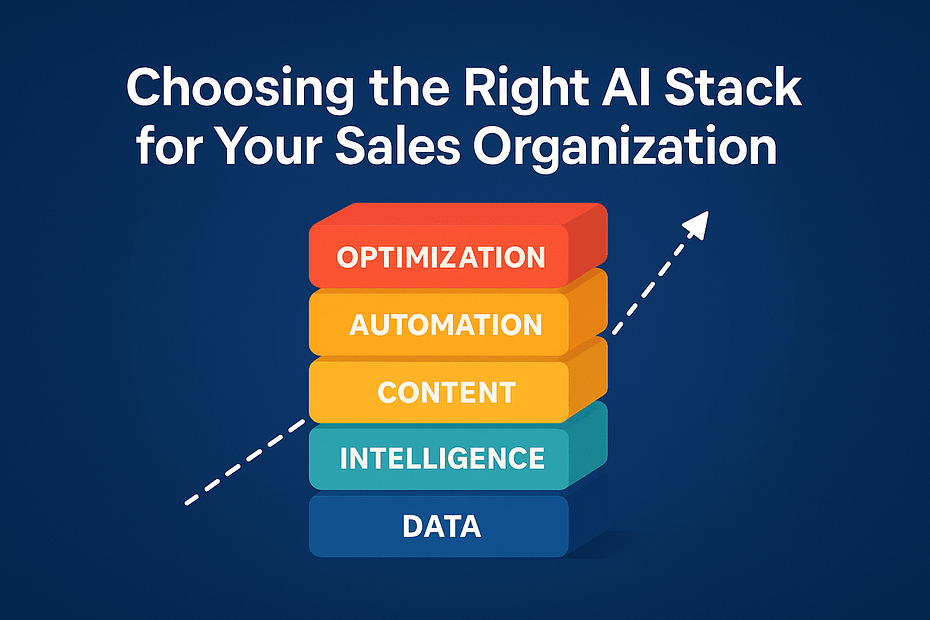
Choosing the Right AI Stack for Your Sales Organization

A VP of Sales recently confided in me: “We have six different AI tools, but our reps are still doing manual work. What went wrong?”

This is the AI tool proliferation problem. Sales leaders often collect tools without a strategy, mistaking a pile of features for a cohesive system. It’s like buying a hammer, screwdriver, saw, and drill without realizing you’re actually trying to build a house. An effective AI stack means integration. When tools work together, they amplify each other’s value. When they don’t, they add complexity, confusion, and wasted money.

Why Strategy Beats Random Adoption

Random tool adoption is rampant across sales organizations. Teams chase shiny new software, often ending up with overlapping features, siloed data, and productivity lost to tool-switching. Instead of solving problems, the stack itself becomes the problem.

But when built strategically, the benefits are profound. Integrated systems reduce manual data entry, accelerate response times, and deliver actionable insights for reps. Three well-chosen, well-connected tools can outperform six isolated ones. Integrated stacks also improve adoption rates by providing consistent interfaces and reducing training overhead.

The Five-Layer AI Stack Framework

To avoid the chaos of random adoption, I use a five-layer framework for structuring sales AI tools:

  1. Data Foundation – Your CRM and data management system, enriched and maintained for accuracy.
  2. Intelligence & Analytics – AI-driven insights, lead scoring, forecasting, and market intelligence.
  3. Automation & Workflow – Sequences, task automation, and cross-platform orchestration.
  4. Content & Communication – AI writing, proposal generation, and customer-facing tools.
  5. Optimization & Learning – Conversation analysis, performance tracking, and continuous improvement.
Read the rest of the article…

Level Up Your Sales Prospecting with Advanced Research Techniques

A shoutout to Chris Spanier and Episode #85 of the Practical, Actionable Marketing Podcast

Sales prospecting has always been a grind. What if you could cut your research time in half and dramatically improve your outreach results?

In Episode #85 of the Practical, Actionable Marketing podcast, host Chris Spanier delivers a masterclass on how to do just that. Titled “Advanced Prospecting Research Tools,” the episode is packed with time-saving techniques and tools that help sales professionals build sharper prospect profiles faster.

As someone with over four decades in sales and sales management, I believe this kind of tactical insight makes a difference. If you haven’t already, listen to the episode. Then, come back here for a quick breakdown of what Chris covered—plus a few of my thoughts.


Why Prospect Research Matters More Than Ever

In a market saturated with sales messages, relevance is your only competitive advantage. The days of blasting generic emails to massive lists are over. Today, the winners are the ones who personalize their outreach with precision—and that begins with better research.

Read the rest of the article…

Why Cold Calling is Dead: The Shift to Relationship-Based Selling

Building an effective sales pipeline requires a shift in strategy. Traditional cold calling has become increasingly ineffective, with decision-makers ignoring unsolicited calls and emails.

In the spring of 2021, Bank of America Corp.’s Merrill Lynch Wealth Management unit banned trainee brokers from making cold calls. According to the Wall Street Journal, it is hard to succeed with cold phone calls in an era when no one picks up. Merrill executives said personal referrals lead to a response around 40% of the time, but less than 2% of people who are cold-called even answer the phone.

Sales teams must adopt a more strategic approach, focusing on relationships rather than volume-based outreach. The key is leveraging existing networks to create warm introductions, significantly improving engagement rates and overall success.

Cold outreach has become expensive and inefficient, and the time spent dialing numbers, leaving voicemails, and sending emails that never get opened results in diminishing returns. Many executives no longer answer unknown calls, and email filters automatically sort cold outreach into spam. Even when messages get through, recipients are skeptical, assuming they are generated by automation rather than a genuine human connection. In reality, sales professionals must find a better way to reach their target audience.

Relationship-based selling offers a more effective alternative. Salespeople should focus on leveraging their connections instead of reaching out to strangers. This approach involves identifying key contacts who can provide warm introductions to potential prospects. These “super connectors” are individuals with strong networks and the ability to facilitate meaningful introductions. By tapping into these relationships, sales teams can bypass the skepticism associated with cold outreach and start conversations with credibility.

Read the rest of the article…