Skip to content

Sales Management

What An MBA Didn’t Teach You About Sales

The sales profession is challenging. You need to work hard at it to succeed. You need to learn from the best. You need to improve your skills continuously. If you think you can sell since you are a hit at parties and have a lot of friends, you may soon find that you are a failure as a salesperson. Blunt truth:

because the sales profession is so hard, you have to focus on doing everything in sales very well, or you will be considered a failure.

I call this blog, Skinned Knees because I try to relate all of the learning that I have done over the past 4+ decades (while skinning my knees in the learning process).

I hope that you learn from my mistakes so that your business will grow!


Tip #7 of 12 – How To Start The New Year STRONG! – Check in with current clients

Sales is about finding the best ways to reach new customers and grow your business efficiently. However, it’s essential not to overlook what you already have. Your current clients are one of your most valuable resources for growth – by serving them better than ever, you can open up a whole world of possibilities for expansion and success. In this video, I will challenge you to leverage your relationships with existing clientele to maximize opportunities… 

Tip #6 of 12 – How To Start The New Year STRONG! – Embrace new technology

New technologies are dramatically changing how businesses operate across all industries, from analytics to artificial intelligence and from automation to social media. As our world becomes more technologically advanced, so does the competitive landscape for salespeople looking to grow their organizations. To stay ahead of this curve, salespeople must learn to embrace these growing technological trends and leverage them for competitive advantage to remain successful in today’s marketplace. In this video, we’ll explore how these… 

Tip #5 of 12 – How To Start The New Year STRONG! – Know your customers better

Whether you’re a salesperson or manager, understanding how and why prospects make and lose money is a crucial element in helping them make intelligent business decisions. Knowing this can help you hone in on the solutions you offer that will benefit their bottom line, making it easier to close more deals. In this video, we explore the following: This is the 5th video of 12 that explores how you can start the new year strongly.… 

Tip #4 of 12 – How To Start The New Year STRONG! – Improve Time Management

As we turn the page on a new year, it’s time for salespeople and sales managers to put their best foot forward by establishing efficient and practical time management habits. Every successful salesman knows that prioritizing goals correctly, staying ahead of deadlines, and honing in on your target audience are hallmarks of a successful selling approach. By beginning the new year off with practical strategies for better utilization of time spent working, you can create… 

Tip #3 of 12 – How To Start The New Year STRONG! – Be (more) curious

The New Year is almost here. If you are in Sales, life is easier if you get out of the gate with incredibly strong revenue. One of the best ways to do that is to plan ahead for the activities that will influence your revenue production. We have all heard of the 12 days of Christmas. This post is part of my series of 12 posts on how to strongly start the new year and… 

Presentation to FocusCFO meeting

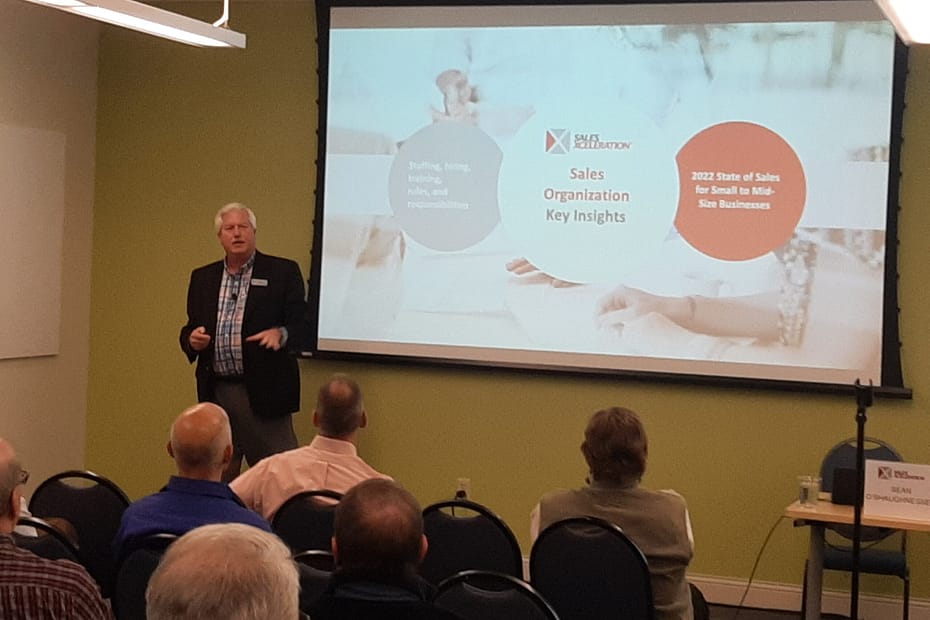
I was honored to present “The States of Sales in Small Businesses” at the annual meeting of FocusCFO. This presentation compiles data from the survey of thousands of business owners regarding their sales practices. Sadly, very few small businesses excel at sales, which is why they need to hire high-quality fractional Vice Presidents of Sales, like the services provided by New Sales Expert, LLC.

FocusCFO provides CFO services on a fractional basis, meaning clients get all the advantages of a full-time CFO on flexible and affordable terms, working under a recurring schedule that fits within their budget. With a CFO on the management team, the entrepreneur is free to focus on what they do best: building great products and services and growing revenue.

Small and mid-sized businesses benefit from FocusCFO’s industry-leading model.

Read the rest of the article…

Two Tall Guys Talking Sales Podcast: How Do You Determine Your Company’s Sales Objectives Each Year?

In this episode, Kevin and Sean discussed the importance of setting appropriate sales goals for a company. They suggested starting with the end goal in mind and then working backward to set achievable but challenging targets. They also advise avoiding pitfalls such as not considering attrition or overstating possibilities when setting goals. Finally, they emphasize the importance of dedicating resources to new markets or initiatives to grow the business rather than only replacing lost customers.

You can subscribe to our podcast by searching in your favorite podcast player for “Two Tall Guys Talking Sales,” or you can listen to the embedded version here.

The following is a transcript of the podcast above. It has been sparsely edited to increase its readability, but many of the idioms and poor spoken grammar have been left in place. Fireflies.ai automatically generated the transcriptionand, as capable as that product is, there are times when words are missed or the sentence structure is incorrectly interpreted. We have tried to catch all of these software misses, but we are confident that some still remain. The below text is provided for those that would rather read than listen to a podcast.

00:00

Kevin Lawson

Hello, and welcome to episode two, not eight, of “Two Guys Talking Sales.” I’m one of your hosts, Kevin. 

00:10

Sean O’Shaughnessey

And I’m Sean. 

00:11

Kevin Lawson

We’re glad you’re here on this Two Guys Talking Sales episode. 

This podcast tackles real sales issues, big and small, for salespeople selling situations and sales leadership. We’ve individually built successful sales careers around the problems and solutions in B-to-B selling, from software and services to manufacturing distribution. We have sold to and for many of the world’s most recognized brands as well as some you have yet to hear of. We know LinkedIn says this is a 30-minute time slot. Still, we’ll only take 15 minutes—nothing like under-promising and over-delivering. For roughly the next 15 minutes, we invite you into our world of experience. We’ll dig into one issue. You’ll have a solution should you encounter a similar situation in your career. Let’s dive in. 

Sean, let’s set the stage. 

01:07

Sean O’Shaughnessey

This topic should be about setting your sales plan objectives for this year. 

01:15

Kevin Lawson

Setting objectives for the year. Like not being tongue-tied on a public broadcast. How about that? 

01:21

Sean O’Shaughnessey

At least you tried to plan ahead and had it written. Now that’s better than I did. I’m just winging it. 

01:25

Kevin Lawson

Our last episode was all about planning your year. Why not have a plan? Well, so you’ll know how you’re doing? 

01:32

Sean O’Shaughnessey

There you go. 

01:33

Kevin Lawson

Today, we will talk about how to determine company sales objectives. Yes, let’s do that. 

Read the rest of the article…

Determining Your Company’s Sales Objectives Each Year

As a company owner, one of the most important aspects of running a successful business is setting and achieving sales objectives. But how do you determine what those objectives should be? Here’s a step-by-step guide to help you set realistic and achievable sales goals for your business.

Sales objectives are goals a company sets for its sales team to achieve over a certain period. These objectives can be anything from increasing revenue by a certain percentage to selling a certain number of products or services. Sales objectives should be set annually, but they can also be set for shorter periods such as quarters or months.

Let’s talk about the basic steps first.

  1. Define your overall goal.
  2. Break down your overall goal into smaller, more manageable goals.
  3. Create a timeline for each goal.
  4. Assign responsibility for each goal to a specific team member or department.
  5. Measure progress and revise objectives as needed.
  6. Celebrate accomplishments and learn from failures.
  7. Define your overall goal.

Sales goals are essential for any company regardless of size. They give you a target to aim for and help to motivate your sales team. Without a goal, getting complacent and falling into bad habits is easy.

It’s essential to clearly understand your company’s sales process before setting a goal. You need to know your closing rate, average deal size, and how many leads you need to generate to hit your target. Once you have this information, you can start to play around with different numbers to see what’s realistic.

Read the rest of the article…