AI Sales Automation: Why Your Chatbot Is Not a Sales Process
Imagine preparing for an important customer meeting. You open your favorite AI assistant, give it the prospect’s name, and ask for a summary of the company’s business challenges and the questions you should ask. Within seconds, you receive a beautifully written briefing. The assistant identifies potential operational problems, competitive pressures, and several opportunities to demonstrate the value of your solution.
There’s just one problem. One of those impressive insights concerns an acquisition the prospect supposedly completed last year.
Except the acquisition never happened.
The artificial intelligence fabricated a plausible business event and presented it as fact. Had you trusted the briefing, you might have opened your meeting with a question that immediately damaged your credibility.
This scenario illustrates a much larger problem with how B2B sales organizations use AI.
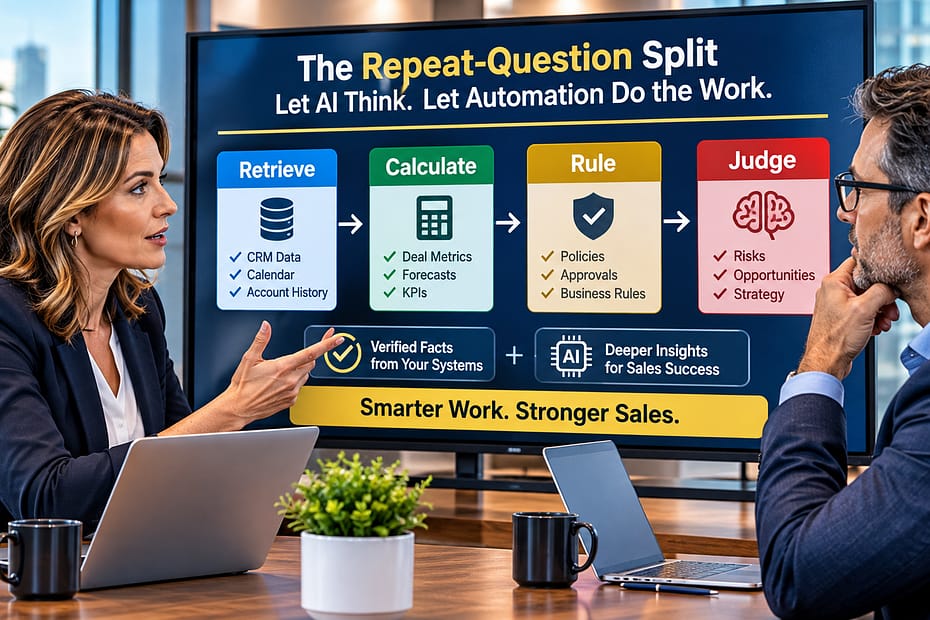
We’re asking artificial intelligence to perform too many different kinds of work without distinguishing which tasks require intelligence and which require reliable execution.
That distinction matters more than the sophistication of the AI model you choose.
The Problem Isn’t Just Hallucinations. It’s Process Design.
Salespeople increasingly rely on ChatGPT, Claude, Gemini, and other Generative AI applications to prepare for meetings, research prospects, write follow-up messages, and analyze opportunities. Those are legitimate applications of AI. In fact, I’d question why a salesperson with access to these capabilities wouldn’t use them. But consider what happens before the salesperson receives a useful answer.
They retrieve information from their CRM, gather previous meeting notes, identify stakeholders, check pricing, and reconstruct details from previous conversations. They paste everything into their AI assistant, ask a question, verify the response, and correct any mistakes.
Tomorrow, they repeat the process for another customer.
The AI may have improved the quality of their analysis, but the underlying sales process remains largely manual.
When twenty salespeople independently reconstruct the same process every day, you don’t have an AI adoption problem. You have a sales management problem.
You’re paying experienced professionals to repeatedly assemble information that your existing systems should already provide.
The solution isn’t necessarily better prompting. It’s better workflow design.
Read the rest of the article…