Skip to content

AI stack

What An MBA Didn’t Teach You About Sales

The sales profession is challenging. You need to work hard at it to succeed. You need to learn from the best. You need to improve your skills continuously. If you think you can sell since you are a hit at parties and have a lot of friends, you may soon find that you are a failure as a salesperson. Blunt truth:

because the sales profession is so hard, you have to focus on doing everything in sales very well, or you will be considered a failure.

I call this blog, Skinned Knees because I try to relate all of the learning that I have done over the past 4+ decades (while skinning my knees in the learning process).

I hope that you learn from my mistakes so that your business will grow!


Free vs. Paid AI Tools: Where to Start

Episode Summary

This episode addresses one of the most common frustrations in modern sales management: the pressure to adopt AI and artificial intelligence tools without the budget to justify experimentation. We explore how sales leaders can build a highly effective, zero-cost “Minimum Viable Pilot” using free platforms to validate value before making any investment. You’ll learn how AI-driven sales processes can dramatically improve productivity, reduce administrative burden, and enhance messaging without requiring upfront spend. The discussion provides a practical roadmap to prove ROI, mitigate risk, and accelerate revenue generation using accessible tools already available today.

Major Highlights

  • The financial paradox facing sales leaders: expectations to innovate with AI while budgets remain frozen.
  • How shadow IT emerges when reps adopt unapproved free tools—creating risk for data privacy and revenue management.
  • The concept of “Validation Before Investment”: using the freemium economy to test, measure, and prove value before requesting budget.
  • A full breakdown of the Zero-Cost AI Stack: ChatGPT Free for content, Make.com Free for automation, and HubSpot Free for CRM operations.
  • Understanding breakpoints—when free tiers stop enabling sales success and start limiting scale, collaboration, or compliance.
  • Why business acumen matters when evaluating AI upgrades: identifying reasoning complexity, privacy requirements, and automation volume.
  • A phased roadmap from individual experimentation to enterprise deployment, aligning AI adoption with measurable revenue generation outcomes.
  • How AI-enhanced sales strategies deliver significant time savings, productivity boosts, and more precise value selling opportunities.
Read the rest of the article…

Choosing the Right AI Stack for Your Sales Organization

A VP of Sales recently confided in me: “We have six different AI tools, but our reps are still doing manual work. What went wrong?”

This is the AI tool proliferation problem. Sales leaders often collect tools without a strategy, mistaking a pile of features for a cohesive system. It’s like buying a hammer, screwdriver, saw, and drill without realizing you’re actually trying to build a house. An effective AI stack means integration. When tools work together, they amplify each other’s value. When they don’t, they add complexity, confusion, and wasted money.

Why Strategy Beats Random Adoption

Random tool adoption is rampant across sales organizations. Teams chase shiny new software, often ending up with overlapping features, siloed data, and productivity lost to tool-switching. Instead of solving problems, the stack itself becomes the problem.

But when built strategically, the benefits are profound. Integrated systems reduce manual data entry, accelerate response times, and deliver actionable insights for reps. Three well-chosen, well-connected tools can outperform six isolated ones. Integrated stacks also improve adoption rates by providing consistent interfaces and reducing training overhead.

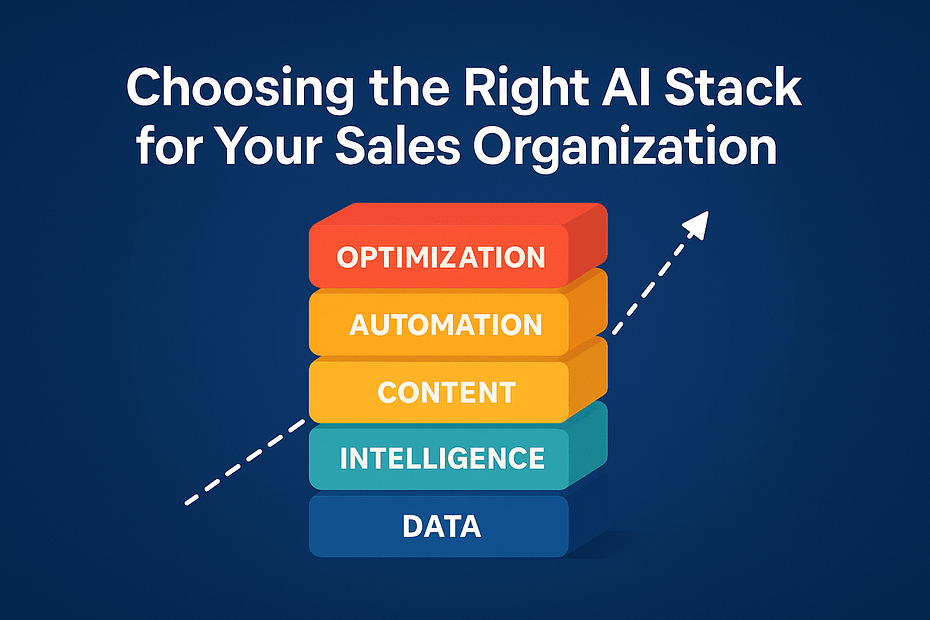
The Five-Layer AI Stack Framework

To avoid the chaos of random adoption, I use a five-layer framework for structuring sales AI tools:

  1. Data Foundation – Your CRM and data management system, enriched and maintained for accuracy.
  2. Intelligence & Analytics – AI-driven insights, lead scoring, forecasting, and market intelligence.
  3. Automation & Workflow – Sequences, task automation, and cross-platform orchestration.
  4. Content & Communication – AI writing, proposal generation, and customer-facing tools.
  5. Optimization & Learning – Conversation analysis, performance tracking, and continuous improvement.
Read the rest of the article…

Choosing the Right AI Stack for Your Sales Organization

Episode Summary

In this episode of AI Tools for Sales Pros, we explain how to move beyond random AI tool adoption and build a strategic AI stack that drives real sales success. Too many organizations collect disconnected tools, creating data silos, inefficiency, and wasted spend. We introduce a five-layer architecture that aligns with proven sales processes and turns artificial intelligence into an amplifier of business acumen, value selling, and messaging. With the right design, your stack becomes a force multiplier for revenue generation and better revenue management.


Major Highlights

  • The proliferation problem: Why collecting disconnected AI tools without a strategy undermines sales management and slows teams down.
  • The five-layer AI stack framework: Data foundation, intelligence & analytics, automation & workflow, content & communication, optimization & learning—built to streamline sales processes.
  • Sales strategies for integration: How integrated stacks support revenue management, sharpenmessaging, and enable value selling across the funnel.
  • Practical ROI planning: Budget allocation by layer, common pitfalls to avoid, and how to measure time saved, pipeline velocity, and revenue generation impact.
  • Real-world configurations: Small, mid-market, and enterprise examples showing how artificial intelligence scales responsibly.
  • Long-term moat: Early architectural choices in tool selection and integration become durable competitive advantages.


Read the rest of the article…