Skip to content

AI tools for sales

What An MBA Didn’t Teach You About Sales

The sales profession is challenging. You need to work hard at it to succeed. You need to learn from the best. You need to improve your skills continuously. If you think you can sell since you are a hit at parties and have a lot of friends, you may soon find that you are a failure as a salesperson. Blunt truth:

because the sales profession is so hard, you have to focus on doing everything in sales very well, or you will be considered a failure.

I call this blog, Skinned Knees because I try to relate all of the learning that I have done over the past 4+ decades (while skinning my knees in the learning process).

I hope that you learn from my mistakes so that your business will grow!


Automating Sales Workflows: When to Use Automation Over Chat

In sales management, there’s often some confusion about when to use artificial intelligence chat interfaces versus automation workflows. Chat interfaces are ideal for creative problem-solving, learning, and strategic research, while automation excels in repetitive, high-volume, data-driven sales tasks. The trick is to recognize when consistency and scalability are more important than customization.

Automation delivers consistent execution, eliminates human error, and operates 24/7. Sales leaders can rely on it for triggered communications, data synchronization across systems, CRM updates, and compliance tasks that require accuracy and complete audit trails. By moving these routine tasks into automated workflows, sales teams free up valuable time for relationship building, revenue generation, and refining sales strategies.

Real-world examples highlight the impact: a team once spent three hours daily crafting manual follow-up emails. Shifting to automated sequences not only saved time but also improved messaging consistency and pipeline response rates. Similarly, another team utilized automation to synchronize sales data across six systems, thereby eliminating bottlenecks and enabling sellers to focus fully on sales.

Hybrid approaches really take things to the next level! By merging human creativity in chat interactions with the quick and precise power of automation, businesses can craft workflows that beautifully balance personalized service with the ability to grow. This type of teamwork enhances value-driven selling, sharpens business skills, and accelerates revenue management throughout the sales journey.

Read the rest of the article…


Sales Management with AI: Chat Interfaces vs. Automation Workflows

Sales organizations today face a critical decision: should they rely on interactive chat interfaces like ChatGPT, Claude, or Gemini, or should they focus on automation workflows? The answer isn’t either/or. Each approach has unique strengths, and choosing the right one directly impacts sales processes, productivity, and revenue generation.

The problem many sales teams encounter is “random implementation.” They hear about a new AI tool, adopt it quickly, and use it for the wrong purpose. The result? Chat interfaces get bogged down with repetitive work, and automation gets tasked with jobs that require creativity and nuance. Misuse not only reduces efficiency but also frustrates teams and erodes trust in artificial intelligence altogether.

So how do you know when chat is the right fit? The decision comes down to task complexity and uniqueness. Chat excels in situations that require creativity, flexibility, and human judgment. Four categories consistently stand out:

  • Creative and strategic tasks: proposals, executive messaging, strategic planning, and competitive positioning.
  • Complex problem-solving: sales opportunity strategy sessions, unique customer needs, and crisis management.
  • Learning and development: role-playing objection handling, skill coaching, and competitive intelligence training.
  • Research and analysis: prospect research, market analysis, and strategic planning.
Read the rest of the article…

The AI Sales Process Map: The Ten-Stage Sales Process Framework

Sales leaders today often fall into the trap of using artificial intelligence tools randomly rather than systematically. This sporadic usage is like owning a Swiss Army knife but only using the bottle opener; you miss out on ninety percent of the available value. AI’s real power comes not from isolated tools but from integrating capabilities across every stage of your sales processes. When mapped correctly, AI accelerates every interaction, shortens sales cycles, and makes revenue generation more predictable.

Random AI adoption leads to inconsistent results. Some reps use it effectively, while others revert to manual methods under pressure, resulting in uneven performance. Systematic AI integration, however, compounds improvements across the entire sales cycle. Data captured at one stage strengthens the next, creating a virtuous cycle of sales success that is scalable, measurable, and sustainable. The outcome is not just faster deals, but stronger business acumen and more consistent revenue management.

The ten-stage AI sales process framework provides a structured way to apply AI:

  1. Prospecting,
  2. Outreach,
  3. Qualification,
  4. Scoping,
  5. Presentation,
  6. Economic Buyer meetings,
  7. Validation Events,
  8. Proposals,
  9. Closing,
  10. Onboarding/expansion.
Read the rest of the article…

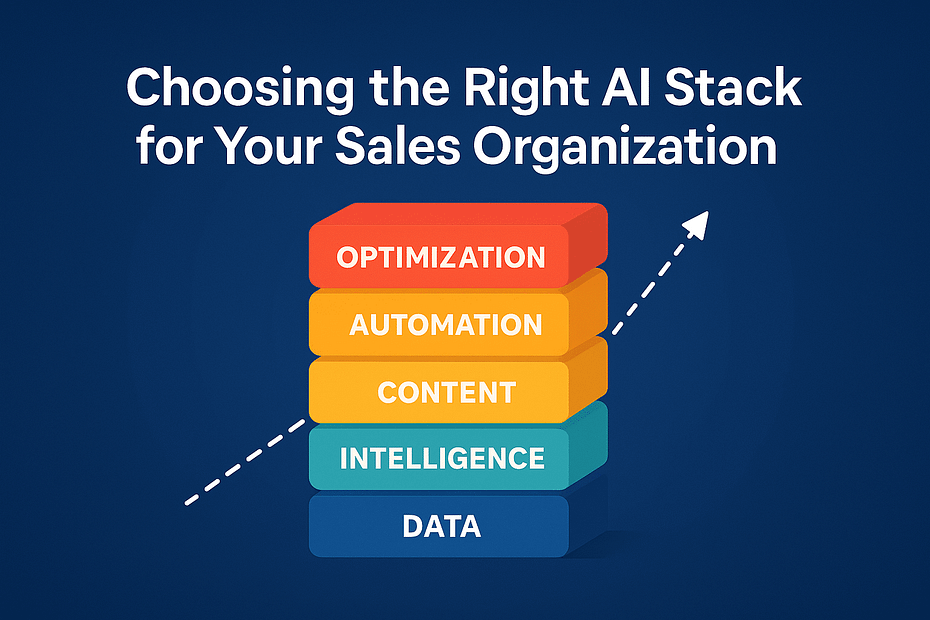
Choosing the Right AI Stack for Your Sales Organization

A VP of Sales recently confided in me: “We have six different AI tools, but our reps are still doing manual work. What went wrong?”

This is the AI tool proliferation problem. Sales leaders often collect tools without a strategy, mistaking a pile of features for a cohesive system. It’s like buying a hammer, screwdriver, saw, and drill without realizing you’re actually trying to build a house. An effective AI stack means integration. When tools work together, they amplify each other’s value. When they don’t, they add complexity, confusion, and wasted money.

Why Strategy Beats Random Adoption

Random tool adoption is rampant across sales organizations. Teams chase shiny new software, often ending up with overlapping features, siloed data, and productivity lost to tool-switching. Instead of solving problems, the stack itself becomes the problem.

But when built strategically, the benefits are profound. Integrated systems reduce manual data entry, accelerate response times, and deliver actionable insights for reps. Three well-chosen, well-connected tools can outperform six isolated ones. Integrated stacks also improve adoption rates by providing consistent interfaces and reducing training overhead.

The Five-Layer AI Stack Framework

To avoid the chaos of random adoption, I use a five-layer framework for structuring sales AI tools:

  1. Data Foundation – Your CRM and data management system, enriched and maintained for accuracy.
  2. Intelligence & Analytics – AI-driven insights, lead scoring, forecasting, and market intelligence.
  3. Automation & Workflow – Sequences, task automation, and cross-platform orchestration.
  4. Content & Communication – AI writing, proposal generation, and customer-facing tools.
  5. Optimization & Learning – Conversation analysis, performance tracking, and continuous improvement.
Read the rest of the article…

From Manual to Automated: A Sales Pro’s Guide to Zapier, Make.com, n8n, and Pipedream

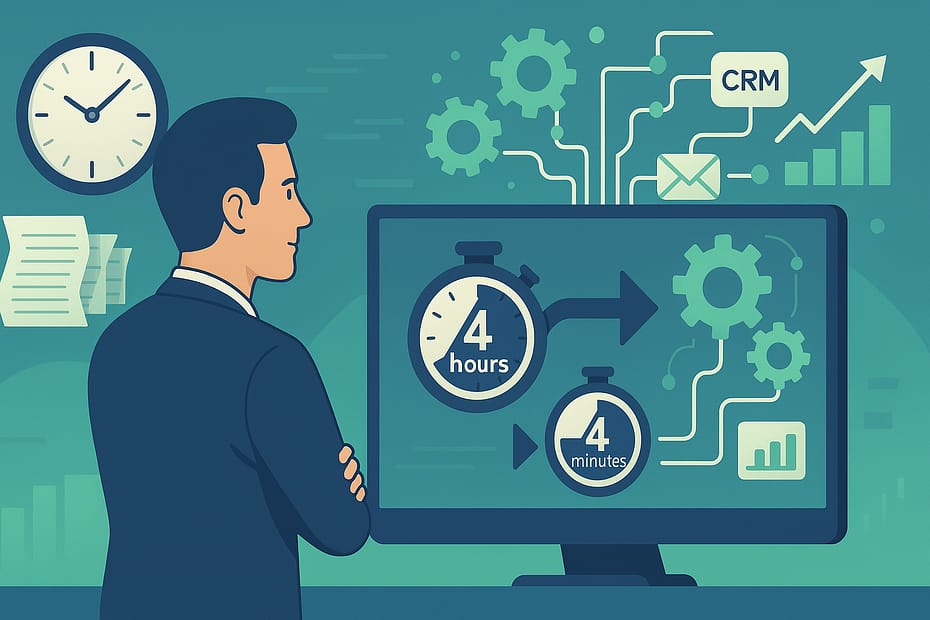
A sales manager recently told me something that stuck: “We went from twenty hours per week of manual work to two hours. Our lead response time dropped from four hours to four minutes.” That dramatic transformation wasn’t magic—it was automation. The reality is that sales teams today have more automation tools available than ever before. But with options like Zapier, Make.com, n8n, and Pipedream, the real challenge isn’t whether you should automate—it’s choosing the right… From Manual to Automated: A Sales Pro’s Guide to Zapier, Make.com, n8n, and Pipedream

APIs Explained for Sales Leaders: Drive Growth Without Extra Headcount

A sales manager recently told me, “I have to copy the same prospect data into five different tools. There has to be a better way.” That frustration is more common than most sales leaders realize, and fortunately, there is a better way. The reality is that sales teams are hemorrhaging productivity due to disconnected systems. Top performers spend hours manually entering data, bouncing between platforms, and correcting inevitable errors. This administrative overhead steals time from… APIs Explained for Sales Leaders: Drive Growth Without Extra Headcount

Cut Through the AI Hype: Practical Definitions for Sales Professionals

Artificial intelligence is transforming sales, but too many leaders are investing in tools they don’t fully understand. The result? Costly mistakes, poor adoption, and missed opportunities. This episode of AI Tools for Sales Pros breaks down the three core technologies behind AI: and explains them in plain language that every sales professional can use. The episode compares the current AI confusion to the database revolution of the 1990s. Just as sales leaders once needed to… Cut Through the AI Hype: Practical Definitions for Sales Professionals