Skip to content

automation

What An MBA Didn’t Teach You About Sales

The sales profession is challenging. You need to work hard at it to succeed. You need to learn from the best. You need to improve your skills continuously. If you think you can sell since you are a hit at parties and have a lot of friends, you may soon find that you are a failure as a salesperson. Blunt truth:

because the sales profession is so hard, you have to focus on doing everything in sales very well, or you will be considered a failure.

I call this blog, Skinned Knees because I try to relate all of the learning that I have done over the past 4+ decades (while skinning my knees in the learning process).

I hope that you learn from my mistakes so that your business will grow!


Reclaiming 15 Hours a Week: The Sales Professional’s Guide to Surviving and Thriving in the Age of AI

Episode Summary

If you feel like your CRM is turning great sellers into tired administrators, you’re not imagining it. This episode breaks down the administrative drag that steals selling time, distorts forecasts, and quietly taxes revenue generation.

We introduce a practical artificial intelligence approach: automate the inputs, then humanize the output so your messaging stays authentic and effective.

The outcome is simple: higher-quality sales processes, stronger sales management decisions, and better Sales success without adding headcount.


Major Highlights

  • The real productivity crisis in B2B sales: administrative drag, CRM debt, and the “technology trap” of too many tools that create more manual work.
  • Why the old brute-force model is breaking: buyers self-educate earlier, competitors respond faster, and generic messaging gets ignored.
  • The core principle: Automate the Input, Humanize the Output. Use AI for research, data capture, and workflow execution while humans control judgment, voice, and value selling nuance.
  • How Benjamin Todd’s “human bottlenecks” framework applies to sales: as AI automates routine work, business acumen, strategic leadership, and complex social intelligence become more valuable.
  • Orchestration engines (n8n and Make.com) as the nervous system: connecting CRM, email, LinkedIn, and transcripts into cohesive sales strategies and repeatable sales processes.
  • Cognitive Prospecting: use AI listening posts to detect triggers (exec hires, funding, cost containment signals) and arrive with a “why now” dossier instead of starting from scratch.
  • One-to-One-at-Scale outreach: generate hyper-relevant drafts from a strategic brief and prospect dossiers, then apply a human “smell test” so messaging lands.
  • Immediate Recap workflows: transcripts flow into structured CRM updates, follow-up tasks, and recap email drafts, accelerating deal momentum and improving revenue management.
  • Always-On Hygiene: AI deduplication and fuzzy matching to reduce bad data, improve forecasting, and protect downstream automation quality.
  • Predictive intelligence and deal risk: revenue intelligence platforms flag risk signatures earlier than human inspection, improving pipeline accuracy and resource allocation.
  • Sales management evolution: managers move from pipeline inspectors to augmented coaches using call analysis to focus coaching where it changes outcomes.
  • The practical end state: more selling time, faster follow-up, improved win rates, and a human-AI centaur model where humans own the last mile.

Read the rest of the article…

From CRM Debt to a Cognitive Revenue Engine: Reclaiming Selling Time with AI

Most B2B sales teams don’t have a talent problem. They have a capacity problem.

Administrative drag is quietly stripping selling time: CRM updates, stakeholder mapping, duplicate cleanup, meeting summaries, and the constant “what should I say next?” work that should not be consuming a senior seller’s day. The downstream damage is bigger than annoyance. Forecast accuracy declines, coaching becomes reactive, and revenue management turns into a negotiation with incomplete data.

Artificial intelligence can fix this, but only if you use it with the right operating model.

Benjamin Todd’s article “How not to lose your job to AI” makes the point that AI doesn’t simply eliminate jobs; it shifts where value concentrates. As routine tasks become cheap, the remaining human bottlenecks become more valuable. Todd’s ATM example is the cleanest version of the idea: ATMs reduced the need for “money counting,” but the overall demand for human banking roles didn’t collapse. The job shifted toward customer-facing work and higher-leverage conversations.

In B2B sales, our “money counting” is CRM entry, list building, and manual research. Our high-leverage work is business acumen, strategic influence, stakeholder alignment, and value selling. The problem is that most teams have it backwards: humans do the hardest input work (research, logging, hygiene), then AI writes the customer-facing messages. That combination produces drained sellers and generic messaging.

A better model is: Automate the input, humanize the output.

Read the rest of the article…

Instant Follow-Up for Field Sales: AI Meeting Recaps That Speed Up Deals

Episode Summary

In complex field sales, deals don’t die in the meeting, they die in the lag after the meeting.

When a buyer asks a technical question, and the rep has to “get back to you,” momentum evaporates, and authority erodes.

This episode lays out how artificial intelligence enables an Instant Field Response: capturing the meeting, retrieving the right internal knowledge, and drafting a precision follow-up before you leave the parking lot.

The outcome is Sales success through faster revenue generation, tighter sales processes, and higher-quality value selling.

Major Highlights

The real enemy: Post-Meeting Lag
The “gap” between meetings and follow-ups is a graveyard for complex B2B deals. A response that arrives tomorrow to a question asked today is already losing heat.

The Administrative Tax in field sales
For decades, reps have carried the burden of manual note-taking, post-call recap, and late-night follow-ups. That tax steals selling time, reduces responsiveness, and quietly damages revenue management by slowing sales velocity.

The shift: from “I’ll get back to you” to the Cognitive Revenue Engine
Instead of treating insight as something created later, you build a workflow where AI supports immediate, contextual delivery.

Cognitive overload is the hidden performance limiter
Reps aren’t overwhelmed by “too much work.” They’re overloaded by trying to listen, interpret, remember, and retrieve technical details under pressure. When AI captures the nuance, the seller can focus on empathy, discovery, and Messaging that advances the deal.

Nodal Automation: the new operating philosophy
The salesperson stops being the single repository of information and the primary transcriptionist. Instead, AI agents handle the mechanical tasks so the rep can lead. This is a sales management shift, not a tech novelty.

The three-layer architecture
1) Field Ear
2) Knowledge Bridge
3) Drafting Agent

Precision Value beats generic follow-up
Most follow-ups are polite but empty. This episode shows how to “mine the meeting” for the buyer’s phrasing and priorities, then mirror their language back in a tailored response.

Signal-Based Selling extends relevance beyond the room
An agentic follow-up can incorporate external signals—market shifts, announcements, or operational triggers—to increase relevance.

The three-stage implementation roadmap
Stage 1: Manual capture (voice memo + AI drafting).
Stage 2: Automated capture (recording app + CRM sync + action items).
Stage 3: Full orchestration (multi-source retrieval + drafted email with attachments queued for review).

This is how you modernize sales processes without trying to “boil the ocean.”

Read the rest of the article…

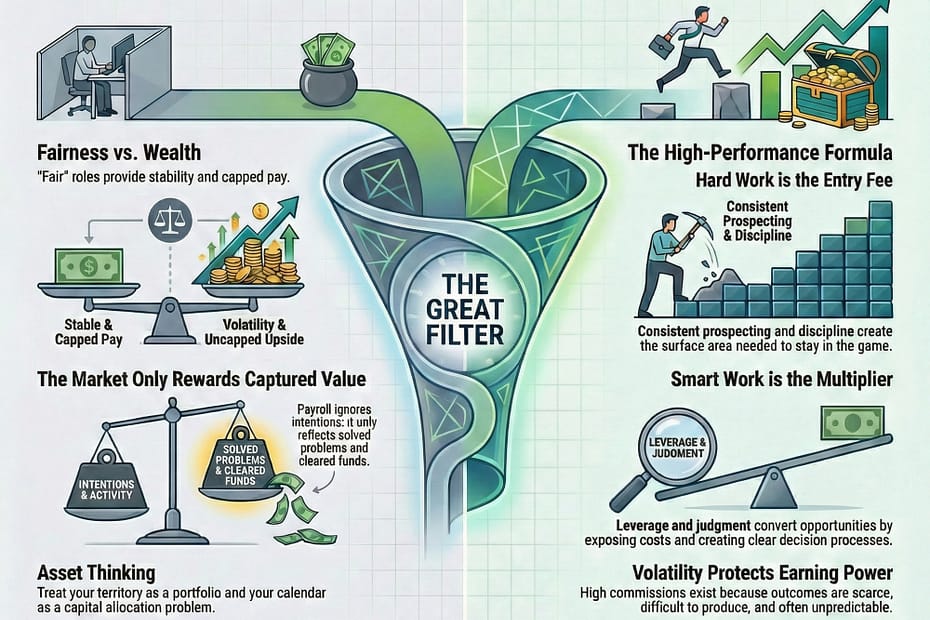
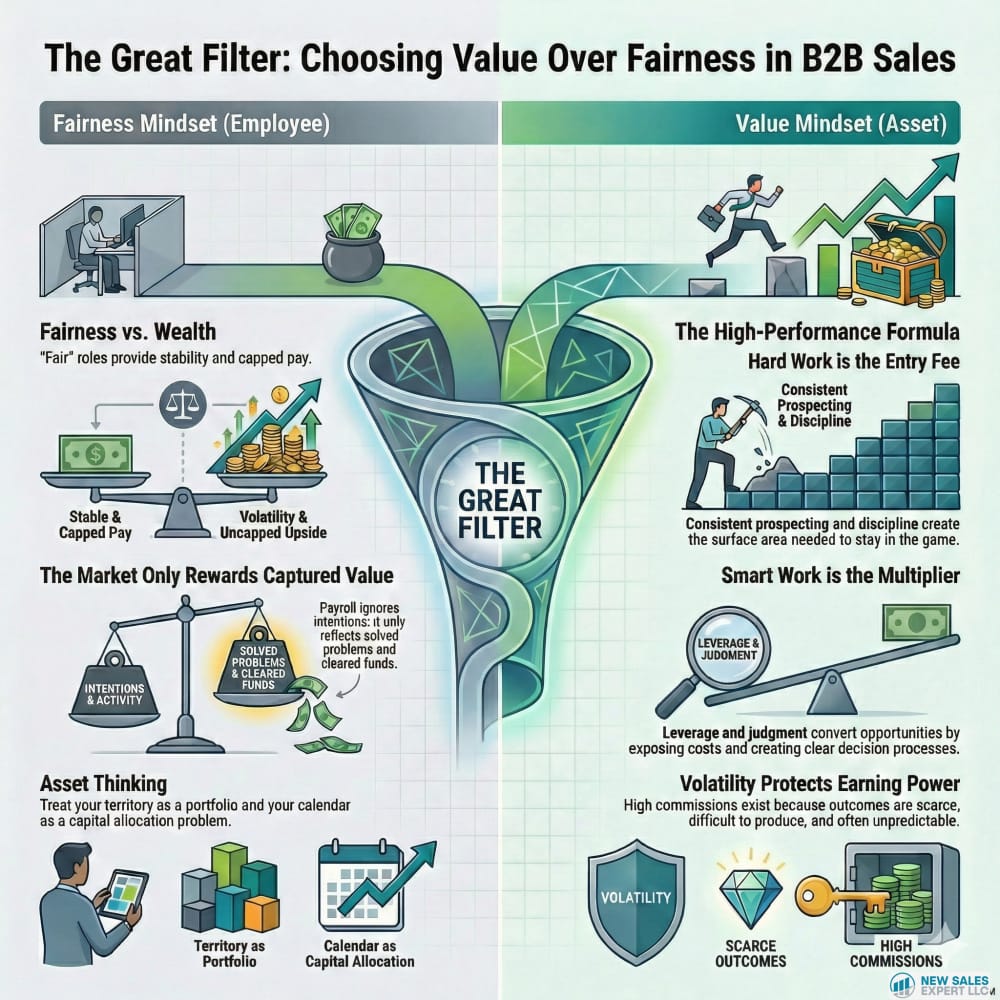
The Great Filter – Why Most People Should Quit B2B Sales Today

If you want fairness, choose a role where performance is measured by compliance and consistency. If you want wealth, stay in sales and accept the only rule that matters: compensation follows captured value.

Walk into any growth-stage B2B sales organization, and you see two populations immediately:

  • One group is stuck in grievance. They stare at the CRM, explain shortfalls with lead quality, territory math, product gaps, or “unrealistic quota.” They want a manager to prescribe the playbook and then validate the effort. Their mindset is hourly, even when they’re paid a salary plus commission.
  • The other group is operating a different model. They talk about leverage, pipeline physics, conversion rates, deal control, and enterprise value. They create their own opportunities. They build customer confidence and earn the right to ask for a decision. They are not looking for comfort. They are looking for the wire.

If you identify with the first group, here’s the most respectful advice I can give you: exit sales on purpose. Move into HR, operations, finance, project management, enablement, customer success, analytics, or any role where the exchange is stable and the scorecard is predictable. Those functions matter. They are important and critical to most companies. They keep companies alive. They are also structurally designed to be fairer.

Sales is designed to be variable, value-based, and exposed. That’s the point.

The safety-net trap

Most people walk into sales carrying the wrong conditioning. School teaches that effort should correlate with reward. Show up, do the work, get the grade. Many corporate functions reinforce it. Do the tasks, hit the process metrics, stay inside the lines, and get the raise.

That conditioning becomes a trap the moment you step into a quota role.

In “fair” roles, compensation tracks your cost and your consistency. Your output is capped by your time, so your income is capped by a band. It’s stable, and it’s a ceiling.

Sales is different because it’s one of the few places left where pay can scale with impact. You are not paid for effort. You are paid for outcomes. That makes it feel brutal to people who want certainty, and it feels like freedom to people who want upside.

The moment you need the world to be fair, sales will punish you. The moment you accept the model, sales becomes one of the most rational games in business.

B2B Sales is rewarding because it isn’t easy or fair
Read the rest of the article…

Why B2B Sales Teams Miss Targets: An AI Operating Model to Eliminate Admin Drag

Episode Summary

In this episode of AI Tools for Sales Pros, we tackle the hidden operational drag limiting revenue generation across B2B teams: highly paid sellers spending most of their week on administrative work instead of customer conversations. The conversation reframes this as a sales management and revenue management problem, not a rep effort problem, and outlines how artificial intelligence and AI orchestration can reverse the trend.

You’ll hear a practical shift from “artisan sales” toward a Cognitive Revenue Engine where automation handles data-heavy tasks, and people focus on value selling, messaging, judgment, and trust. The result is a more scalable model for Sales success built on better Sales processes, stronger Business acumen, and faster execution.

Major Highlights

  • The core bottleneck in modern B2B selling is not activity volume; it is administrative drag that consumes prime selling time and weakens pipeline momentum.
  • Most teams are trapped in a Technology Trap: adding tools without orchestration, which increases complexity and reduces real customer-facing capacity.
  • The strategic shift is from “human-led, tech-assisted” to “tech-led, human-centric,” where AI handles repetitive data entry, and sellers own high-value decisions.
  • The Autonomous Revenue Engine is presented as an integrated operating model, not a single app—combining data hygiene, automation workflows, and AI content support.
  • No-code orchestration platforms (for example, Make.com, Zapier, n8n) are the connective layer that turns disconnected tools into coordinated execution.
  • Signal-Based Selling replaces manual account research with AI-powered monitoring for buying triggers, strategic shifts, and timely engagement opportunities.
  • The “Editor-in-Chief” model upgrades seller productivity: AI drafts and structures; humans validate, refine, and personalize quickly.
  • Always-On Hygiene is non-negotiable: deduplication, normalization, and CRM integrity are prerequisites for reliable AI outputs and budget efficiency.
  • The 80/20 “last mile” principle remains central: AI can handle the first 80%, but human context, empathy, and risk judgment determine deal quality.
  • A deterministic hybrid model protects trust by keeping facts and pricing rules-based while using AI for language and speed.
Read the rest of the article…

The Last Mile in Sales AI: How to Scale Revenue Without Losing Trust

Episode Summary

In this episode of AI Tools for Sales Pros, Sean O’Shaughnessey breaks down the “Last Mile” problem in modern selling: AI can assemble the first 80% of the work, but only a human expert can deliver the final 20% that protects trust, margin, and outcomes.

He argues that the real productivity crisis in B2B sales is not effort, but misallocation—top sales talent is buried in administrative work instead of revenue generation.

The episode introduces a practical operating model where deterministic automation handles fixed truths and process control, while AI accelerates messaging and drafting. The result is faster execution, better sales management discipline, and more time for the trust-building conversations that drive sales success.

Major Highlights

  • The “Last Mile” principle: artificial intelligence is an accelerator, not an autopilot. Human judgment is still required to validate context, edge cases, and risk.
  • Why productivity is stuck: many B2B teams still spend roughly one-third of time on revenue generation and two-thirds on internal sales processes and admin overhead.
  • The “Artisan Trap” vs. the “New Way”: handcrafted work from scratch is being replaced by cognitive prospecting, listening posts, and autonomous workflows.
  • Deterministic vs. Non-Deterministic outputs: high-risk outputs (pricing, contracts, compliance) require deterministic controls; AI should support formatting, messaging, and personalization.
  • Automation + AI hybrid model: rules-based automation supplies verified data, AI shapes language, and final checks enforce consistency and accuracy.
  • Revenue management implication: the objective is not more content—it is more high-quality customer conversations and better conversion velocity.
  • Trust and value selling: relationship depth, multi-threading, and repeated high-value interactions are still core drivers of win rates and profitable growth.
  • Real-world lesson: AI can flag opportunities, but business acumen determines timing, sequencing, and whether an account is ready for expansion.
  • The “5-Minute Value-Add” mindset: AI removes blank-page work so reps can focus on strategy, messaging quality, and customer-specific relevance.
  • Leadership call to action: evaluate current AI deployments as systems for revenue generation, not isolated tools for novelty or speed alone.
Read the rest of the article…

Why AI in B2B Sales Fails at the Last Mile and How to Fix It

Most conversations about AI in B2B sales focus on speed. Fewer focus on control. That is the blind spot.

AI can produce drafts, summaries, research, and follow-up frameworks in seconds. That part is real. But the final 20%, the last mile, is where revenue quality is either protected or destroyed. That final layer requires human judgment: context, timing, risk assessment, and the decision of what should happen next.

The central operating issue in sales today is not effort. It is an allocation. Too many high-value salespeople are spending prime hours on low-value administrative work. CRM cleanup. Internal updates. Document hunting. Manual transcription. Reformatting information that should already be structured. That is a sales management design flaw, not a rep discipline issue.

When sales organizations fix this, performance changes fast. More customer-facing time creates more trust-building interactions. More trust creates better access, stronger positioning, and better conversion outcomes. This is not theoretical. It is how revenue generation compounds in real markets.

The right model is not “AI only.” It is a hybrid model: deterministic automation for correctness, AI for speed and language quality, human oversight for business judgment.

Deterministic systems should control anything that must be exact: pricing, contract elements, offer logic, approval rules, and data integrity. AI should then layer natural language, personalization, and messaging refinement on top of verified inputs. This is how you scale value selling without introducing preventable errors.

If your team is still using AI as a standalone drafting tool, you are under-leveraging it. If your team is sending AI output without last-mile review, you are overexposing the business. The goal is not automation theater. The goal is repeatable, high-confidence sales processes that increase throughput without compromising trust.

Read the rest of the article…

Sixty-Second Slide Review: Use AI to Build Better Slide Decks and Win Back Selling Time

Episode Summary

It’s late Thursday, and you’re stuck building a “pivotal” executive deck with no marketing support, no design help, and no extra hours—so you pay the hidden sales tax: administrative drag that steals selling time and dulls your edge.

In today’s B2B environment, the problem isn’t effort; it’s the Tollbooth Effect—manual CRM updates, document hunting, and slide formatting that cools deals and slows revenue generation.

This episode lays out a practical AI-augmented productivity suite approach that turns you into an editor-in-chief: AI handles structure and mechanics, you handle judgment, tone, and human impact. The result is faster, cleaner messaging, stronger sales processes, and more time for real revenue management work.

Major Highlights

  • The “sales tax” is real: administrative drag and internal processes consume the majority of a seller’s week, starving revenue-generating activity and limiting Sales success.
  • The Tollbooth Effect: momentum from discovery dies when the system forces manual labor—CRM hygiene, notes cleanup, and deck formatting—right when you should be advancing the deal.
  • The Producer Mindset shift: your value is strategy, business acumen, and human connection; technology executes content creation and formatting at machine speed.
  • The workflow: use tools like Microsoft Copilot or Gemini for Workspace to turn transcripts and notes into structured inputs; then generate a slide-by-slide narrative from a strategic brief.
  • The human-in-the-loop protocol: you are not the author, you are the editor—review each slide for accuracy, tone, and the emotional reality behind the buyer’s problem.
  • The Sixty-Second Slide Review: compress a four-hour deck build into a ten-minute strategic review, improving responsiveness and increasing pipeline velocity.
  • Tool paths across ecosystems: PowerPoint automation via VBA generation, Google Slides creation via Gemini Canvas with export, and Keynote creation via AppleScript—same outcome, different environment.
  • Why it matters: reclaiming selling time compounds into higher output, better value selling conversations, and a visible “halo effect” from professional, fast follow-up.
  • Clean data is the multiplier: “always-on hygiene” turns your CRM into a trustworthy source of truth, improving the accuracy of AI-generated outputs and strengthening customer confidence.
  • AI fluency is not coding: it’s orchestrating tools to produce insight and execution—practical sales strategies that let you move faster without losing the human center.
Read the rest of the article…

Generate Custom Proposals in Seconds from CRM Data

Episode Summary

Most B2B teams are still paying a hidden “sales tax” every time a proposal gets requested: hours of document assembly, copy-paste errors, and slow internal processes that kill deal momentum. This episode reframes proposal creation from an artisan craft into Strategic Response Management (SRM), where proposals become a dynamic asset and the rep becomes the producer, not the typist.

Using AI and automation as the nervous system of your sales stack, you can move from “Friday afternoon panic” to a 60-second executive review. The outcome is simple: faster response, cleaner Messaging, stronger Value selling, and more consistent Revenue generation.

Major Highlights

  • The real problem isn’t proposals. It’s the momentum gap created when internal processes delay a buyer-ready moment.
  • Why “The Artisan Trap” is outdated: 80% of most proposals are recycled boilerplate masquerading as personalization.
  • Strategic Response Management (SRM): proposals as a continuously improved system, not a static Word document.
  • How the modern sales stack works as a “nervous system”: CRM status change triggers automated assembly, data pulls, pricing, and version control.
  • Where artificial intelligence actually belongs: rewriting the executive summary using the prospect’s own words and tailoring proof points, without breaking brand standards.
  • The “60-Second Review” operating model: reps edit and approve instead of starting from a blank page.
  • Context-rich alerting: interactive proposals that show engagement data so sales management can coach deal strategy instead of proofreading.
  • Standards before Automation: AI amplifies what you already do, so sloppy Sales processes just get faster.
  • Impact examples: faster proposal creation, improved win rates, and better Revenue management through speed and relevance.
  • The Document Friction Audit: a simple way to quantify the hours lost per deal and identify what to automate first.
Read the rest of the article…

Call Analysis and Coaching with AI (Part 1: Core Coaching Skills)

Episode Summary

You can’t coach what you don’t see, and most sales managers only hear a tiny fraction of their team’s calls. This episode introduces Augmented Coaching: using artificial intelligence and conversation intelligence to analyze every customer conversation and surface specific, teachable moments without adding hours to your week. You’ll learn how AI-driven insights like talk-to-listen ratio, question quality, and sentiment shifts turn coaching from gut feel into repeatable sales management. The outcome is simple: tighter sales processes, faster ramp, stronger messaging consistency, and more reliable revenue generation.

Major Highlights

  • The “coaching gap” problem: when managers review only a small percentage of calls, most rep behavior lives in a black box, and bad habits compound.
  • Why this is a capacity issue, not a willpower issue: managers get buried in forecasts, deal support, admin work, and internal meetings.
  • The shift from intuition-era coaching to Augmented Coaching: AI monitors and analyzes; the manager coaches the moments that matter.
  • What conversation intelligence platforms do (examples include Gong and Chorus.ai): record, transcribe, and analyze calls to produce objective coaching data.
  • Creating a “collective sales brain”: capture what top performers do (phrasing, objection handling, discovery patterns) and scale it across the team.
  • The “Game Tape” approach: use short clips (often 2 minutes or less) to coach discovery, agenda-setting, objection handling, and value selling.
  • Business impact examples discussed: improved win rates, reduced ramp time, and reclaiming manager hours through automation and targeted coaching.
  • Tool selection and architecture: conversation intelligence belongs in the Optimization and Learning layer, supported by a solid data foundation and intelligence layer.
  • Budget-friendly options: lighter-weight tools like Fireflies.ai, Otter.ai, or Fathom can still provide transcription, recaps, and action-item capture.
  • Call Libraries as a force multiplier: curated playlists of best-in-class calls accelerate onboarding and standardize sales strategies across the team.
  • Change management guidance: position AI as coaching support, share team trends before individual call-outs, and celebrate improvement publicly to build trust.
  • The leadership upgrade: stop being a pipeline inspector and become a performance coach focused on the skills that drive sales success and revenue management.
Read the rest of the article…