Skip to content

automation

What An MBA Didn’t Teach You About Sales

The sales profession is challenging. You need to work hard at it to succeed. You need to learn from the best. You need to improve your skills continuously. If you think you can sell since you are a hit at parties and have a lot of friends, you may soon find that you are a failure as a salesperson. Blunt truth:

because the sales profession is so hard, you have to focus on doing everything in sales very well, or you will be considered a failure.

I call this blog, Skinned Knees because I try to relate all of the learning that I have done over the past 4+ decades (while skinning my knees in the learning process).

I hope that you learn from my mistakes so that your business will grow!


Chat Interfaces vs. Automation Workflows (Part 2: When to Use Automation)

Episode Summary

In this episode of AI Tools for Sales Pros, we explore the decision framework for using chat interfaces versus automation workflows. While chat excels in creative, strategic, and complex problem-solving, automation is best for high-volume, repetitive, and data-driven tasks that demand speed, precision, and scalability. Through real-world client stories, we illustrate how automation frees up time for strategic sales strategies, improves revenue generation, and ensures consistent execution. By combining artificial intelligence with thoughtful automation, sales professionals can achieve greater efficiency, enhanced business acumen, and measurable sales success.

Major Highlights

  • The role of automation in repetitive sales processes like CRM updates, scheduling, and triggered communications.
  • How automation supports compliance and documentation requirements with audit trails and error handling.
  • Real-world examples where sales teams saved hours by shifting from manual messaging to automated workflows.
  • Strategies for integrating chat creativity with automation efficiency to create hybrid workflows for revenue management and value selling.
  • Common mistakes in tool selection, overcomplication, and integration issues—and how to avoid them.
  • How automation improves messaging, data accuracy, and timing to increase revenue generation and pipeline consistency.

Read the rest of the article…

Chat Interfaces vs. Automation Workflows (Part 1: When to Use Chat)

In this episode of AI Tools for Sales Pros, we explore a common question among sales managers: whether to use chat interfaces like ChatGPT, Claude, or Gemini or rely on automation workflows. The choice is not simply about tools—it directly affects sales management, productivity, and overall sales success. We break down a practical framework to determine when chat-based artificial intelligence is the right fit for sales processes and revenue generation. By understanding where chat adds the most value, leaders can optimize business acumen, messaging, and sales strategies.

Major Highlights

  • The dangers of random AI implementation and why tool choice shapes sales processes and revenue management outcomes.
  • Key differences between chat interfaces and automation workflows—chat enhances creativity and problem-solving, while automation delivers consistency and scale.
  • A decision framework to evaluate task type and match the right approach: chat for creative, complex, and strategic work; automation for high-volume, repetitive workflows.
  • Four categories where chat excels: creative and strategic tasks, complex problem-solving, learning and development, and research and analysis.
  • Real-world examples of value selling improvements, proposal generation, deal strategy, sales training, and competitive research using chat interfaces.
  • How using the right artificial intelligence tool improves sales messaging, strengthens business acumen, and drives revenue generation.


Read the rest of the article…

Sales Management with AI: Chat Interfaces vs. Automation Workflows

Sales organizations today face a critical decision: should they rely on interactive chat interfaces like ChatGPT, Claude, or Gemini, or should they focus on automation workflows? The answer isn’t either/or. Each approach has unique strengths, and choosing the right one directly impacts sales processes, productivity, and revenue generation.

The problem many sales teams encounter is “random implementation.” They hear about a new AI tool, adopt it quickly, and use it for the wrong purpose. The result? Chat interfaces get bogged down with repetitive work, and automation gets tasked with jobs that require creativity and nuance. Misuse not only reduces efficiency but also frustrates teams and erodes trust in artificial intelligence altogether.

So how do you know when chat is the right fit? The decision comes down to task complexity and uniqueness. Chat excels in situations that require creativity, flexibility, and human judgment. Four categories consistently stand out:

  • Creative and strategic tasks: proposals, executive messaging, strategic planning, and competitive positioning.
  • Complex problem-solving: sales opportunity strategy sessions, unique customer needs, and crisis management.
  • Learning and development: role-playing objection handling, skill coaching, and competitive intelligence training.
  • Research and analysis: prospect research, market analysis, and strategic planning.
Read the rest of the article…

Choosing the Right AI Stack for Your Sales Organization

A VP of Sales recently confided in me: “We have six different AI tools, but our reps are still doing manual work. What went wrong?”

This is the AI tool proliferation problem. Sales leaders often collect tools without a strategy, mistaking a pile of features for a cohesive system. It’s like buying a hammer, screwdriver, saw, and drill without realizing you’re actually trying to build a house. An effective AI stack means integration. When tools work together, they amplify each other’s value. When they don’t, they add complexity, confusion, and wasted money.

Why Strategy Beats Random Adoption

Random tool adoption is rampant across sales organizations. Teams chase shiny new software, often ending up with overlapping features, siloed data, and productivity lost to tool-switching. Instead of solving problems, the stack itself becomes the problem.

But when built strategically, the benefits are profound. Integrated systems reduce manual data entry, accelerate response times, and deliver actionable insights for reps. Three well-chosen, well-connected tools can outperform six isolated ones. Integrated stacks also improve adoption rates by providing consistent interfaces and reducing training overhead.

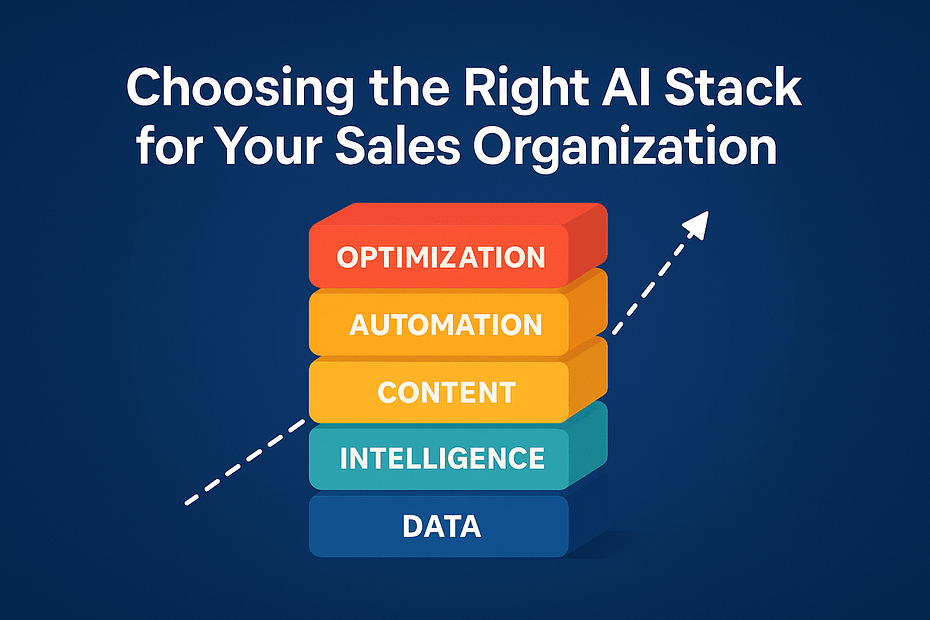
The Five-Layer AI Stack Framework

To avoid the chaos of random adoption, I use a five-layer framework for structuring sales AI tools:

  1. Data Foundation – Your CRM and data management system, enriched and maintained for accuracy.
  2. Intelligence & Analytics – AI-driven insights, lead scoring, forecasting, and market intelligence.
  3. Automation & Workflow – Sequences, task automation, and cross-platform orchestration.
  4. Content & Communication – AI writing, proposal generation, and customer-facing tools.
  5. Optimization & Learning – Conversation analysis, performance tracking, and continuous improvement.
Read the rest of the article…

Choosing the Right AI Stack for Your Sales Organization

Episode Summary

In this episode of AI Tools for Sales Pros, we explain how to move beyond random AI tool adoption and build a strategic AI stack that drives real sales success. Too many organizations collect disconnected tools, creating data silos, inefficiency, and wasted spend. We introduce a five-layer architecture that aligns with proven sales processes and turns artificial intelligence into an amplifier of business acumen, value selling, and messaging. With the right design, your stack becomes a force multiplier for revenue generation and better revenue management.


Major Highlights

  • The proliferation problem: Why collecting disconnected AI tools without a strategy undermines sales management and slows teams down.
  • The five-layer AI stack framework: Data foundation, intelligence & analytics, automation & workflow, content & communication, optimization & learning—built to streamline sales processes.
  • Sales strategies for integration: How integrated stacks support revenue management, sharpenmessaging, and enable value selling across the funnel.
  • Practical ROI planning: Budget allocation by layer, common pitfalls to avoid, and how to measure time saved, pipeline velocity, and revenue generation impact.
  • Real-world configurations: Small, mid-market, and enterprise examples showing how artificial intelligence scales responsibly.
  • Long-term moat: Early architectural choices in tool selection and integration become durable competitive advantages.


Read the rest of the article…

Intro to Automation: Make.com, Zapier, n8n, and String from Pipedream for Sales Pros

In this episode of AI Tools for Sales Pros, we dive into the critical decision of selecting the right automation platform for your sales organization. From Zapier’s simplicity to Make.com’s visual workflow design, from n8n’s open-source flexibility to Pipedream’s developer-friendly tools, each platform offers unique advantages—and pitfalls—for sales teams. We examine how team skills, budget, and complexity influence the right choice and share real-world results from companies that achieved dramatic efficiency gains. By the end, you’ll know how to align platform capabilities with your team’s technical comfort and long-term automation strategy.


Major Highlights

  • Why choosing the right automation platform is one of the most important technology decisions for sales teams.
  • The hidden costs of mismatched platforms include budget waste, abandoned projects, and migration headaches.
  • A breakdown of the four leading automation tools:
  • Zapier: User-friendly pioneer with the largest integration library.
  • Make.com: Visual workflow builder for advanced, high-volume automation.
  • n8n: An open-source powerhouse offering unlimited flexibility and cost efficiency.
  • Pipedream (including String): Developer-friendly with real-time processing power.
  • Key criteria to consider: team technical comfort, use case complexity, budget, scale, and integration requirements.
  • Practical implementation strategies for each platform, including quick wins and longer-term adoption.
  • How multi-platform strategies can be deployed and when they make sense.

  • Read the rest of the article…

    From Manual to Automated: A Sales Pro’s Guide to Zapier, Make.com, n8n, and Pipedream

    A sales manager recently told me something that stuck: “We went from twenty hours per week of manual work to two hours. Our lead response time dropped from four hours to four minutes.” That dramatic transformation wasn’t magic—it was automation. The reality is that sales teams today have more automation tools available than ever before. But with options like Zapier, Make.com, n8n, and Pipedream, the real challenge isn’t whether you should automate—it’s choosing the right… 

    Two Tall Guys Talking Sales – Sales Strategies That Outperform AI Tools: ICP, Value Selling, and Revenue Management – Episode 150

    In today’s fast-changing sales landscape, everyone is talking about AI, automation, and digital tools, but are these the keys to sales success? In this episode of Two Tall Guys Talking Sales, hosts Kevin Lawson and Sean O’Shaughnessey explore why documenting your sales processes, defining your ideal client profile (ICP), and sharpening your value selling approach must come before chasing shiny new technologies. Whether you’re leading a sales team or building revenue generation strategies as a… 

    APIs 101: What They Are and Why Sales Should Care

    Sales teams are wasting hours each week copying data between disconnected systems. This manual work drains productivity, creates errors, and frustrates your top performers. In this episode, Sean explains how APIs, those invisible bridges between software tools, can eliminate repetitive tasks, improve data accuracy, and give sales teams back valuable selling time. You’ll hear practical definitions, real-world use cases, and a step-by-step approach for getting started with sales automation.


    Major Highlights:

    • Why disconnected sales tools create wasted time, errors, and lost productivity
    • Simple, sales-friendly definition of APIs and how they work behind the scenes
    • Real-world sales use cases:
    • Lead generation and enrichment with data pulled directly into CRMs
    • Automated email sequences triggered by prospect behaviors
    • Real-time deal tracking and forecasting with pipeline integrations
    • Customer success workflows for retention and expansion
  • No-code integration platforms (Zapier, Make.com, Power Automate, Pipedream) that make APIs accessible to non-technical teams
  • Key questions to ask vendors about API capabilities before investing in sales tools
  • Security, compliance, and best practices for managing API integrations safely
  • A beginner-friendly framework for launching your first sales API workflow

  • Read the rest of the article…

    ChatGPT vs. Claude vs. Gemini vs. Copilot: Which AI Wins in Sales?

    A few days ago, a sales manager asked me which AI platform to use for writing cold emails. I told him it depends on what kind of emails he’s writing, and he looked confused. That confusion is common and costly. ChatGPT, Claude, Gemini, and Copilot all look similar at first glance, but in reality, they serve very different purposes depending on your sales workflow. Choosing the right platform matters because the wrong choice drains time,…