Skip to content

Claude

What An MBA Didn’t Teach You About Sales

The sales profession is challenging. You need to work hard at it to succeed. You need to learn from the best. You need to improve your skills continuously. If you think you can sell since you are a hit at parties and have a lot of friends, you may soon find that you are a failure as a salesperson. Blunt truth:

because the sales profession is so hard, you have to focus on doing everything in sales very well, or you will be considered a failure.

I call this blog, Skinned Knees because I try to relate all of the learning that I have done over the past 4+ decades (while skinning my knees in the learning process).

I hope that you learn from my mistakes so that your business will grow!


How to Win When AI-Powered B2B Buyers Already Know Your Product

Imagine walking into a major prospect meeting after two days of preparation. You have reviewed the account, refined your presentation, and rehearsed your opening. Three minutes into your presentation, the vice president of operations interrupts.

“We already know what your product does. We compared you with five competitors using AI.”

She turns her laptop around. On the screen is a spreadsheet with 200 rows of features, prices, reviews, and implementation claims. Some entries are accurate. Others are questionable. Every entry has already influenced how her team thinks about your solution. Your instinct might be to continue the presentation, challenge the inaccuracies, or defend your product feature by feature. All three responses surrender control of the business conversation. The buyer does not need another source of product information. She needs help making a decision.

The Salesperson’s Information Advantage Is Gone

Artificial intelligence has changed what B2B buyers can accomplish before they speak to a salesperson. Generative AI tools can summarize technical documents, compare competing products, model pricing scenarios, identify perceived weaknesses, and develop vendor shortlists in a fraction of the time those activities once required.

According to Gartner’s May 2026 research, 45% of surveyed B2B buyers used generative AI during a recent purchase. Sixty-seven percent said they preferred a sales-rep-free experience. Yet 69% wanted to validate AI-generated insights with a sales representative. Those numbers are not contradictory. Buyers increasingly prefer to gather information independently, then turn to someone who can help them assess its reliability, apply it to their business, and reduce the risk of a bad decision.

This changes the definition of value selling. A salesperson’s value is no longer primarily access to information. It is the ability to translate evidence into business judgment and confidence in decisions.

Your Most Dangerous Competitor Is No Decision

An AI-assisted buying committee may be more informed individually and less aligned collectively. The CFO asks an AI assistant to identify the cheapest alternative. Operations prioritizes reliability and throughput. IT investigates integration and cybersecurity. Procurement scores the vendors against another set of criteria. Each stakeholder arrives with an apparently objective answer. The answers do not necessarily agree. More information creates more debate, more validation requests, and more reasons to defer the decision.

This is how information paralysis becomes a revenue problem. The salesperson who responds with another 40-slide deck adds information without resolving uncertainty. The stronger seller identifies the few factors that determine whether the investment produces a measurable business result.

For a manufacturing automation purchase, those factors might be unplanned downtime, production throughput, and integration costs. The other 197 spreadsheet rows may be informative without being decisive.

Read the rest of the article…

AI Sales Automation: Why Your Chatbot Is Not a Sales Process

Imagine preparing for an important customer meeting. You open your favorite AI assistant, give it the prospect’s name, and ask for a summary of the company’s business challenges and the questions you should ask. Within seconds, you receive a beautifully written briefing. The assistant identifies potential operational problems, competitive pressures, and several opportunities to demonstrate the value of your solution.

There’s just one problem. One of those impressive insights concerns an acquisition the prospect supposedly completed last year.

Except the acquisition never happened.

The artificial intelligence fabricated a plausible business event and presented it as fact. Had you trusted the briefing, you might have opened your meeting with a question that immediately damaged your credibility.

This scenario illustrates a much larger problem with how B2B sales organizations use AI.

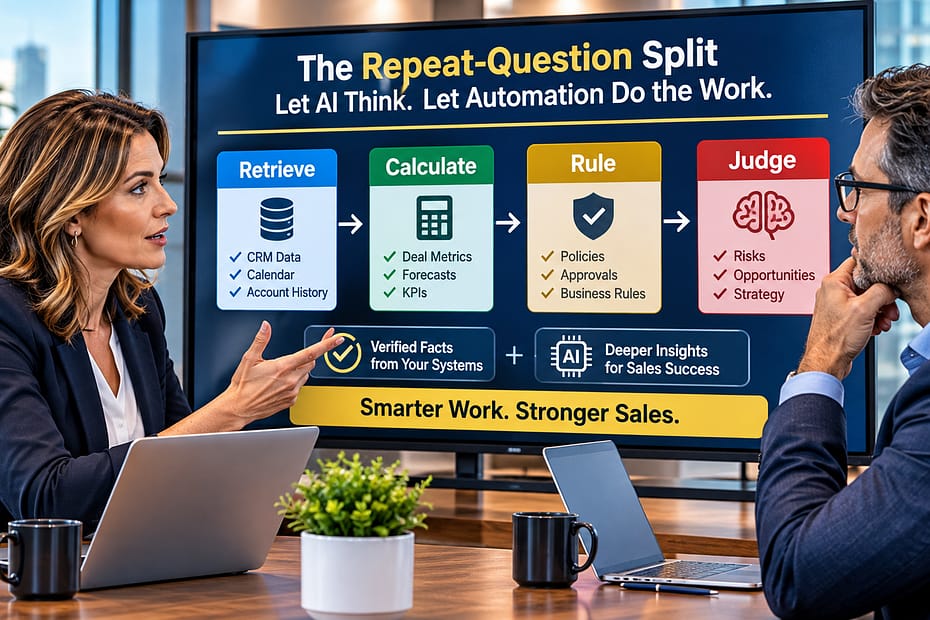
We’re asking artificial intelligence to perform too many different kinds of work without distinguishing which tasks require intelligence and which require reliable execution.

That distinction matters more than the sophistication of the AI model you choose.

The Problem Isn’t Just Hallucinations. It’s Process Design.

Salespeople increasingly rely on ChatGPT, Claude, Gemini, and other Generative AI applications to prepare for meetings, research prospects, write follow-up messages, and analyze opportunities. Those are legitimate applications of AI. In fact, I’d question why a salesperson with access to these capabilities wouldn’t use them. But consider what happens before the salesperson receives a useful answer.

They retrieve information from their CRM, gather previous meeting notes, identify stakeholders, check pricing, and reconstruct details from previous conversations. They paste everything into their AI assistant, ask a question, verify the response, and correct any mistakes.

Tomorrow, they repeat the process for another customer.

The AI may have improved the quality of their analysis, but the underlying sales process remains largely manual.

When twenty salespeople independently reconstruct the same process every day, you don’t have an AI adoption problem. You have a sales management problem.

You’re paying experienced professionals to repeatedly assemble information that your existing systems should already provide.

The solution isn’t necessarily better prompting. It’s better workflow design.

Read the rest of the article…

Building a Zero-Cost AI Sales Stack: How to Validate Value Before You Spend a Dollar

Most sales leaders today feel the tension between innovation and fiscal responsibility. You know artificial intelligence can accelerate productivity, clarify messaging, and drive revenue generation. You also know your competitors are implementing AI-driven sales processes and reaping the benefits. Yet you are expected to somehow produce results without the budget to experiment, test, or validate new technology.

This pressure creates the classic chicken-and-egg dilemma. You cannot get budget approval without demonstrating value, but you cannot demonstrate value without access to capable tools. That tension often leaves sales leaders paralyzed, observing advancements but unable to participate. It is an exhausting cycle that erodes confidence and slows down organizational progress.

The good news is that modern software economics have shifted. You no longer need an enterprise-level budget to run meaningful AI pilots. Instead, today’s freemium models allow teams to build real workflows, automate real processes, and create real sales success with no financial risk. These free tiers exist because vendors want you to become reliant on the workflow, meaning you can use that dynamic to your advantage as you design early-stage pilots.

A practical approach for sales management is to treat free AI tools as validation engines rather than long-term solutions. You begin with lightweight experimentation, focusing on a single friction point that slows your team. Whether the issue involves pre-call research, drafting follow-up emails, or scoring inbound leads, AI can automate repetitive tasks, freeing your sellers to focus on value selling. The goal is not perfection; it is measurement.

Read the rest of the article…

Sales Management with AI: Chat Interfaces vs. Automation Workflows

Sales organizations today face a critical decision: should they rely on interactive chat interfaces like ChatGPT, Claude, or Gemini, or should they focus on automation workflows? The answer isn’t either/or. Each approach has unique strengths, and choosing the right one directly impacts sales processes, productivity, and revenue generation.

The problem many sales teams encounter is “random implementation.” They hear about a new AI tool, adopt it quickly, and use it for the wrong purpose. The result? Chat interfaces get bogged down with repetitive work, and automation gets tasked with jobs that require creativity and nuance. Misuse not only reduces efficiency but also frustrates teams and erodes trust in artificial intelligence altogether.

So how do you know when chat is the right fit? The decision comes down to task complexity and uniqueness. Chat excels in situations that require creativity, flexibility, and human judgment. Four categories consistently stand out:

  • Creative and strategic tasks: proposals, executive messaging, strategic planning, and competitive positioning.
  • Complex problem-solving: sales opportunity strategy sessions, unique customer needs, and crisis management.
  • Learning and development: role-playing objection handling, skill coaching, and competitive intelligence training.
  • Research and analysis: prospect research, market analysis, and strategic planning.
Read the rest of the article…

ChatGPT vs. Claude vs. Gemini vs. Copilot: Which AI Wins in Sales?

A few days ago, a sales manager asked me which AI platform to use for writing cold emails. I told him it depends on what kind of emails he’s writing, and he looked confused. That confusion is common and costly. ChatGPT, Claude, Gemini, and Copilot all look similar at first glance, but in reality, they serve very different purposes depending on your sales workflow. Choosing the right platform matters because the wrong choice drains time,… 

Two Tall Guys Talking Sales – Future-Proofing Your Sales Career with AI, Strategy, and Smarter Workflows – Episode 144

Is artificial intelligence coming for your sales job? Not if you understand the power of business acumen, value selling, and strategic adoption of tools that amplify, not replace, human expertise. In this high-impact episode of Two Tall Guys Talking Sales, Kevin and Sean tackle the loud claims of AI-induced layoffs with a grounded, practical message for salespeople and sales managers: evolve or fall behind. This is not a doomsday episode; it’s a wake-up call, a…