Skip to content

communication

What An MBA Didn’t Teach You About Sales

The sales profession is challenging. You need to work hard at it to succeed. You need to learn from the best. You need to improve your skills continuously. If you think you can sell since you are a hit at parties and have a lot of friends, you may soon find that you are a failure as a salesperson. Blunt truth:

because the sales profession is so hard, you have to focus on doing everything in sales very well, or you will be considered a failure.

I call this blog, Skinned Knees because I try to relate all of the learning that I have done over the past 4+ decades (while skinning my knees in the learning process).

I hope that you learn from my mistakes so that your business will grow!


Stop Betting on Superstars: How Operating Standards Turn Sellers into Predictable Producers

Many teams grow, but few truly scale revenue beyond individual hero efforts. That difference changes everything for leaders today and in the future. Growth relies on hustle; scaling depends on repeatability across segments and individuals. Your strategy must reflect that hard truth in practice.

Are you relying on one standout to win deals month after month? That looks strong until risk turns visible and costly. One resignation can cripple momentum and expose brittle systems that you had previously ignored.

Scalable sales replaces heroics with defined, teachable operating rhythms that everyone follows. It turns chaos into predictable pipeline progress and results. It clarifies markets, messages, motions, and measurable expectations for every seller on a weekly basis. It builds leverage into onboarding and coaching for consistency. It protects margins while systematically accelerating win rates and velocity across territories.

The foundation begins with a clear picture of your ideal customer, including any disqualifying factors. Having an accurate Ideal Client Profile (ICP) helps minimize waste and reduce uncertainty in your efforts. Take time to define firmographics, pain points, triggers, and buying behaviors using consistent language based on shared evidence. Understand who cares about these issues and why it matters to them now. Also, identify negative personas to sharpen your focus and qualification processes in marketing and sales. A well-defined ICP can significantly boost your conversion rates and shorten the sales cycle.

Next, turn your ICP into straightforward messaging and discovery frameworks tailored for each stage. Consider what unique problems you solve for your customers. What outcomes are most important to them, and who are the key stakeholders by role and priority?

Build talk tracks that lead buyers, not chase buyers with purpose always. Anchor questions to the business metrics and risks they feel. Teach a qualification that tests mutual commitment and outlines next steps with attached dates. Avoid fluffy demos; design relevant proofs using their data. Process specificity turns B players into consistent producers without copying another personality.

I suggest you establish a practical, stage-based operating rhythm that everyone can easily understand and follow. By sharing clear definitions and expectations, managing the pipeline becomes a consistent and smooth process each week. Define each stage with specific exit criteria—avoiding vague intentions or subjective feelings. For example, discovery is considered complete when stakeholders confirm the consequences and impact, and solution fit is achieved when success criteria and ownership are clearly aligned. The commit stage should be backed by a shared plan with clear dates and assigned owners. During weekly reviews, focus on assessing quality rather than just quantity or activity counts. Ask yourself:

  • Does evidence from buyers’ backstage moves have a direct impact on their purchasing decisions?
  • Are the next steps specific, mutually agreed upon, and already scheduled on both calendars?
Read the rest of the article…

Differentiating Through Value: Mastering the Art of Consumable Sales

Navigating the competitive landscape of consumable sales calls for a thoughtful and kind-hearted approach. Salespeople, sales managers, and CEOs of small companies should remember that their role is about more than just making transactions. In a market where products often seem very alike in quality and price, what truly sets you apart is your ability to consistently show value. So, how can you create lasting relationships with your customers, even when many options are available?

Consider the analogy of fast-food giants like Burger King and McDonald’s. Both offer similar products, yet they each have a dedicated customer base. The key lies in creating a unique selling proposition that resonates with your target audience. 

As a salesperson, your goal is to become indispensable to your customers. This means transforming from a mere vendor to a trusted advisor who is deeply integrated into the customer’s business operations.

Become Part of Their Team

A critical part of this integration is understanding what a “gatherer” is. A gatherer is more than just an account manager. They build a close, almost inseparable bond with the customer. They become a trusted part of the customer’s team, often turning to them for advice and solving problems together. Building this kind of trust requires a genuine understanding of the customer’s business, enabling you to offer insights and solutions that extend beyond the products you provide.

In the realm of consumable sales, where products are used and replaced regularly, the salesperson’s value lies in their ability to maintain and continually grow the relationship. This involves not just selling a product but also selling yourself and your company. Your expertise, reliability, and ability to anticipate and solve problems become the key differentiators. When customers face challenges, they should instinctively think of you as the go-to person for solutions, regardless of minor price differences or delivery times.

To attain this trusted advisor status, you must focus on three core elements: 

  1. the product, 
  2. the company, 
  3. yourself. 

While the product and the company are essential, the most significant value often comes from you as the salesperson. Your ability to understand the prospect’s needs, guide their purchasing decisions, and challenge them to think differently about their business can set you apart from the competition.

Read the rest of the article…
Reclaiming Hours of Selling Time with AI – Lessons from MAICON 2025

You just checked your team’s dashboard. Activity looks fine. But deep down, you know that the numbers don’t tell the whole story.

Every salesperson loses time to the same unseen burden: administrative drag. After each successful discovery call, there’s a 20-minute grind with CRM updates, email summaries, and internal handoffs. This “sales tax” cuts into selling time, hurts momentum, and costs your company thousands weekly in lost productivity.

I just returned from MAICON 2025, and I was so inspired that I wanted to share some of the biggest lessons. At the MAICON 2025 conference in Cleveland, the message was clear: artificial intelligence is changing sales management, not by replacing people, but by empowering them. The winning teams are using AI to eliminate “digital grunt work” through orchestration, not standardization.

Orchestration, Not Standardization

MAICON’s main message was that sales leaders should stop searching for the “one magical platform.” Instead, the most successful organizations coordinate several top-tier tools. Their AI ecosystems are modular, flexible, and collaborative.

It starts with three pieces:

  1. a transcription tool like Fireflies,
  2. an automation hub like Make.com or Zapier,
  3. your existing CRM and communication systems.
Read the rest of the article…

Stop Researching, Start Connecting: An AI-Powered System for Warm Introductions

Most sales teams begin the week by opening a dozen browser tabs and grinding through scattered research, LinkedIn, Google News, company websites, and databases. Hours later, they emerge with a few generic talking points and a cold list that still feels cold. The deeper issue isn’t inefficiency; it’s invisibility. Warm introductions already exist across your company’s network, in email histories, calendars, and executives’ LinkedIn connections, but you can’t see them on Monday morning.

The Relationship-First approach changes that default. Before a single cold call or email, you perform a deliberate “Warm Path Check.” You ask, “Who do we know who knows them?” This question transforms prospecting from random outreach into a repeatable, data-driven process that prioritizes relationships. When you start as a referred conversation rather than an interruption, skepticism drops, credibility rises, and the sales cycle compresses dramatically.

The Hidden Network You’re Not Using

Every organization has an untapped network, a web of past colleagues, vendors, and clients who could open doors to your dream accounts. The problem is that this network is hidden in plain sight. It lives in the collective memory of your company’s communication patterns, but there’s no easy way to access it manually. That’s where KnowledgeNet comes in.

KnowledgeNet serves as your organization’s “relationship intelligence” layer. It analyzes communication data (emails, meetings, messages) to reveal who knows whom, and how strong those connections really are. Instead of guessing, you can instantly see that a colleague in engineering once worked closely with the CFO of a target account. That’s a warm path waiting to be used.

Read the rest of the article…

Beyond Spell Check: How Grammarly’s AI Can Transform Sales Communication

Clear, professional communication is the foundation of sales success. Yet, in 2025, much of our selling occurs not face-to-face, but through written words, emails, proposals, CRM notes, and social media messages. This shift means your writing is no longer just a form of communication; it’s your personal brand, your first impression, and often the deciding factor in whether a conversation continues or comes to a halt.

Grammarly has evolved far beyond its original purpose as a grammar checker. Today, it’s an artificial intelligence–powered platform that helps sales teams increase efficiency, refine their messaging, and accelerate revenue growth. It works directly within the tools you already use, such as Gmail, LinkedIn, Salesforce, and HubSpot, helping sales professionals write with greater confidence and clarity.

Sales organizations using Grammarly have seen measurable improvements: Databricks saved $1.4 million annually; Smartsheet cut thousands of hours from proposal creation; and Zoom reported higher customer satisfaction thanks to improved written communication. These results aren’t luck; they’re the product of refined sales processes, consistent messaging, and clear communication supported by AI.

For individual salespeople, Grammarly helps improve value selling by ensuring that every message is professional, engaging, and on-brand. Its AI engine not only corrects errors but also suggests stronger phrasing, predicts reader reactions, and even aligns your tone with your business acumen and brand voice. For sales leaders, it standardizes team communication and reinforces a culture of professionalism across departments.

Read the rest of the article…

Automating Sales Workflows: When to Use Automation Over Chat

In sales management, there’s often some confusion about when to use artificial intelligence chat interfaces versus automation workflows. Chat interfaces are ideal for creative problem-solving, learning, and strategic research, while automation excels in repetitive, high-volume, data-driven sales tasks. The trick is to recognize when consistency and scalability are more important than customization.

Automation delivers consistent execution, eliminates human error, and operates 24/7. Sales leaders can rely on it for triggered communications, data synchronization across systems, CRM updates, and compliance tasks that require accuracy and complete audit trails. By moving these routine tasks into automated workflows, sales teams free up valuable time for relationship building, revenue generation, and refining sales strategies.

Real-world examples highlight the impact: a team once spent three hours daily crafting manual follow-up emails. Shifting to automated sequences not only saved time but also improved messaging consistency and pipeline response rates. Similarly, another team utilized automation to synchronize sales data across six systems, thereby eliminating bottlenecks and enabling sellers to focus fully on sales.

Hybrid approaches really take things to the next level! By merging human creativity in chat interactions with the quick and precise power of automation, businesses can craft workflows that beautifully balance personalized service with the ability to grow. This type of teamwork enhances value-driven selling, sharpens business skills, and accelerates revenue management throughout the sales journey.

Read the rest of the article…

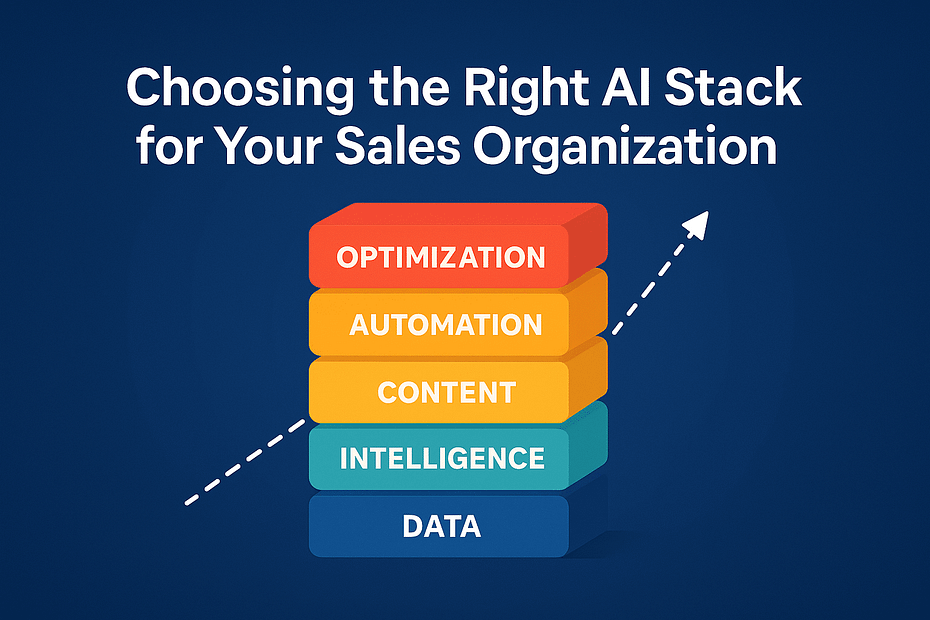
Choosing the Right AI Stack for Your Sales Organization

A VP of Sales recently confided in me: “We have six different AI tools, but our reps are still doing manual work. What went wrong?”

This is the AI tool proliferation problem. Sales leaders often collect tools without a strategy, mistaking a pile of features for a cohesive system. It’s like buying a hammer, screwdriver, saw, and drill without realizing you’re actually trying to build a house. An effective AI stack means integration. When tools work together, they amplify each other’s value. When they don’t, they add complexity, confusion, and wasted money.

Why Strategy Beats Random Adoption

Random tool adoption is rampant across sales organizations. Teams chase shiny new software, often ending up with overlapping features, siloed data, and productivity lost to tool-switching. Instead of solving problems, the stack itself becomes the problem.

But when built strategically, the benefits are profound. Integrated systems reduce manual data entry, accelerate response times, and deliver actionable insights for reps. Three well-chosen, well-connected tools can outperform six isolated ones. Integrated stacks also improve adoption rates by providing consistent interfaces and reducing training overhead.

The Five-Layer AI Stack Framework

To avoid the chaos of random adoption, I use a five-layer framework for structuring sales AI tools:

  1. Data Foundation – Your CRM and data management system, enriched and maintained for accuracy.
  2. Intelligence & Analytics – AI-driven insights, lead scoring, forecasting, and market intelligence.
  3. Automation & Workflow – Sequences, task automation, and cross-platform orchestration.
  4. Content & Communication – AI writing, proposal generation, and customer-facing tools.
  5. Optimization & Learning – Conversation analysis, performance tracking, and continuous improvement.
Read the rest of the article…

Mastering Sales Channels: How to Align Your Strategy for Maximum Impact

Understanding the dynamics of sales channels can transform how businesses approach their markets. Many sales professionals, whether they are salespeople, managers, or CEOs, often miss a critical distinction: the difference between the product they are selling and the value it provides. 

This gap in understanding can lead to suboptimal sales performance, particularly in environments where products are sold through intermediaries, such as distributors, referral partners, or dealer networks. The challenge is not just about knowing your product, but also about understanding how to position it in a way that resonates with every player in the sales chain.

Sales success starts with recognizing who your true customer is. In sales management or channel sales, the end customer is often not the person you interact with directly. Instead, your “customer” might be the intermediary, your distributor, reseller, or even your own sales team. These intermediaries are the ones who ultimately connect your product to its final user. If you don’t understand their challenges, motivations, and context, you risk failing to equip them with the necessary tools to succeed. Are you selling a product’s features, or are you helping them understand how to sell it effectively? This distinction is vital.

When selling through intermediaries, the emphasis should shift from “what the product does” to “how the product can be sold.” Your distributors or referral partners don’t need every technical detail of your product. They need clarity on how it solves problems for their customers, how it fits into their existing offerings, and how they can position it to drive sales. 

The goal is not to overwhelm your partners with information but to provide actionable insights that align with their specific needs. If you’re focusing solely on product features, you’re likely missing the mark.

Salespeople and sales managers must also recognize the game they are playing. Are you selling a commodity, a widely available product, or an exclusive offering? Each scenario demands a different strategy. 

Commodities often compete on price, necessitating bulk sales or value-added services to differentiate themselves. Widely available products often rely on relationships, service quality, or unique add-ons to differentiate themselves. Exclusive products, on the other hand, can often avoid price wars by emphasizing their uniqueness and superior quality. Knowing which game you’re in allows you to tailor your approach and avoid misaligned strategies.

For small businesses and solopreneurs, the challenge lies in effectively managing referral partners. Referral partnerships are a powerful way to generate leads, but they require careful management and oversight. 

Read the rest of the article…

AI Isn’t Replacing Salespeople, It’s Giving Them a Competitive Edge

AI isn’t replacing salespeople, it’s making them more effective. The real risk isn’t losing your job to AI; it’s losing to a competitor who uses AI better than you do. Sales professionals who integrate AI into their workflow will outperform those who don’t. 

It’s not about technology taking over but about using technology to gain an edge. The market is becoming increasingly competitive, and the most efficient salespeople will emerge victorious.

Time is a salesperson’s most valuable asset. 

Every minute spent on administrative tasks is a minute not spent selling. AI helps reclaim those lost hours. Tools that automate writing, scheduling, and research allow salespeople to focus on what matters: building relationships and closing deals. If you’re not leveraging AI to increase productivity, you’re leaving opportunities on the table.

Sales emails need to be clear and professional. AI-powered writing assistants ensure your messages are polished and effective. A poorly written email can cost you a deal. AI tools catch grammatical mistakes, improve clarity, and even suggest more effective phrasing. This isn’t just about looking professional; it’s about being understood. 

If your message isn’t clear, it won’t convert.

Presentations are another time-consuming task. AI can generate professional decks in minutes. Instead of spending hours designing slides, salespeople can focus on developing effective strategies. AI-powered tools create branded, structured presentations based on simple inputs. This ensures consistency while saving time. Sales professionals who utilize AI for presentations can focus on delivering insights rather than formatting slides.

CRM systems are the backbone of sales operations. AI enhances CRM by automating data entry, tracking customer interactions, and suggesting next steps. Salespeople often struggle with keeping CRM data updated. AI reduces this friction by automatically capturing and organizing information. A well-maintained CRM leads to better forecasting and stronger customer relationships. 

If your CRM doesn’t have AI capabilities, it’s time to upgrade.

AI-driven insights enable sales managers to make more informed decisions, rather than relying on instinct. Managers can use AI to analyze performance trends, identify coaching opportunities, and predict revenue outcomes. AI doesn’t replace leadership; it enhances it. 

Sales managers who adopt AI can build stronger teams and achieve better results. Ignoring AI in sales management is a strategic mistake.

Lead generation is another area where AI adds value. AI-powered tools can analyze vast amounts of data to identify high-potential prospects. Instead of spending hours researching leads, salespeople can receive AI-generated recommendations. This allows for more targeted outreach and higher conversion rates. AI doesn’t just find leads, it finds the right leads.

Sales follow-up is often inconsistent. AI ensures follow-ups happen at the right time with the right message. Automated reminders and AI-generated responses keep deals moving forward. 

A well-timed follow-up can be the difference between closing a deal and losing it. AI helps salespeople stay on top of their pipeline without relying on memory.

Read the rest of the article…

Turning Around Sales Performance: Strategies for CEOs and Sales Managers to Foster Internal Alignment

Navigating a sales turnaround isn’t just about fixing numbers; it’s about transforming the business. It’s about realigning expectations, rebuilding internal trust, and creating a structured, sustainable path forward. 

If you’re a CEO, sales manager, or a key salesperson in your organization, the pressure to reverse a sales slump can feel overwhelming. However, the truth is that turnarounds aren’t made in a sprint; they’re built through clarity, consistency, and effective communication.

Too often, sales leaders make the mistake of focusing only on the downward trend. They get caught up in the urgency of the numbers and forget that the real challenge lies in managing upward, setting expectations with executive leadership, and aligning them with reality. 

If your sales team is underperforming, your internal stakeholders are your new audience. Just as with external prospects, you need to manage their expectations with a clear, actionable plan.

The process starts with a shift in mindset. 

Instead of viewing upper management as critics, think of them as clients. What do they need to believe in this turnaround? What information do they need to trust your leadership? Start by building a high-level outline. Avoid over-engineering the details in the early stages. Focus on where you want to go, then reverse-engineer the steps to get there.

Every turnaround starts from a rear position. That means your first job is to stop the downward momentum. Before you can scale revenue, you need to stabilize it. That requires a clear definition of success, agreed upon by everyone involved. 

  • Are you trying to double revenue in 12 months? 
  • Or just return to last year’s baseline? 
  • Is that goal realistic given your market, team, and resources? 

If not, revise it. A stretch goal is fine. A fantasy is not.

Read the rest of the article…