Skip to content

conversation intelligence

What An MBA Didn’t Teach You About Sales

The sales profession is challenging. You need to work hard at it to succeed. You need to learn from the best. You need to improve your skills continuously. If you think you can sell since you are a hit at parties and have a lot of friends, you may soon find that you are a failure as a salesperson. Blunt truth:

because the sales profession is so hard, you have to focus on doing everything in sales very well, or you will be considered a failure.

I call this blog, Skinned Knees because I try to relate all of the learning that I have done over the past 4+ decades (while skinning my knees in the learning process).

I hope that you learn from my mistakes so that your business will grow!


Call Analysis and Coaching with AI (Part 1: Core Coaching Skills)

Episode Summary

You can’t coach what you don’t see, and most sales managers only hear a tiny fraction of their team’s calls. This episode introduces Augmented Coaching: using artificial intelligence and conversation intelligence to analyze every customer conversation and surface specific, teachable moments without adding hours to your week. You’ll learn how AI-driven insights like talk-to-listen ratio, question quality, and sentiment shifts turn coaching from gut feel into repeatable sales management. The outcome is simple: tighter sales processes, faster ramp, stronger messaging consistency, and more reliable revenue generation.

Major Highlights

  • The “coaching gap” problem: when managers review only a small percentage of calls, most rep behavior lives in a black box, and bad habits compound.
  • Why this is a capacity issue, not a willpower issue: managers get buried in forecasts, deal support, admin work, and internal meetings.
  • The shift from intuition-era coaching to Augmented Coaching: AI monitors and analyzes; the manager coaches the moments that matter.
  • What conversation intelligence platforms do (examples include Gong and Chorus.ai): record, transcribe, and analyze calls to produce objective coaching data.
  • Creating a “collective sales brain”: capture what top performers do (phrasing, objection handling, discovery patterns) and scale it across the team.
  • The “Game Tape” approach: use short clips (often 2 minutes or less) to coach discovery, agenda-setting, objection handling, and value selling.
  • Business impact examples discussed: improved win rates, reduced ramp time, and reclaiming manager hours through automation and targeted coaching.
  • Tool selection and architecture: conversation intelligence belongs in the Optimization and Learning layer, supported by a solid data foundation and intelligence layer.
  • Budget-friendly options: lighter-weight tools like Fireflies.ai, Otter.ai, or Fathom can still provide transcription, recaps, and action-item capture.
  • Call Libraries as a force multiplier: curated playlists of best-in-class calls accelerate onboarding and standardize sales strategies across the team.
  • Change management guidance: position AI as coaching support, share team trends before individual call-outs, and celebrate improvement publicly to build trust.
  • The leadership upgrade: stop being a pipeline inspector and become a performance coach focused on the skills that drive sales success and revenue management.
Read the rest of the article…

Choosing the Right AI Stack for Your Sales Organization

A VP of Sales recently confided in me: “We have six different AI tools, but our reps are still doing manual work. What went wrong?”

This is the AI tool proliferation problem. Sales leaders often collect tools without a strategy, mistaking a pile of features for a cohesive system. It’s like buying a hammer, screwdriver, saw, and drill without realizing you’re actually trying to build a house. An effective AI stack means integration. When tools work together, they amplify each other’s value. When they don’t, they add complexity, confusion, and wasted money.

Why Strategy Beats Random Adoption

Random tool adoption is rampant across sales organizations. Teams chase shiny new software, often ending up with overlapping features, siloed data, and productivity lost to tool-switching. Instead of solving problems, the stack itself becomes the problem.

But when built strategically, the benefits are profound. Integrated systems reduce manual data entry, accelerate response times, and deliver actionable insights for reps. Three well-chosen, well-connected tools can outperform six isolated ones. Integrated stacks also improve adoption rates by providing consistent interfaces and reducing training overhead.

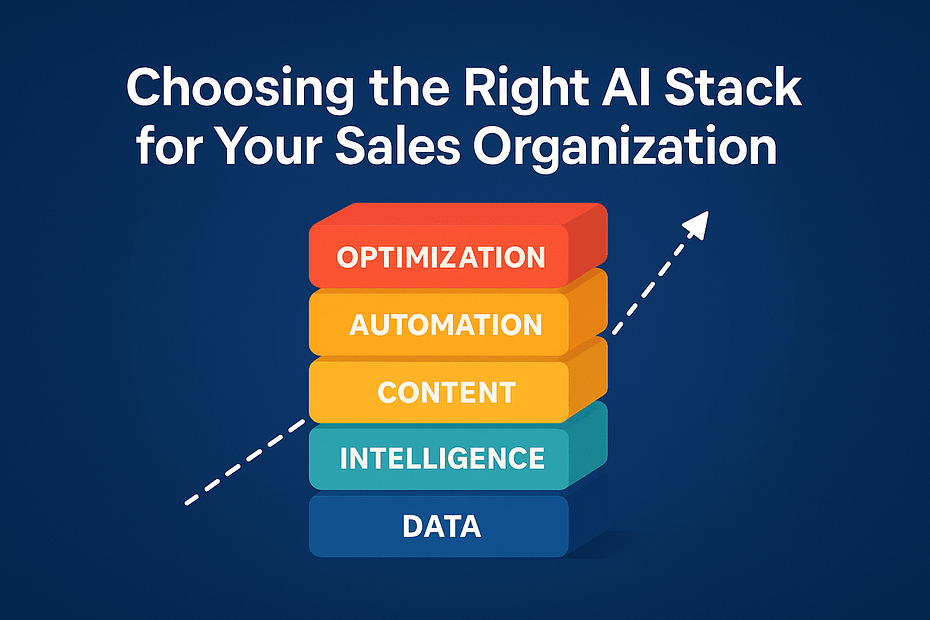
The Five-Layer AI Stack Framework

To avoid the chaos of random adoption, I use a five-layer framework for structuring sales AI tools:

  1. Data Foundation – Your CRM and data management system, enriched and maintained for accuracy.
  2. Intelligence & Analytics – AI-driven insights, lead scoring, forecasting, and market intelligence.
  3. Automation & Workflow – Sequences, task automation, and cross-platform orchestration.
  4. Content & Communication – AI writing, proposal generation, and customer-facing tools.
  5. Optimization & Learning – Conversation analysis, performance tracking, and continuous improvement.
Read the rest of the article…