
Skip to content

data enrichment

What An MBA Didn’t Teach You About Sales

The sales profession is challenging. You need to work hard at it to succeed. You need to learn from the best. You need to improve your skills continuously. If you think you can sell since you are a hit at parties and have a lot of friends, you may soon find that you are a failure as a salesperson. Blunt truth:

because the sales profession is so hard, you have to focus on doing everything in sales very well, or you will be considered a failure.

I call this blog, Skinned Knees because I try to relate all of the learning that I have done over the past 4+ decades (while skinning my knees in the learning process).

I hope that you learn from my mistakes so that your business will grow!


How AI-Powered Contact Enrichment Transforms B2B Sales Conversations

In today’s fast-paced B2B world, sales teams can no longer afford to waste hours gathering prospect data manually. Artificial intelligence has enabled the automation of contact enrichment, transforming basic contact records into comprehensive profiles rich in actionable business intelligence.

Contact enrichment powered by AI doesn’t just make your team faster; it makes them smarter. By combining multiple data sources into unified profiles, your sales organization gains the kind of business acumen that enables precision-targeted messaging and true value selling. The difference between a generic pitch and a relevant, consultative conversation often comes down to the quality and depth of the data your team has at its fingertips.

Platforms like Clay, Clearbit, Apollo, and ZoomInfo give sales leaders visibility into company size, funding rounds, leadership changes, technology stacks, and even recent business developments. This transforms your approach from transactional outreach to consultative engagement rooted in strategic intelligence. The outcome is faster response times, higher conversion rates, and more meaningful sales conversations.

The beauty of these systems lies in their integration with CRMs like HubSpot, Salesforce, or Pipedrive. Automated workflows ensure that every new lead entry is enriched in real-time with firmographic and behavioral insights. This is how sales teams reduce their research time from hours to minutes while maintaining the quality of personalized outreach that customers expect.

Read the rest of the article…
Choosing the Right AI Stack for Your Sales Organization

A VP of Sales recently confided in me: “We have six different AI tools, but our reps are still doing manual work. What went wrong?”

This is the AI tool proliferation problem. Sales leaders often collect tools without a strategy, mistaking a pile of features for a cohesive system. It’s like buying a hammer, screwdriver, saw, and drill without realizing you’re actually trying to build a house. An effective AI stack means integration. When tools work together, they amplify each other’s value. When they don’t, they add complexity, confusion, and wasted money.

Why Strategy Beats Random Adoption

Random tool adoption is rampant across sales organizations. Teams chase shiny new software, often ending up with overlapping features, siloed data, and productivity lost to tool-switching. Instead of solving problems, the stack itself becomes the problem.

But when built strategically, the benefits are profound. Integrated systems reduce manual data entry, accelerate response times, and deliver actionable insights for reps. Three well-chosen, well-connected tools can outperform six isolated ones. Integrated stacks also improve adoption rates by providing consistent interfaces and reducing training overhead.

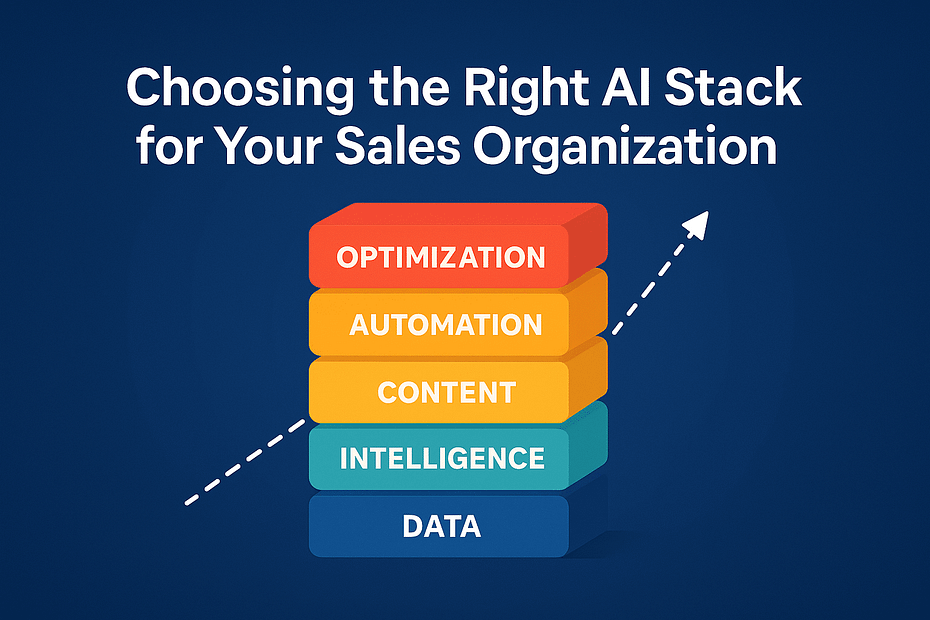
The Five-Layer AI Stack Framework

To avoid the chaos of random adoption, I use a five-layer framework for structuring sales AI tools:

  1. Data Foundation – Your CRM and data management system, enriched and maintained for accuracy.
  2. Intelligence & Analytics – AI-driven insights, lead scoring, forecasting, and market intelligence.
  3. Automation & Workflow – Sequences, task automation, and cross-platform orchestration.
  4. Content & Communication – AI writing, proposal generation, and customer-facing tools.
  5. Optimization & Learning – Conversation analysis, performance tracking, and continuous improvement.
Read the rest of the article…