Skip to content

decision-makers

What An MBA Didn’t Teach You About Sales

The sales profession is challenging. You need to work hard at it to succeed. You need to learn from the best. You need to improve your skills continuously. If you think you can sell since you are a hit at parties and have a lot of friends, you may soon find that you are a failure as a salesperson. Blunt truth:

because the sales profession is so hard, you have to focus on doing everything in sales very well, or you will be considered a failure.

I call this blog, Skinned Knees because I try to relate all of the learning that I have done over the past 4+ decades (while skinning my knees in the learning process).

I hope that you learn from my mistakes so that your business will grow!


Two Tall Guys Talking Sales – Sales Management Masterclass: Paul Rafferty’s Proven Framework for Smarter Deal Reviews and Revenue Generation – Episode 159

Welcome back to Two Tall Guys Talking Sales with hosts Kevin Lawson and Sean O’Shaughnessey. In this dynamic episode, the Tall Guys welcome Paul Rafferty from Sales Xceleration to explore the art and science of sales coaching, deal qualification, and the importance of building sales acumen. Paul brings decades of experience in sales management, value selling, and revenue generation, offering a practical framework for sales leaders who want to coach their teams more effectively and for reps who want to stop chasing the wrong deals.

Discover how to transform your team’s approach to sales processes—from opportunity scoring to understanding a buyer’s “pain chain.” This conversation is packed with actionable insights that blend sales strategy, business acumen, and real-world stories you can immediately apply to your own selling environment.

Key Topics Discussed

  • 03:00 — Building a Deal Coaching Framework:
    Paul introduces his 100-point scorecard system that evaluates the Ideal Prospect Profile, the Pain Chain, and Commitment to Decision. This framework transforms deal reviews into powerful coaching sessions rather than mere forecast updates.
  • 05:10 — The “Pain Chain” and Sales Philosophy:
    Sean and Paul discuss how understanding buyer pain isn’t optional—it’s foundational to value selling. Without real pain, there’s no compelling reason for your buyer to act.
  • 06:45 — From Friendly to Effective Salesperson:
    Paul and Sean discuss how friendliness can open doors, but it’s teaching and insight that ultimately win deals. Sales success comes from challenging your prospects and helping them think differently.
  • 08:00 — Why Deals Get Stuck:
    Kevin and Paul explore how most stalled deals trace back to weak discovery. Coaching your team to go deeper early in the sales process prevents gridlock later.
  • 10:30 — The Currency of Knowledge:
    Paul explains that in modern selling, gifts and lunches no longer move the needle—information does. Great salespeople earn influence by being teachers, not vendors.

Key Quotes

  • Paul Rafferty (03:50):
    “It’s not what you do—it’s what they do. The scorecard helps you coach reps to spend time where there’s real buying intent, not just big logos.”
  • Sean O’Shaughnessey (05:43):
    “Salespeople need to understand the theory of sales. Without knowing the frameworks—like the pain chain or solution selling—you’re just saying, ‘I’m a nice guy, buy from me.’”
  • Kevin Lawson (08:38):
    “Most deals go to die in the discovery phase. Coaching means rewinding the tape and helping reps fix what wasn’t done early enough.”
  • Paul Rafferty (12:51):
    “Your currency is information—help your buyer look smart, get promoted, and win internally. That’s real value selling.”

Additional Resources

  • Paul Rafferty
    • prafferty@salesxceleration.com 
    • https://www.linkedin.com/in/pauljrafferty/
  • Books referenced:
    • Solution Selling by Michael Bosworth – https://a.co/d/hHtYSiX
    • The Challenger Sale by Matthew Dixon & Brent Adamson – https://a.co/d/2kJsbDU
    • Strategic Selling by Robert Miller & Stephen Heiman – https://a.co/d/icPcC6H

A Significant Actionable Item from this Podcast

Implement a Deal Coaching Scorecard.
Instead of subjective forecasting (“This deal is 70% likely to close”), create an objective scoring model based on:

  1. Ideal Prospect Fit (25 pts) – Does this prospect align with your best customer profile?
  2. Pain Chain (25 pts) – Have they admitted to a real, solvable pain?
  3. Commitment to Decision (50 pts) – Have they engaged decision-makers and committed to next steps?

Use this tool in your next pipeline review. It will sharpen your sales management coaching, improve revenue forecasting, and elevate your team’s overall sales success. If you want more information about this scorecard, reach out to Paul Rafferty at his address above.

Read the rest of the article…

Stop Researching, Start Connecting: An AI-Powered System for Warm Introductions

Most sales teams begin the week by opening a dozen browser tabs and grinding through scattered research, LinkedIn, Google News, company websites, and databases. Hours later, they emerge with a few generic talking points and a cold list that still feels cold. The deeper issue isn’t inefficiency; it’s invisibility. Warm introductions already exist across your company’s network, in email histories, calendars, and executives’ LinkedIn connections, but you can’t see them on Monday morning.

The Relationship-First approach changes that default. Before a single cold call or email, you perform a deliberate “Warm Path Check.” You ask, “Who do we know who knows them?” This question transforms prospecting from random outreach into a repeatable, data-driven process that prioritizes relationships. When you start as a referred conversation rather than an interruption, skepticism drops, credibility rises, and the sales cycle compresses dramatically.

The Hidden Network You’re Not Using

Every organization has an untapped network, a web of past colleagues, vendors, and clients who could open doors to your dream accounts. The problem is that this network is hidden in plain sight. It lives in the collective memory of your company’s communication patterns, but there’s no easy way to access it manually. That’s where KnowledgeNet comes in.

KnowledgeNet serves as your organization’s “relationship intelligence” layer. It analyzes communication data (emails, meetings, messages) to reveal who knows whom, and how strong those connections really are. Instead of guessing, you can instantly see that a colleague in engineering once worked closely with the CFO of a target account. That’s a warm path waiting to be used.

Read the rest of the article…

Two Tall Guys Talking Sales – How to Define Sales Territories for Maximum Revenue Generation – Episode 154

Sales leaders and sales professionals: are your territories setting you up for sales success or holding your team back? 

In this episode, hosts Kevin Lawson and Sean O’Shaughnessey tackle the critical role of defining territories, commission plans, and account strategies. From building fair but effective territories to creating actionable plans that drive revenue generation, this conversation blends sales management insight with practical sales strategies to help you win more consistently and grow with intention.

Key Topics Discussed

  • Defining Territories with Purpose (00:23) – Why intentional design matters more than “spray and pray” selling.
  • Fairness vs. Evenness in Territories (01:27) – Sean explains why territories don’t need to be identical, but they must be logical and fair to prevent turnover.
  • How Salespeople Should Approach New Territories (04:53) – Kevin outlines the mindset and business acumen required to succeed under a new commission plan.
  • Planning Ahead for Sales Success (08:21) – Sean breaks down how early planning impacts Q1 results, revenue management, and long-term sales processes.
  • The Power of Written Territory and Account Plans (12:23) – Kevin explains how documenting your strategies in a CRM enhances value selling and accountability.

Key Quotes

  • Sean O’Shaughnessey (01:10): “When you’re driving down the road, you’re not driving with the mirrors—you’re driving with the windshield. Defining your territory is incredibly important to know where you’re going.”
  • Kevin Lawson (06:00): “A new commission plan is not an indictment of past performance; it’s your executives telling you how and where they want the company to grow.”
  • Kevin Lawson (12:42): “When a plan is written, it’s real. You win more often when your goals and account strategies are captured, documented, and revisited.”

A Significant Actionable Item from this Podcast

Write down your territory and account growth plan before the new year begins. Identify 20 accounts to expand, document the cast of characters (champions, blockers, decision-makers), and map a path to increase revenue generation. Then, enter this plan into your CRM to hold yourself accountable and align with your company’s sales strategies.

Read the rest of the article…

Two Tall Guys Talking Sales – No Leads, No Problem: Sales Strategies to Reignite Momentum – Episode 148

When your sales pipeline hits a wall—or worse, goes completely flat—it can feel like you’re spinning your wheels. In this episode of Two Tall Guys Talking Sales, hosts Kevin Lawson and Sean O’Shaughnessey dive deep into what to do when your sales team is facing a revenue generation stall. This is a fast-paced, actionable conversation focused entirely on what sales leaders can do to recharge a stalled pipeline—without relying on marketing. Whether you’re in B2B… Two Tall Guys Talking Sales – No Leads, No Problem: Sales Strategies to Reignite Momentum – Episode 148

Navigating the Sales Maze: Overcoming Missed Steps in Your Sales Process

The challenges for a salesperson or a sales manager are numerous. One such challenge that often arises during the sales process is the realization that a crucial step has been skipped. This situation is not uncommon and is faced by many salespeople. However, it’s not a moment for reprimanding or pulling out an accountability chart. Instead, it’s a moment of realization and an opportunity to rectify the error to avoid ending up in the ‘no decision lane.’

I have written about the importance of skipping stages of the sales process elsewhere on this site, most recently in “The Key to Profitable Sales Organizations: Understanding and Adhering to the Sales Process,” where I remind you that, according to the Harvard Business Review, 28% of companies that master at least three stages of their sales process will see an increase in revenue growth.

When you recognize you’ve missed a step in your sales process, it resembles backing up a train. You’ve got a lot of cars put together, but one is out on its own. Addressing this situation requires a specific style and approach. As a sales leader, your focus should be on the next step in the process. Have you covered this step from a question in the sales meeting? It’s important to ask questions like, “What is next? What is missing? What is now?” 

As a salesperson, if you realize you’ve missed a step, address it head-on. This approach allows you to rectify your error and builds trust with your prospect by demonstrating transparency and accountability. 

Read the rest of the article…

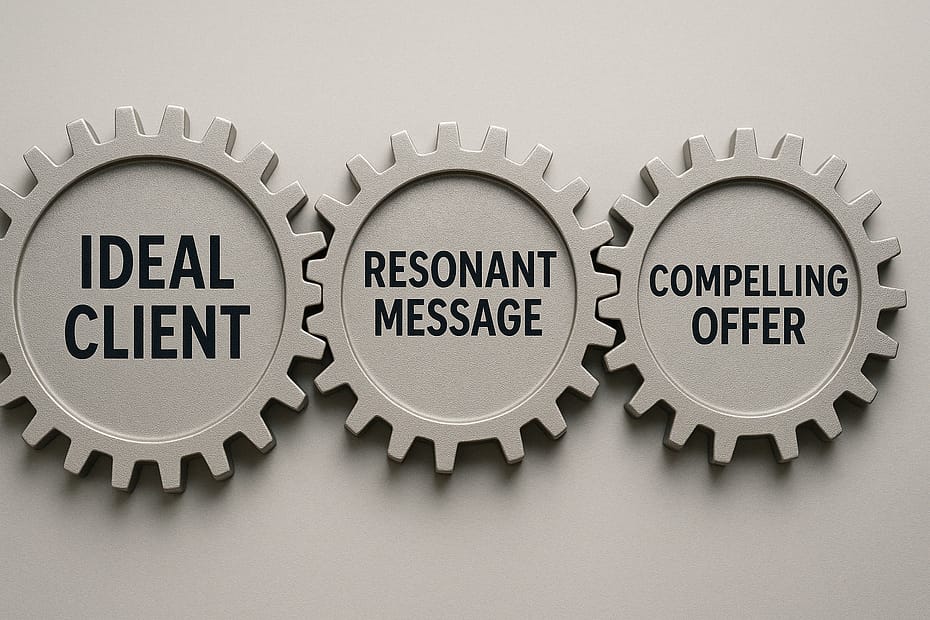
The Three Pillars of Sales Success: Ideal Client Profiles, Effective Messaging, and Aspirational Offers

Let’s start this article with a rhetorical question to the sales professionals, sales managers, or CEOs: Have you ever found yourself guilty of sending messages to prospects without fully considering their specific needs or how your offer aligns with them?

If so, you’re not alone—this is a common pitfall in sales. The good news is, it’s entirely fixable by developing a straightforward, strategic approach.

An effective sales strategy hinges on three core components: defining your ideal client profile (ICP), crafting a resonant message, and presenting a compelling offer. These elements are interconnected. Mastering their alignment will significantly enhance your sales effectiveness.

Ideal Client Profile

Let’s start with the ideal client profile. How well do you know the companies you’re targeting? Identifying your ideal customer is foundational to your entire sales approach. It’s not enough to say that your market is “small businesses” or “tech companies.” Instead, think about your best clients—the ones you genuinely enjoy working with, who value your product, and who generate profitable, sustainable business. Think about companies that rarely devalue your product or service by asking for a discount. What do these clients have in common?

Now that you have your favorite customers from above, reflect on your top five or ten accounts. Are they in the same industry? Do they share similar challenges or company structures? Perhaps they all have common goals that your product consistently solves. Pinpoint these commonalities. This process will help you create a precise and actionable ideal client profile.

But don’t stop at company-level characteristics. Remember, even in B2B sales, you’re ultimately selling to individuals. Identify the specific roles or buyers within these organizations that are responsible for making buying decisions. Who are these decision-makers? What motivates them personally and professionally? Do they all have the same kind of college education? Do they all have similar career paths? Understanding the people behind the logo makes your outreach more personal, targeted, and effective.

What is your message?

Once you’ve developed a clear picture of your ideal client and the people within those companies, the next step is crafting a message that reflects your value-selling message. This message is how you communicate your value proposition—it’s the bridge between your product and your prospect’s needs. Too often, sales messaging falls flat because it focuses heavily on the seller rather than the buyer. Statements that emphasize “we,” “I,” or “our product” rarely resonate deeply. Instead, effective messaging highlights the customer’s perspective, clearly communicating the benefits they will experience.

Read the rest of the article…