Skip to content

enterprise value

What An MBA Didn’t Teach You About Sales

The sales profession is challenging. You need to work hard at it to succeed. You need to learn from the best. You need to improve your skills continuously. If you think you can sell since you are a hit at parties and have a lot of friends, you may soon find that you are a failure as a salesperson. Blunt truth:

because the sales profession is so hard, you have to focus on doing everything in sales very well, or you will be considered a failure.

I call this blog, Skinned Knees because I try to relate all of the learning that I have done over the past 4+ decades (while skinning my knees in the learning process).

I hope that you learn from my mistakes so that your business will grow!


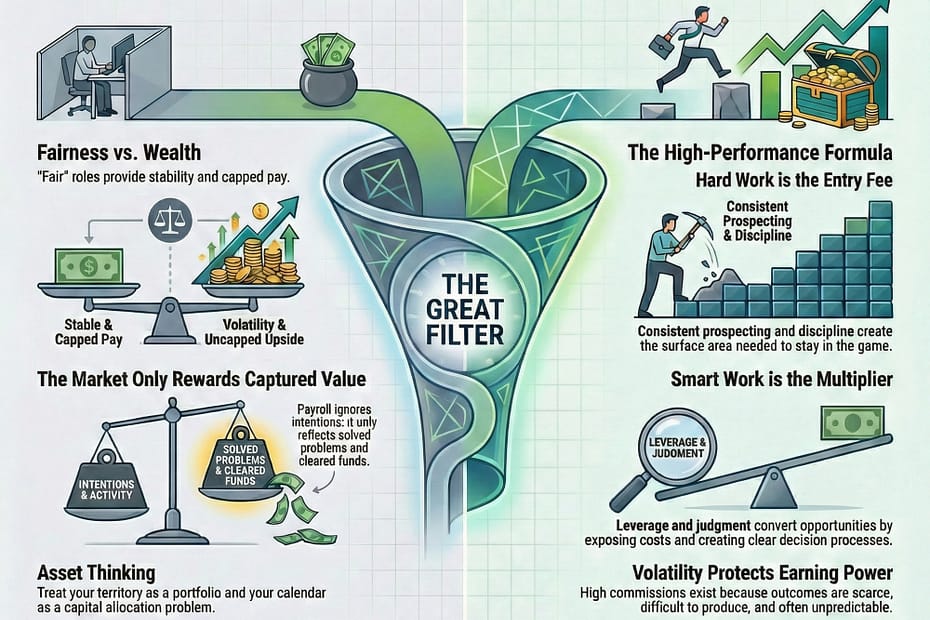
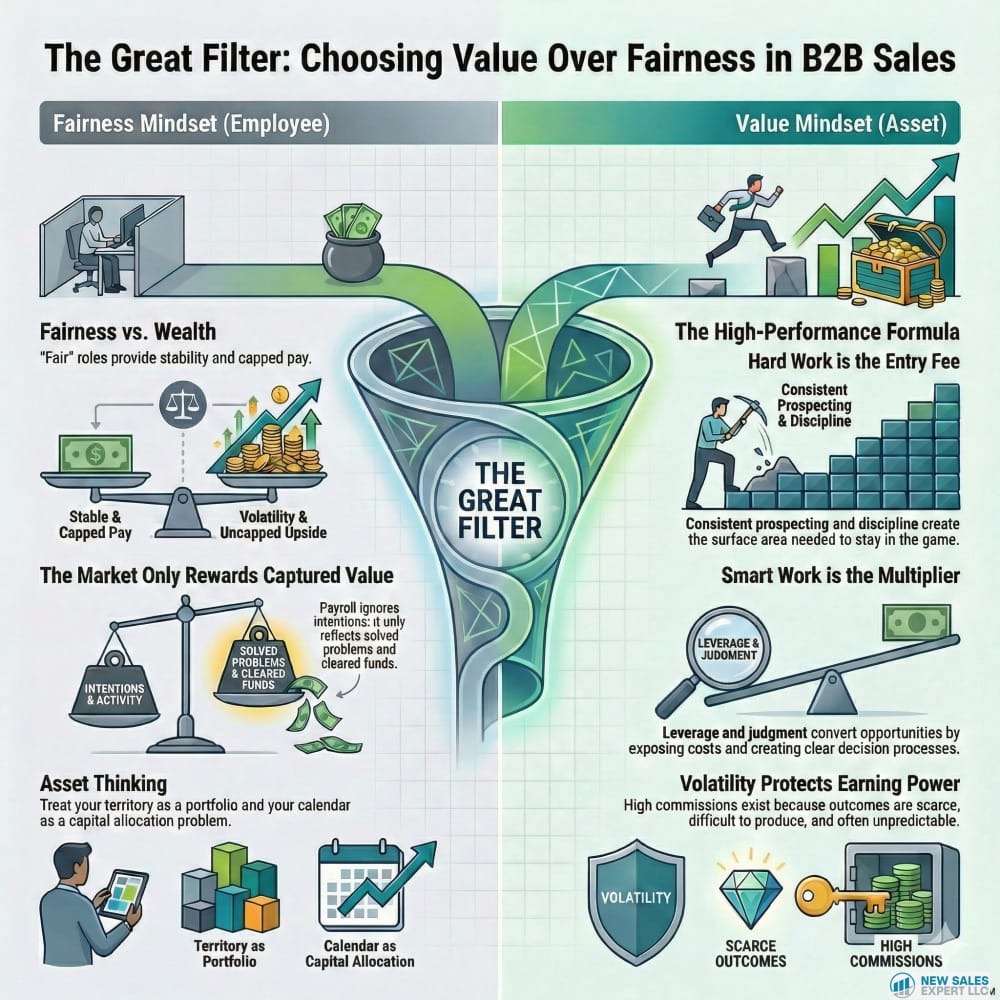
The Great Filter – Why Most People Should Quit B2B Sales Today

If you want fairness, choose a role where performance is measured by compliance and consistency. If you want wealth, stay in sales and accept the only rule that matters: compensation follows captured value.

Walk into any growth-stage B2B sales organization, and you see two populations immediately:

  • One group is stuck in grievance. They stare at the CRM, explain shortfalls with lead quality, territory math, product gaps, or “unrealistic quota.” They want a manager to prescribe the playbook and then validate the effort. Their mindset is hourly, even when they’re paid a salary plus commission.
  • The other group is operating a different model. They talk about leverage, pipeline physics, conversion rates, deal control, and enterprise value. They create their own opportunities. They build customer confidence and earn the right to ask for a decision. They are not looking for comfort. They are looking for the wire.

If you identify with the first group, here’s the most respectful advice I can give you: exit sales on purpose. Move into HR, operations, finance, project management, enablement, customer success, analytics, or any role where the exchange is stable and the scorecard is predictable. Those functions matter. They are important and critical to most companies. They keep companies alive. They are also structurally designed to be fairer.

Sales is designed to be variable, value-based, and exposed. That’s the point.

The safety-net trap

Most people walk into sales carrying the wrong conditioning. School teaches that effort should correlate with reward. Show up, do the work, get the grade. Many corporate functions reinforce it. Do the tasks, hit the process metrics, stay inside the lines, and get the raise.

That conditioning becomes a trap the moment you step into a quota role.

In “fair” roles, compensation tracks your cost and your consistency. Your output is capped by your time, so your income is capped by a band. It’s stable, and it’s a ceiling.

Sales is different because it’s one of the few places left where pay can scale with impact. You are not paid for effort. You are paid for outcomes. That makes it feel brutal to people who want certainty, and it feels like freedom to people who want upside.

The moment you need the world to be fair, sales will punish you. The moment you accept the model, sales becomes one of the most rational games in business.

B2B Sales is rewarding because it isn’t easy or fair
Read the rest of the article…

The Dual Blueprint Requirement: Why Growth Demands Two Plans, Not One

Launching a company or steering one through a merger, turnaround, or major transition requires clarity about how value will be created and, just as importantly, how revenue will actually be generated.

Many leadership teams recognize the need for a Business Plan, but overlook that sustainable growth requires a second, complementary plan. The main breakdown is not the strategy itself, but the assumption that strategy automatically creates revenue. Bridging strategy and revenue requires a distinct plan for that conversion, targeting a different audience.

The Business Plan sets direction from the top down. The Sales Plan is validated by demonstrating how that direction can become actual revenue from the bottom up.

Both are essential. Neither works in isolation.

The Business Plan: Charting the Course (Top-Down)

The Business Plan exists to answer specific questions for a particular audience. Its primary readers are CEOs, CFOs, bankers, private equity partners, and venture investors. These stakeholders are evaluating risk, scale, and return. They want to know where the company is going and why the destination is worth the journey.

At its core, the Business Plan articulates strategic intent. It defines the mission, the long-term objectives, and the differentiated value proposition that the company believes the market will reward. It frames the opportunity in language that aligns leadership, capital, and governance.

Market analysis in this context is necessarily high-level. It focuses on the total addressable market, industry dynamics, competitive positioning, and macro trends. The goal is not to explain how every deal will be won, but to establish that a meaningful opportunity exists and that the company has a credible right to pursue it.

Financial projections follow the same logic. They are built on broad assumptions: projected market share, average selling price, renewal and retention rates, inflation, and multi-year revenue targets. These numbers are directional. They signal ambition and scale rather than operational certainty.

Read the rest of the article…

Hiring Your First Sales Leader? Build a Sales Machine, Not a Band-Aid

You are ready to hire your first sales leader when you are prepared to buy leverage, not relief. Titles do not grow revenue. A high-impact sales leader creates durable selling capability, reduces owner dependency, and raises standards through coaching, recruiting, and operating cadence. If what you really want is a second version of you to carry the number and keep deals moving, you are hiring a band-aid, and you will pay for it twice.

Most owners make this hire at precisely the wrong moment. The pressure is real, the pipeline feels fragile, and the business is starting to outgrow informal management. So the owner reaches for the obvious move: “We need a sales manager.” The problem is that the role is designed around short-term comfort rather than long-term capacity. The result is a well-paid administrative firefighter who inherits the chaos instead of fixing the system that creates it.

Before you post a job, clarify the objective. Do you want a revenue driver or a capability builder?

A revenue driver is a manager who helps you hit the number by conducting deal inspections, applying forecast pressure, and holding reps accountable. That can be valuable, but it is often a disguised need for personal production. A capability builder is a leader who creates repeatable performance by improving the quality of selling, tightening hiring standards, and building a coaching system that makes average reps better and good reps consistent. That is the role that changes enterprise value.

Here is the hard truth most owners avoid. If you design a role that combines selling and leading, selling will win. Always. When a leader has a quota, the business trains them to prioritize their own deals over the team’s development. They will “help” reps when a deal is in a late-stage, visible phase, then postpone coaching, recruiting, and onboarding because those activities do not pay this month. Over time, the team remains dependent, the pipeline remains uneven, and the owner remains in the middle.

Assessing readiness: leader or band aid

Readiness is not a revenue threshold. It is an operating decision. The question is whether you will let a sales leader lead.

The owner’s trap is hiring a leader while keeping day-to-day control: still running reviews, intervening in pricing, rewriting emails, jumping on calls, and closing important deals. In that environment, the new leader cannot build authority; they become an assistant with a title. You’ll be frustrated they’re “not taking enough off my plate,” while they’re frustrated at not being able to make decisions without you.

If you want a clean test, look for these warning signs:

  • You are still the primary deal closer and default problem solver.
  • You do not believe the company can make the number without your direct involvement.
  • You step into deals because you do not trust the process, the rep, or the forecast.
  • Your coaching is ad hoc, usually when something goes wrong.
  • Recruiting is episodic, triggered by pain, rather than continuous.
Read the rest of the article…