
Skip to content

Human-in-the-Loop

What An MBA Didn’t Teach You About Sales

The sales profession is challenging. You need to work hard at it to succeed. You need to learn from the best. You need to improve your skills continuously. If you think you can sell since you are a hit at parties and have a lot of friends, you may soon find that you are a failure as a salesperson. Blunt truth:

because the sales profession is so hard, you have to focus on doing everything in sales very well, or you will be considered a failure.

I call this blog, Skinned Knees because I try to relate all of the learning that I have done over the past 4+ decades (while skinning my knees in the learning process).

I hope that you learn from my mistakes so that your business will grow!


AI Sales Coaching: How to Stop Rescuing Deals and Start Developing Salespeople

There is a dangerous moment in the growth of many B2B companies. It happens when the best salesperson becomes the sales manager.

The promotion seems obvious. This person consistently exceeds quota, understands customers, knows how to close difficult deals, and has earned the team’s respect. Who could be better qualified?

Six months later, that same person is personally rescuing the team’s largest opportunities, handling difficult customer objections, negotiating with executives, and keeping the forecast alive.

The company’s revenue looks healthy. The owner is satisfied. The sales manager appears indispensable.

And that is precisely the problem.

The company hasn’t developed a scalable sales organization. It has become dependent on one talented individual. Artificial intelligence offers an opportunity to change this pattern. But only if we rethink what sales management should accomplish.

The Difference Between Managing Deals and Developing Salespeople

Traditional sales management relies heavily on inspection and intervention. Managers review pipeline reports, examine forecasts, enforce activity requirements, and intervene when opportunities get into trouble. These activities are necessary, but they are not the same as coaching.

Consider a salesperson who confidently announces during a pipeline review that Mary is the Champion for a major opportunity. The manager suspects that Mary is simply a friendly contact who likes the product. An experienced manager might join the next customer meeting, take control of the conversation, and personally secure executive support. The opportunity might close. Unfortunately, the salesperson hasn’t developed the ability to identify and validate a real Champion.

A better manager asks a different question:

“What has Mary actually done that proves she is your Champion?”

Has Mary introduced the salesperson to important stakeholders? Has she explained the customer’s internal decision process? Has she advocated for the solution when the salesperson wasn’t present? Has she taken any personal risk to help the opportunity advance? If the salesperson cannot identify meaningful actions, the relationship remains an untested hypothesis.

The manager’s next responsibility isn’t to take over. It is to help the salesperson determine how to test that relationship. That coaching conversation improves the salesperson’s judgment, potentially affecting every future opportunity.

The objective of sales leadership is not to make the manager better at closing deals. It is to make the entire team better at closing deals.

Read the rest of the article…
AI Sales Automation: Why Your Chatbot Is Not a Sales Process

Imagine preparing for an important customer meeting. You open your favorite AI assistant, give it the prospect’s name, and ask for a summary of the company’s business challenges and the questions you should ask. Within seconds, you receive a beautifully written briefing. The assistant identifies potential operational problems, competitive pressures, and several opportunities to demonstrate the value of your solution.

There’s just one problem. One of those impressive insights concerns an acquisition the prospect supposedly completed last year.

Except the acquisition never happened.

The artificial intelligence fabricated a plausible business event and presented it as fact. Had you trusted the briefing, you might have opened your meeting with a question that immediately damaged your credibility.

This scenario illustrates a much larger problem with how B2B sales organizations use AI.

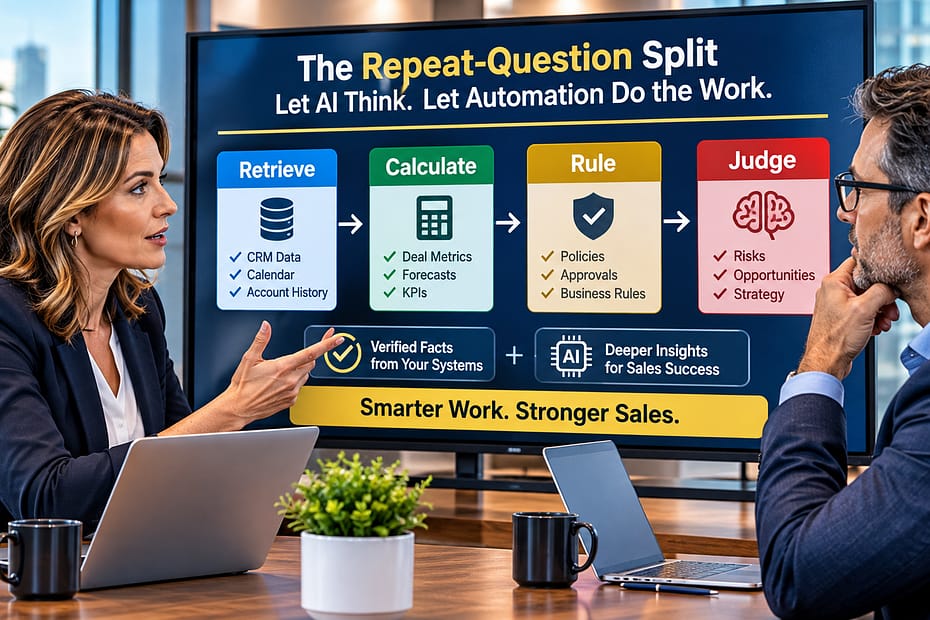
We’re asking artificial intelligence to perform too many different kinds of work without distinguishing which tasks require intelligence and which require reliable execution.

That distinction matters more than the sophistication of the AI model you choose.

The Problem Isn’t Just Hallucinations. It’s Process Design.

Salespeople increasingly rely on ChatGPT, Claude, Gemini, and other Generative AI applications to prepare for meetings, research prospects, write follow-up messages, and analyze opportunities. Those are legitimate applications of AI. In fact, I’d question why a salesperson with access to these capabilities wouldn’t use them. But consider what happens before the salesperson receives a useful answer.

They retrieve information from their CRM, gather previous meeting notes, identify stakeholders, check pricing, and reconstruct details from previous conversations. They paste everything into their AI assistant, ask a question, verify the response, and correct any mistakes.

Tomorrow, they repeat the process for another customer.

The AI may have improved the quality of their analysis, but the underlying sales process remains largely manual.

When twenty salespeople independently reconstruct the same process every day, you don’t have an AI adoption problem. You have a sales management problem.

You’re paying experienced professionals to repeatedly assemble information that your existing systems should already provide.

The solution isn’t necessarily better prompting. It’s better workflow design.

Read the rest of the article…