Skip to content

Ideal Customer

What An MBA Didn’t Teach You About Sales

The sales profession is challenging. You need to work hard at it to succeed. You need to learn from the best. You need to improve your skills continuously. If you think you can sell since you are a hit at parties and have a lot of friends, you may soon find that you are a failure as a salesperson. Blunt truth:

because the sales profession is so hard, you have to focus on doing everything in sales very well, or you will be considered a failure.

I call this blog, Skinned Knees because I try to relate all of the learning that I have done over the past 4+ decades (while skinning my knees in the learning process).

I hope that you learn from my mistakes so that your business will grow!


Stop Betting on Superstars: How Operating Standards Turn Sellers into Predictable Producers

Many teams grow, but few truly scale revenue beyond individual hero efforts. That difference changes everything for leaders today and in the future. Growth relies on hustle; scaling depends on repeatability across segments and individuals. Your strategy must reflect that hard truth in practice.

Are you relying on one standout to win deals month after month? That looks strong until risk turns visible and costly. One resignation can cripple momentum and expose brittle systems that you had previously ignored.

Scalable sales replaces heroics with defined, teachable operating rhythms that everyone follows. It turns chaos into predictable pipeline progress and results. It clarifies markets, messages, motions, and measurable expectations for every seller on a weekly basis. It builds leverage into onboarding and coaching for consistency. It protects margins while systematically accelerating win rates and velocity across territories.

The foundation begins with a clear picture of your ideal customer, including any disqualifying factors. Having an accurate Ideal Client Profile (ICP) helps minimize waste and reduce uncertainty in your efforts. Take time to define firmographics, pain points, triggers, and buying behaviors using consistent language based on shared evidence. Understand who cares about these issues and why it matters to them now. Also, identify negative personas to sharpen your focus and qualification processes in marketing and sales. A well-defined ICP can significantly boost your conversion rates and shorten the sales cycle.

Next, turn your ICP into straightforward messaging and discovery frameworks tailored for each stage. Consider what unique problems you solve for your customers. What outcomes are most important to them, and who are the key stakeholders by role and priority?

Build talk tracks that lead buyers, not chase buyers with purpose always. Anchor questions to the business metrics and risks they feel. Teach a qualification that tests mutual commitment and outlines next steps with attached dates. Avoid fluffy demos; design relevant proofs using their data. Process specificity turns B players into consistent producers without copying another personality.

I suggest you establish a practical, stage-based operating rhythm that everyone can easily understand and follow. By sharing clear definitions and expectations, managing the pipeline becomes a consistent and smooth process each week. Define each stage with specific exit criteria—avoiding vague intentions or subjective feelings. For example, discovery is considered complete when stakeholders confirm the consequences and impact, and solution fit is achieved when success criteria and ownership are clearly aligned. The commit stage should be backed by a shared plan with clear dates and assigned owners. During weekly reviews, focus on assessing quality rather than just quantity or activity counts. Ask yourself:

  • Does evidence from buyers’ backstage moves have a direct impact on their purchasing decisions?
  • Are the next steps specific, mutually agreed upon, and already scheduled on both calendars?
Read the rest of the article…

The Evolution of Sales: Scaling from 10 to 100 Customers

The journey of a business unfolds as a story of growth, change, and ongoing adaptation. As salespeople, sales managers, and CEOs, we all share the ups and downs that come with this path. One of the most exciting moments in sales is the shift from landing your first ten customers to growing your family of clients to 50 or even 100. This milestone is truly a game-changer, shaping the future direction of your business.

When you’re starting, your focus is on acquiring those first ten customers. You’re trying to find your footing in the market, identify your target audience, and refine your product or service offering. You might be customizing your product or service for each customer to ensure it fits their specific needs. However, as you aim for the next level of growth, you need to start thinking about systemizing your sales process. 

To grow successfully, it’s helpful to have a standardized product or service. While customizing can be useful when you’re just starting out, it can become hard to manage and slow you down as your customer base expands. 

Focus on creating a product or service that you can sell over and over again with just small tweaks. This approach simplifies your sales process and makes it easier for others to sell your offerings, too.

Read the rest of the article…

Two Tall Guys Talking Sales – The First 90 Days as a Sales Leader: Proven Strategies for Sales Management Success – Episode 157

When a company hires or promotes its first sales manager, expectations run high, but clarity can be low. In this episode of Two Tall Guys Talking Sales, hosts Sean O’Shaughnessey and Kevin Lawson unpack what the first 90 days should look like for a new sales leader. Whether you’re a CEO onboarding a new manager or that manager stepping into the role themselves, this discussion provides practical guidance on setting realistic expectations, building trust, and establishing the foundation for long-term sales success and revenue growth.

Key Topics Discussed

  • Setting Realistic Expectations as an Owner (02:00)
    Kevin explores how CEOs should frame success during the first 90 days, emphasizing the importance of patience, trust-building, and understanding that sales management transformation takes time.
  • Avoiding the “Fix This First” Trap (06:30)
    Sean cautions business owners against dumping old personnel problems on new leaders, explaining why cleaning up someone else’s mess undermines early business acumen and trust.
  • Building Relationships and Learning the Business (08:30)
    Sean shares tactical advice for new sales managers: conduct one-on-ones, ride along with reps, and build rapport across departments, marketing, operations, and finance, to master internal sales processes and interdepartmental alignment.
  • Understanding Internal and External Tools (11:12)
    Kevin discusses discovering hidden tools and levers, people, systems, vendor programs, or product configurations that can immediately improve team performance and value-selling opportunities.
  • Repackaging and Aligning Offers to the Market (12:30)
    The hosts outline how sales leaders can rethink product structures and messaging to better serve customer needs, thereby improving revenue management and profitability.

Key Quotes

  • “Trust is a currency. It has to be earned by customers, by salespeople, by peers, and you can’t buy it in the first 30 days.”,  Kevin Lawson (03:00)
  • “Don’t make your new sales leader the bad guy. If there’s a tough personnel decision, handle it before they start.”,  Sean O’Shaughnessey (07:00)
  • “Learn your company inside and out. If you don’t know who runs manufacturing or how the supply chain works, you can’t lead your salespeople effectively.”,  Sean O’Shaughnessey (10:00)
  • “You might have 20 products, but 100 possible solutions. The smart leader finds ways to repackage and sell in ways the customer actually values.”,  Kevin Lawson (13:00)

Additional Resources

  • Episodes on sales onboarding, marketing alignment, and ideal customer profiling (ICP) were referenced throughout the conversation.
  • Explore more insights and tools for sales leaders at b2b-sales-lab.com.

A Significant Actionable Item from this Podcast

Create a 90-Day Integration Plan.
If you’re a new sales manager, spend your first month listening and learning. Conduct one-on-ones with every salesperson, schedule cross-department meetings, and document what each function needs from sales. In the second month, identify process gaps and start designing improvements. By the third month, implement one or two visible wins, such as improving forecasting accuracy or clarifying sales messaging, to demonstrate value and build momentum.

Read the rest of the article…

From 10 to 100 Customers: Scaling Your Sales Process for Growth

For founders of companies, the journey of a business is a narrative of evolution, growth, and constant adaptation. As salespeople, sales managers, and CEOs, we are all too familiar with the challenges and triumphs that punctuate this journey. In the world of sales, one of the most critical turning points is the transition from acquiring your first ten customers to expanding your customer base to 50 or even 100. This pivotal moment sets the trajectory of a business and is a key focus of our discussion.

When you’re starting, the founding team is focused on acquiring those first ten customers. They’re trying to find their footing in the market, identify their target audience, and refine their product or service offering. You might be customizing your product or service for each customer to ensure it fits their specific needs. However, as you aim for the next level of growth, it’s crucial to start thinking about systemizing your sales process. This will ensure efficiency and prepare you for the next level of growth. 

To scale effectively, company leaders need to standardize their product or service offering. While customization can be beneficial in the early stages, it becomes impractical and inefficient as your customer base grows. The key here is to create a product or service that can be sold repeatedly with minimal adjustments. This streamlines the sales process, making it easier for others to sell the product or service.

In the early stages of a business, the founders might be the ones doing all the selling. But as the company grows, this becomes less feasible. To reach a larger number of customers, you need to bring others on board to sell for you. This is where standardization comes into play. By standardizing your product or service, you make it easier for others to understand and sell it. 

Read the rest of the article…

The Three Pillars of Sales Success: Ideal Client Profiles, Effective Messaging, and Aspirational Offers

Let’s start this article with a rhetorical question to the sales professionals, sales managers, or CEOs: Have you ever found yourself guilty of sending messages to prospects without fully considering their specific needs or how your offer aligns with them?

If so, you’re not alone—this is a common pitfall in sales. The good news is, it’s entirely fixable by developing a straightforward, strategic approach.

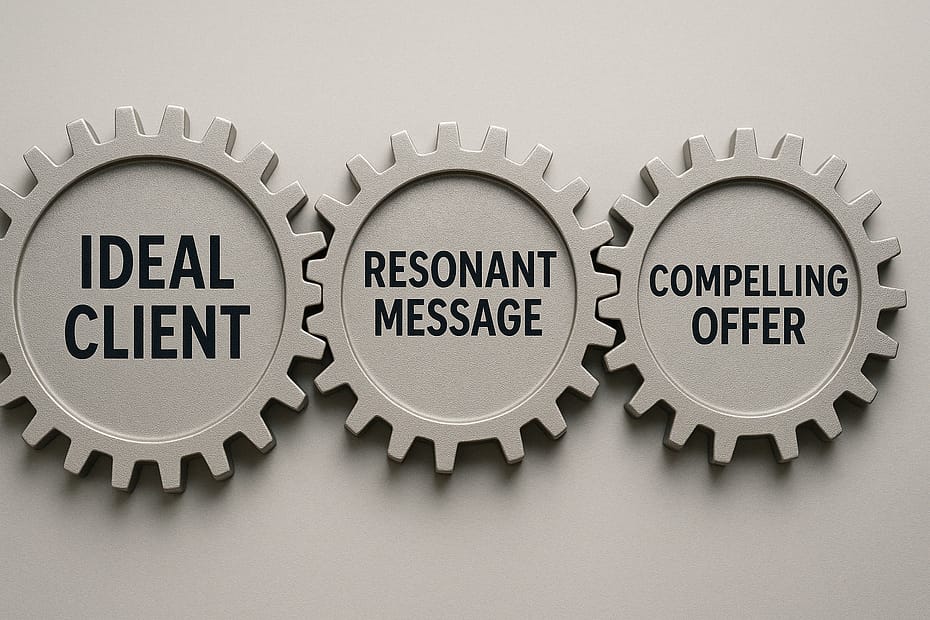
An effective sales strategy hinges on three core components: defining your ideal client profile (ICP), crafting a resonant message, and presenting a compelling offer. These elements are interconnected. Mastering their alignment will significantly enhance your sales effectiveness.

Ideal Client Profile

Let’s start with the ideal client profile. How well do you know the companies you’re targeting? Identifying your ideal customer is foundational to your entire sales approach. It’s not enough to say that your market is “small businesses” or “tech companies.” Instead, think about your best clients—the ones you genuinely enjoy working with, who value your product, and who generate profitable, sustainable business. Think about companies that rarely devalue your product or service by asking for a discount. What do these clients have in common?

Now that you have your favorite customers from above, reflect on your top five or ten accounts. Are they in the same industry? Do they share similar challenges or company structures? Perhaps they all have common goals that your product consistently solves. Pinpoint these commonalities. This process will help you create a precise and actionable ideal client profile.

But don’t stop at company-level characteristics. Remember, even in B2B sales, you’re ultimately selling to individuals. Identify the specific roles or buyers within these organizations that are responsible for making buying decisions. Who are these decision-makers? What motivates them personally and professionally? Do they all have the same kind of college education? Do they all have similar career paths? Understanding the people behind the logo makes your outreach more personal, targeted, and effective.

What is your message?

Once you’ve developed a clear picture of your ideal client and the people within those companies, the next step is crafting a message that reflects your value-selling message. This message is how you communicate your value proposition—it’s the bridge between your product and your prospect’s needs. Too often, sales messaging falls flat because it focuses heavily on the seller rather than the buyer. Statements that emphasize “we,” “I,” or “our product” rarely resonate deeply. Instead, effective messaging highlights the customer’s perspective, clearly communicating the benefits they will experience.

Read the rest of the article…

Stop Guessing. Start Assessing: The First Step Toward Sales Growth

Are you feeling stuck in your sales organization? You’re not alone. Many founders, CEOs, and sales leaders eventually hit an invisible wall—a growth plateau. Key deals slip away. Your top salesperson, who carries far too much weight, starts to burn out.

In these moments, the instinct is often to push harder. But what’s needed isn’t more hustle. It’s clarity. And clarity starts with a strategic sales assessment.

What a Sales Assessment Means

Too often, leaders see assessments as formalities—checklists that confirm what they already believe. That’s a mistake. An accurate sales assessment is diagnostic. It reveals what’s working, what’s broken, and what’s missing.

Revenue growth doesn’t always mean you’re on the right path. Many companies are growing despite misalignment, not because of strategic execution. Are your sales activities aligned with your market opportunity? Are you pursuing the right prospects with the right message? Or are you just getting lucky?

Read the rest of the article…

John Spencer Explains Scaling Sales Teams- Turning A-Player Performance into Company-Wide Success

In this episode of Two Tall Guys Talking Sales, hosts Kevin Lawson and Sean O’Shaughnessey sit down with John Spencer, a seasoned sales leader and founder of Clear Direction Sales Development. Together, they explore the crucial differences between growth and scale, particularly in organizations leaning too heavily on a superstar seller. If you’re leading a sales organization that relies on one standout performer—or trying to replicate success across your sales team—this is a must-listen conversation… John Spencer Explains Scaling Sales Teams- Turning A-Player Performance into Company-Wide Success

Level Up Your Sales Prospecting with Advanced Research Techniques

A shoutout to Chris Spanier and Episode #85 of the Practical, Actionable Marketing Podcast

Sales prospecting has always been a grind. What if you could cut your research time in half and dramatically improve your outreach results?

In Episode #85 of the Practical, Actionable Marketing podcast, host Chris Spanier delivers a masterclass on how to do just that. Titled “Advanced Prospecting Research Tools,” the episode is packed with time-saving techniques and tools that help sales professionals build sharper prospect profiles faster.

As someone with over four decades in sales and sales management, I believe this kind of tactical insight makes a difference. If you haven’t already, listen to the episode. Then, come back here for a quick breakdown of what Chris covered—plus a few of my thoughts.


Why Prospect Research Matters More Than Ever

In a market saturated with sales messages, relevance is your only competitive advantage. The days of blasting generic emails to massive lists are over. Today, the winners are the ones who personalize their outreach with precision—and that begins with better research.

Read the rest of the article…

Two Tall Guys Talking Sales – Sales Prospecting: Are You Chasing Leads or Cultivating Success? – E127

In this episode of Two Tall Guys Talking Sales, Kevin Lawson and Sean O’Shaughnessey dive into the art of sales prospecting using an unusual but powerful analogy—chasing butterflies versus building a garden. Are you tirelessly running after leads or cultivating an environment where ideal prospects naturally come to you? Learn how to create a long-term strategy for consistent revenue growth by positioning your business as the go-to solution for your ideal customers. Key Topics Discussed:… Two Tall Guys Talking Sales – Sales Prospecting: Are You Chasing Leads or Cultivating Success? – E127

Building Winning Sales Teams for the Future: Insights for CEOs and Sales Leaders

What are the key moves that CEOs and sales leaders must make to prepare their teams for success in 2025? That’s exactly what we explored in a recent episode of the Art and Science of Complex Sales podcast hosted by Paul Fuller of Membrain. I had the pleasure of joining Kevin Lawson, President of Lighthouse Sales Advisors, for a deep dive into the strategies defining high-performing sales organizations in the year ahead. You may recognize… Building Winning Sales Teams for the Future: Insights for CEOs and Sales Leaders