Skip to content

LinkedIn

What An MBA Didn’t Teach You About Sales

The sales profession is challenging. You need to work hard at it to succeed. You need to learn from the best. You need to improve your skills continuously. If you think you can sell since you are a hit at parties and have a lot of friends, you may soon find that you are a failure as a salesperson. Blunt truth:

because the sales profession is so hard, you have to focus on doing everything in sales very well, or you will be considered a failure.

I call this blog, Skinned Knees because I try to relate all of the learning that I have done over the past 4+ decades (while skinning my knees in the learning process).

I hope that you learn from my mistakes so that your business will grow!


Two Tall Guys Talking Sales Podcast – Are You Coachable? The Sales Skill That Quietly Drives Quota Attainment – Episode 179

Kevin Lawson and Sean O’Shaughnessey take on a question that exposes more than technique: Are you actually coachable? This episode of Two Tall Guys Talking Sales digs into the connection between coachability, trust, quota attainment, and long-term sales success. Along the way, they move beyond generic advice and into the real mechanics of growth in selling—how coaching sharpens business acumen, improves sales management, strengthens sales processes, and ultimately drives stronger revenue generation. If you care about becoming more effective in high-pressure sales moments, this episode is worth downloading.

Key Topics Discussed

Why coachability matters in sales and sales leadership (00:00)
Kevin opens by tying coachability to performance, preparation, and intentional execution. Sean expands the lens, arguing that coachability is not just a seller issue. Sales leaders need it too, especially when they are accountable to a CEO, president, CFO, or board and must adapt in real time to what the field is actually seeing.

The difference between getting coaching and applying coaching (03:13)
Sean makes a critical distinction: being coachable is not nodding politely at advice. It is trying the idea, evaluating the outcome, and returning with thoughtful feedback about what worked, what missed, and how to adapt the tactic to your own style, messaging, and customer context.

The basketball free-throw analogy for pressure-selling moments (04:29)
One of the strongest sections in the episode compares a live sales moment to stepping to the free-throw line with the game on the line. The coach cannot take the shot for you. In the same way, no manager can rescue you when the CEO unexpectedly joins the meeting and says, “Let’s make a deal right now.” That is where preparation, coaching, and value-selling discipline show up.

Coaching comes from more places than your manager (06:33)
Kevin broadens the definition of coach to include peers, internal champions, prospect-side advocates, customers, and even deals you lost. That is an important shift for anyone serious about sales strategies and revenue management. The lesson is simple: if you accept input from only one source, you limit your own development.

Why coachability increases quota attainment (08:24)
Kevin makes the case that coachability is not a soft trait. It has hard commercial consequences. Sellers who stay open to wise counsel, surround themselves with strong peers, and learn from feedback tend to improve execution and increase quota attainment. This is where personal growth meets real sales success.

Trust as the real product being sold (09:47)
Sean closes with the episode’s most durable idea: sellers do not merely sell products or services. They sell trust. Trust in themselves, in the offering, in the company behind it, and in the process that follows the sale. That framing has major implications for messaging, value selling, and every part of the sales process.

Key Quotes

Kevin Lawson (07:51)
“If you are not willing in an interview scenario to take coaching and feedback, you’re probably not going to make it as a seller.”

Kevin Lawson (08:24)
“Being coachable has the magic outcome of quota attainment increases.”

Sean O’Shaughnessey (03:34)
“You need to try the ideas. Now, the key to being coachable though, is to try it, think about what happened, and then respond back to your coach and say, ‘I tried to do that and it didn’t quite work. What did I miss?’”

Sean O’Shaughnessey (09:47)
“You sell trust.”

Sean O’Shaughnessey (10:22)
“If you always think that I am selling trust… that I am not a liar… that what I tell you, Mr. Prospect, is the truth… we’ll do validation events or whatever, but you’ve got to trust that the product’s going to work.”

A Significant Actionable Item from this Podcast

Audit one recent coaching moment and ask yourself a harder question than “Did I hear the advice?” Ask, “Did I actually apply it, reflect on the result, and return with a better question?” That is the real test of coachability. Pick one deal, one lost opportunity, or one upcoming customer conversation and intentionally apply a piece of coaching before your next call. Consistently done, this improves business acumen, tightens sales processes, and makes revenue generation more predictable.

Read the rest of the article…

Two Tall Guys Talking Sales Podcast – Sales Success Playbook: Ethical Gifting, Better Messaging, and Higher Win Rates with Sendoso’s Kris Rudeegraap – Episode 178

Kevin Lawson and Sean O’Shaughnessey sit down with Kris Rudeegraap, Co-CEO of Sendoso, to get brutally practical about one thing most reps underestimate: how to cut through noise without sounding gimmicky or “bribey.” This episode breaks down gifting as a repeatable, ethical sales strategy that supports sales management and revenue generation, whether you’re trying to break into target accounts, accelerate a stalled deal, or reinforce relationships with customers who already trust you.

Key Topics Discussed

  • Breaking through the gatekeeper and digital noise with modern sales strategies (00:05)
    Kevin frames the real question sellers are asking: what actually drives sales success when inboxes are flooded, and attention is scarce?

  • The “right vs. wrong” of gifting: tactic beats timing (02:13)
    Kris outlines the difference between thoughtful outreach and a clumsy “gift-for-meeting” move that damages credibility.

  • Building a gifting sequence inside your sales processes (ABM + long-cycle deals) (03:55)
    How to use gifting as a deliberate step in your outreach and pipeline motion, not a one-off stunt.

  • Value selling through gratitude: gifts as relationship reinforcement (04:45)
    Sean connects gifting to thanking customers for orders and references—small moves that strengthen champions and improve revenue management.

  • AI-driven gifting: recommendations, timing, messaging, and address intelligence (10:24)
    Kris explains how AI improves targeting and relevance, reducing research time and enhancing personalization and response rates.

  • Metrics that matter: win rates, meeting rates, and attribution (11:45)
    Sean pushes for numbers; Kris shares performance lifts and points listeners to deeper case studies.

Key Quotes

  • Kevin Lawson (00:05): “How am I actually going to make my number? What is actually going to get through the gatekeeper… and help me meet my number?”

  • Sean O’Shaughnessey (01:20): “How can we use tools like gifts appropriately so that we’re not bribing the customer… but we are making it like, ‘wow, these guys are pretty cool. I wanna talk to them.’”

  • Kris Rudeegraap (02:25): “I don’t think the problem is when to send. It’s like the tactic of how you’re sending is what could be wrong.”

  • Kris Rudeegraap (12:18): “We’ve seen [win rates] increased up to nine x by using gifting in the sales cycle… and… up to four x increase the likelihood of booking a meeting.”

Additional Resources

  • Sendoso website (case studies and data studies): Sendoso.com 

  • Kris Rudeegraap: kris@sendoso.com https://www.linkedin.com/in/rudeegraap/

  • Sendoso on LinkedIn https://www.linkedin.com/company/sendoso/

A Significant Actionable Item from this Podcast

Pick 10 target accounts and design a two-touch gifting step that fits your current sales processes. One touch is for prospecting (to earn attention), one touch is for late-stage momentum (to reduce friction). The requirement: pair each gift with a message that tightens messaging around either (a) your value proposition in the customer’s world or (b) a real personal detail you’ve validated. If you can’t explain why that specific item fits that specific recipient, don’t send it. This is business acumen applied to outreach, not arts-and-crafts.

Read the rest of the article…

Reclaiming 15 Hours a Week: The Sales Professional’s Guide to Surviving and Thriving in the Age of AI

Episode Summary

If you feel like your CRM is turning great sellers into tired administrators, you’re not imagining it. This episode breaks down the administrative drag that steals selling time, distorts forecasts, and quietly taxes revenue generation.

We introduce a practical artificial intelligence approach: automate the inputs, then humanize the output so your messaging stays authentic and effective.

The outcome is simple: higher-quality sales processes, stronger sales management decisions, and better Sales success without adding headcount.


Major Highlights

  • The real productivity crisis in B2B sales: administrative drag, CRM debt, and the “technology trap” of too many tools that create more manual work.
  • Why the old brute-force model is breaking: buyers self-educate earlier, competitors respond faster, and generic messaging gets ignored.
  • The core principle: Automate the Input, Humanize the Output. Use AI for research, data capture, and workflow execution while humans control judgment, voice, and value selling nuance.
  • How Benjamin Todd’s “human bottlenecks” framework applies to sales: as AI automates routine work, business acumen, strategic leadership, and complex social intelligence become more valuable.
  • Orchestration engines (n8n and Make.com) as the nervous system: connecting CRM, email, LinkedIn, and transcripts into cohesive sales strategies and repeatable sales processes.
  • Cognitive Prospecting: use AI listening posts to detect triggers (exec hires, funding, cost containment signals) and arrive with a “why now” dossier instead of starting from scratch.
  • One-to-One-at-Scale outreach: generate hyper-relevant drafts from a strategic brief and prospect dossiers, then apply a human “smell test” so messaging lands.
  • Immediate Recap workflows: transcripts flow into structured CRM updates, follow-up tasks, and recap email drafts, accelerating deal momentum and improving revenue management.
  • Always-On Hygiene: AI deduplication and fuzzy matching to reduce bad data, improve forecasting, and protect downstream automation quality.
  • Predictive intelligence and deal risk: revenue intelligence platforms flag risk signatures earlier than human inspection, improving pipeline accuracy and resource allocation.
  • Sales management evolution: managers move from pipeline inspectors to augmented coaches using call analysis to focus coaching where it changes outcomes.
  • The practical end state: more selling time, faster follow-up, improved win rates, and a human-AI centaur model where humans own the last mile.
Read the rest of the article…

From CRM Debt to a Cognitive Revenue Engine: Reclaiming Selling Time with AI

Most B2B sales teams don’t have a talent problem. They have a capacity problem.

Administrative drag is quietly stripping selling time: CRM updates, stakeholder mapping, duplicate cleanup, meeting summaries, and the constant “what should I say next?” work that should not be consuming a senior seller’s day. The downstream damage is bigger than annoyance. Forecast accuracy declines, coaching becomes reactive, and revenue management turns into a negotiation with incomplete data.

Artificial intelligence can fix this, but only if you use it with the right operating model.

Benjamin Todd’s article “How not to lose your job to AI” makes the point that AI doesn’t simply eliminate jobs; it shifts where value concentrates. As routine tasks become cheap, the remaining human bottlenecks become more valuable. Todd’s ATM example is the cleanest version of the idea: ATMs reduced the need for “money counting,” but the overall demand for human banking roles didn’t collapse. The job shifted toward customer-facing work and higher-leverage conversations.

In B2B sales, our “money counting” is CRM entry, list building, and manual research. Our high-leverage work is business acumen, strategic influence, stakeholder alignment, and value selling. The problem is that most teams have it backwards: humans do the hardest input work (research, logging, hygiene), then AI writes the customer-facing messages. That combination produces drained sellers and generic messaging.

A better model is: Automate the input, humanize the output.

Read the rest of the article…

Two Tall Guys Talking Sales Podcast – Sales Call Horror Stories with Steve Landrum That Teach Real Sales Management – Episode 177

This episode of Two Tall Guys Talking Sales is a rapid-fire masterclass in what actually happens in the field—when sales calls go sideways, when leaders show up unannounced, and when a “small” mistake exposes a bigger gap in sales management. Kevin Lawson and Sean O’Shaughnessey are joined by fractional VP of Sales Steve Landrum to swap real stories with real lessons: territory planning that’s more than a map, sales processes that don’t rely on charm, and value selling that holds up under negotiation pressure. If you care about sales success, business acumen, and revenue generation, this one lands.

Key Topics Discussed

  • 00:42 — The “relationship trap”: knowing everything about the buyer… and leaving with no order (sales strategies vs. socializing)

  • 03:15 — When you bring the boss and forget the basics: doing your homework and reading the room (territory planning and sales management discipline)

  • 05:53 — Negotiation leverage in the real world: walking away, holding the line, and protecting revenue management

  • 09:13 — “Two ears, one mouth”: listening as a core sales process, not a personality trait

  • 10:52 — Building a “secondary sales team”: referrals, advocates, and credibility that sells before you speak (messaging and value selling)

Key Quotes

  • Kevin (02:06): “You’re building relationships, yes, but you’re in sales. You’re not in order taking.”

  • Sean (07:23): “I want you to take this $20… because that’s as much money as I’m going to lose to you today.”

  • Steve (09:13): “You got two ears and one mouth. Use it accordingly… Use it to that ratio.”

  • Steve (11:11): “A customer… will believe what somebody else says about you before they hear it from you.”

Additional Resources

A Significant Actionable Item from this Podcast

In your next customer conversation, design a 10-minute opening that forces you to earn the right to talk: ask two buyer-centered questions, then stay silent long enough for a real answer. Immediately follow with one “proof prompt” that activates your secondary sales team: “Who else have you seen solve this well—and would you be open to an introduction?” This single move upgrades your sales processes, strengthens your messaging, and improves revenue generation because credibility enters the room before your pitch does.

Read the rest of the article…

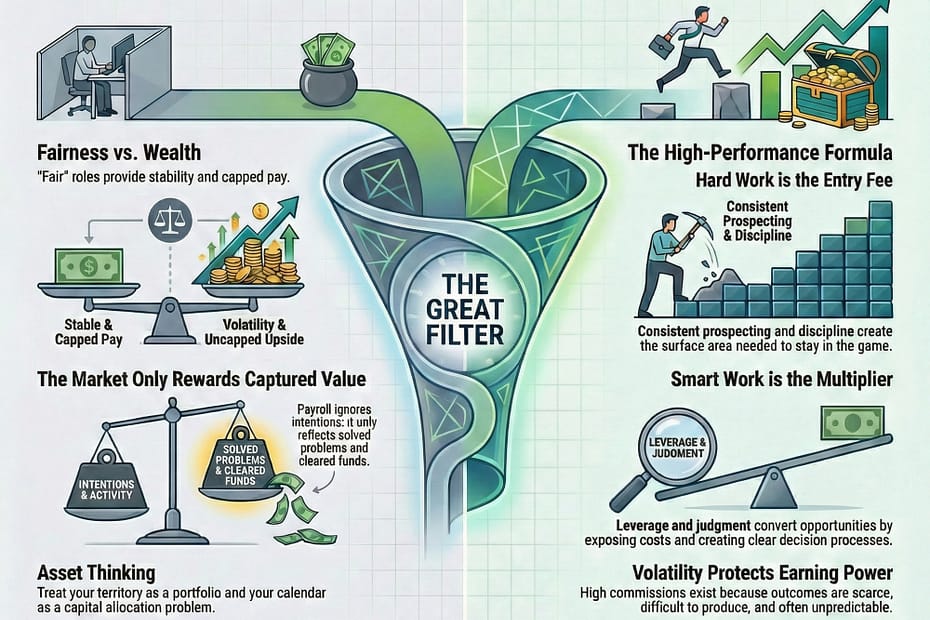
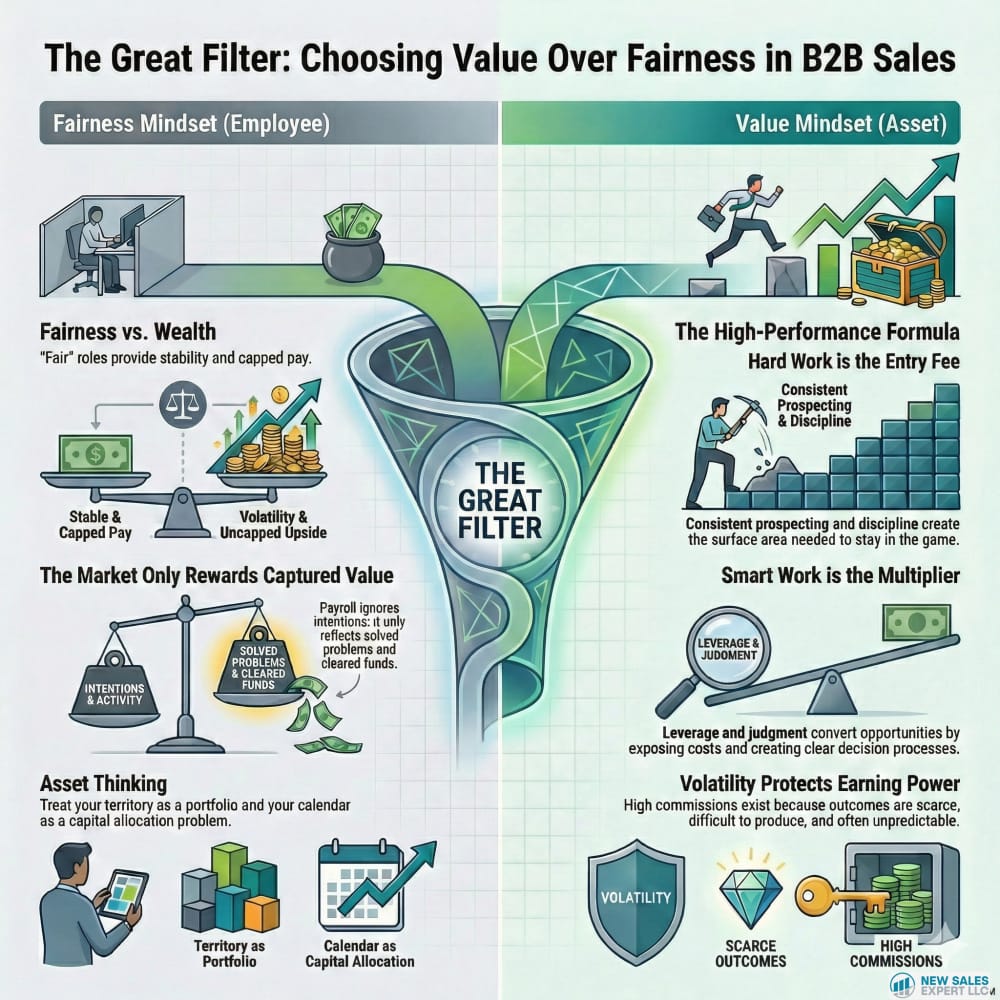
The Great Filter – Why Most People Should Quit B2B Sales Today

If you want fairness, choose a role where performance is measured by compliance and consistency. If you want wealth, stay in sales and accept the only rule that matters: compensation follows captured value.

Walk into any growth-stage B2B sales organization, and you see two populations immediately:

  • One group is stuck in grievance. They stare at the CRM, explain shortfalls with lead quality, territory math, product gaps, or “unrealistic quota.” They want a manager to prescribe the playbook and then validate the effort. Their mindset is hourly, even when they’re paid a salary plus commission.
  • The other group is operating a different model. They talk about leverage, pipeline physics, conversion rates, deal control, and enterprise value. They create their own opportunities. They build customer confidence and earn the right to ask for a decision. They are not looking for comfort. They are looking for the wire.

If you identify with the first group, here’s the most respectful advice I can give you: exit sales on purpose. Move into HR, operations, finance, project management, enablement, customer success, analytics, or any role where the exchange is stable and the scorecard is predictable. Those functions matter. They are important and critical to most companies. They keep companies alive. They are also structurally designed to be fairer.

Sales is designed to be variable, value-based, and exposed. That’s the point.

The safety-net trap

Most people walk into sales carrying the wrong conditioning. School teaches that effort should correlate with reward. Show up, do the work, get the grade. Many corporate functions reinforce it. Do the tasks, hit the process metrics, stay inside the lines, and get the raise.

That conditioning becomes a trap the moment you step into a quota role.

In “fair” roles, compensation tracks your cost and your consistency. Your output is capped by your time, so your income is capped by a band. It’s stable, and it’s a ceiling.

Sales is different because it’s one of the few places left where pay can scale with impact. You are not paid for effort. You are paid for outcomes. That makes it feel brutal to people who want certainty, and it feels like freedom to people who want upside.

The moment you need the world to be fair, sales will punish you. The moment you accept the model, sales becomes one of the most rational games in business.

B2B Sales is rewarding because it isn’t easy or fair
Read the rest of the article…

Two Tall Guys Talking Sales Podcast – What Kind of Sales Coach Are You? The Leadership Styles That Drive Consistent Revenue – Episode 176

If you’ve ever tried to “coach the team” by telling everyone to sell like the top rep, this episode is your reality check. Sean O’Shaughnessey and Kevin Lawson use March Madness, dynasties, and training-room discipline to unpack a serious sales management issue: what kind of coach are you, and are your sales processes actually buildable, or just a personality contest? The conversation lands in a practical place: consistent revenue generation comes from systems, controls, and repeatable sales strategies, not heroics. It also flips the lens to the seller: if you can’t explain why you’re successful, you can’t improve, and you definitely can’t teach.

Key Topics Discussed

  • 01:50 — “What kind of coach are you?” Recruiting stars vs developing talent, and what that means for sales success

  • 03:10 — The “learning manager” model: systems, controls, and building consistency instead of one-and-done wins

  • 04:40 — Sean’s coaching philosophy: taking B-players with A-player upside and building a winning system around them

  • 07:00 — Why peer groups accelerate growth: where to workshop messaging, revenue management, and sales processes without doing it in public

  • 10:05 — The seller’s responsibility: understand your own value selling motion so you can replicate it (or fix it)

Key Quotes

  • Kevin (04:25): “Prospecting needs to be consistent. It can’t be something you do and sprint and then stop, and then sprint, and then stop.”

  • Sean (06:20): “I don’t necessarily try to get the C to a B, I’m more of a B to an A kind of a coach.”

  • Sean (11:40): “When you say, ‘this is how I would respond,’ and somebody says, ‘why?’… you should have an answer to that question.”

Additional Resources

  • B2B Sales Lab: b2b-sales-lab.com

A Significant Actionable Item from this Podcast

Write down your personal “sales success recipe” as a simple, teachable sequence: the 5–7 moves you make that reliably create forward motion (your messaging choices, your cadence, how you qualify, how you handle pushback, how you ask for next steps). For each move, add one sentence answering “why this works.” If you can’t explain the why, you’re not managing a sales process—you’re relying on instinct. That limits your business acumen as a seller today and blocks sales management effectiveness if you’re ever asked to lead tomorrow.

Read the rest of the article…

Two Tall Guys Talking Sales Podcast – From Rookie to Revenue Leader: Mentorship, Business Acumen, and Better Sales Processes – Episode 175

In this episode of Two Tall Guys Talking Sales, Kevin Lawson and Sean O’Shaughnessey sit down with Keith LaHonta to unpack a truth many teams overlook: sales success is rarely a solo act. It is built through mentor-mentee relationships that sharpen judgment, accelerate business acumen, and improve real-world execution. This conversation goes beyond career nostalgia and gets practical about how mentorship strengthens sales management, improves sales processes, and directly impacts revenue generation. If you care about long-term sales success, not just short-term wins, this episode is worth downloading.

Key Topics Discussed

  • Why mentorship is a sales force multiplier, not a “nice to have” (00:00)
    The episode opens with a direct challenge to the lone-wolf myth in selling. Kevin frames mentorship as a legacy engine that compounds value over time for both mentors and mentees.

  • Early-career mentorship lessons that still drive performance today (01:00)
    Keith shares how his Xerox mentor modeled discipline, consistency, and accountability in the field, showing how foundational coaching habits still shape modern sales strategies.

  • The “spare tire” story: operational preparedness as a credibility advantage (03:15)
    A simple field habit: keeping order forms ready becomes a bigger lesson in sales processes: prepare before the call, so opportunity never outruns execution.

  • Matching the right mentor to the right sales role (04:45)
    Keith draws a sharp distinction between “hunters” and “farmers,” explaining why mentorship must align with role design and expected outcomes in revenue management.

  • How to identify high-upside mentees and build better development conversations (10:20)
    Keith explains how he assesses coachability, background, and team orientation in the first 10–15 minutes, critical insight for leaders hiring and developing talent.

  • Where to find mentorship when your company doesn’t provide it (12:50)
    Sean highlights community-driven mentoring through the B2B Sales Lab, positioning peer mentorship as a practical path to stronger messaging, greater value-selling confidence, and better decision-making.

Key Quotes

  • Kevin Lawson (00:00):
    “It is our network of mentors and mentees that are really going to build and establish us as a legacy business.”

  • Keith LaHonta (01:30):
    “He would do anything I would do… He’d sit with me while I made cold calls… Just the basics to where I would do anything for him.”

  • Keith LaHonta (08:05):
    “Knowledge is king.”

  • Keith LaHonta (09:05):
    “Whether it’ll lead to a deal or not, I’m not sure, but he gained credibility.”

  • Sean O’Shaughnessey (06:55):
    “If you are young in your career, [it’s time] to actually reach out and try to find people that are going to guide you through this career.”

Additional Resources

  • Keith LaHonta on LinkedIn https://www.linkedin.com/in/keith-lahonta-11b621/

  • B2B Sales Lab – peer-based mentorship community for sales professionals and leaders. Join us at b2b-sales-lab.com


A Significant Actionable Item from this Podcast

Build and use an “8-Question Credibility Scorecard” for your next prospect meeting.
Don’t stop at the three obvious discovery questions. Draft eight questions tied to your buyer’s business model, operational risks, buying criteria, and success metrics. Then answer as many as possible before the meeting. Why this matters: deeper preparation improves messaging quality, signals business acumen, and supports value selling in live conversations. It also upgrades sales management conversations because reps can be coached against a consistent preparation standard, not a vague effort.

Read the rest of the article…

Two Tall Guys Talking Sales Podcast – Stop Selling in Silence: Personal Messaging That Fuels Revenue Growth – Episode 174

In this episode, Sean and Kevin get brutally practical about a problem most sellers underestimate: you don’t just market your company and your product—you have to market you. If prospects can’t trust you, they won’t trust your solution, your messaging, or your ability to deliver outcomes. The conversation turns “personal brand” into real sales processes you can run weekly to improve revenue generation, pipeline quality, and long-term sales success.

Key Topics Discussed

  • Marketing “the salesperson” as the trust layer (00:59–02:05)

  • “Marketer, market thyself” when you don’t have a marketing team (02:50–05:18)

  • Turn sales calls into content: capture lessons, create proof points, reuse everywhere (03:46–05:00)

  • Stop living in the calendar: carve out thinking time to improve how you sell (08:05–08:42)

  • Network sideways to create referrals: market to the people your buyers already trust (09:01–11:39)

  • Use social presence + networking together so referrals convert faster (12:47–13:33)

Key Quotes

  • Kevin (02:58): “When you’re a salesperson who doesn’t have a marketing team behind you… you must market yourself.”

  • Sean (01:17): “The number one thing you have to do is get them to trust you.”

  • Kevin (06:59): “If you’re telling your story… you’re a much more valuable strategic partner.”

  • Sean (10:23): “You should market to them… those people… may just hear [a problem]… ‘Let me introduce you to Mike.’”

Additional Resources

  • Chris Spanier and Carpe Diem Marketing – https://www.linkedin.com/in/cspanier/ – https://www.carpediemconsultinggroup.com/
  • Practical Actionable Marketing – https://podcasts.apple.com/us/podcast/practical-actionable-marketing/id1697011310

  • The Challenger Sale – https://a.co/d/9ntWVuH

  • Amy Connor and CMO on Loan – https://www.linkedin.com/in/amyconnor/ – https://cmo-onloan.com/

A Significant Actionable Item from this Podcast

Block 45 minutes next week—no excuses—and build a simple “trust engine” from your last five sales conversations. Write down the problem, what you recommended, the proof point, and the result (even if it’s partial). Turn that into one short post and one longer proof asset (a case study outline, a send-ahead, or a leave-behind). Then take the same story to your partner network—ERP reps, logistics providers, engineers, and adjacent vendors—and make your value-selling narrative easy for them to repeat. This is revenue management at the seller level: consistent story, consistent credibility, consistent pull-through.

Read the rest of the article…

Two Tall Guys Talking Sales Podcast – Your Sales Team’s LinkedIn Profiles Are Costing You Deals: Fix the Trust Signals – Episode 173

Sales leaders don’t lose deals on product. They lose them on trust signals—especially the ones buyers pick up before the second conversation even happens. In this episode of Two Tall Guys Talking Sales, Kevin Lawson and Sean O’Shaughnessey break down how your team’s digital presence either reinforces credibility or quietly undermines it. The throughline is simple: your sellers’ profiles and posts are part of sales management, part Messaging, and part Revenue management, because they shape…