
Skip to content

n8n

What An MBA Didn’t Teach You About Sales

The sales profession is challenging. You need to work hard at it to succeed. You need to learn from the best. You need to improve your skills continuously. If you think you can sell since you are a hit at parties and have a lot of friends, you may soon find that you are a failure as a salesperson. Blunt truth:

because the sales profession is so hard, you have to focus on doing everything in sales very well, or you will be considered a failure.

I call this blog, Skinned Knees because I try to relate all of the learning that I have done over the past 4+ decades (while skinning my knees in the learning process).

I hope that you learn from my mistakes so that your business will grow!


Reclaim Selling Time: How AI Eliminates the Sales Tax and Restores Pipeline Momentum

Most sales leaders are trying to solve a 2026 productivity problem with 2010 management logic. They hire more people, increase activity targets, and apply pressure to the same system. The system doesn’t respond because the constraint isn’t an effort. It’s architecture.

The operational reality is brutal: administrative work is consuming the day and choking selling time. Reps are stuck doing low-level research, logging notes, and stitching together follow-ups across disconnected tools. That “sales tax” creates a momentum gap between good conversations and slow execution. The outcome is predictable: fewer high-quality touches, slower deal movement, less accurate forecasting, and a pipeline that looks busy yet remains fragile.

The fix is not another round of tactical efficiency. It’s a structural reversal: move from a human-led, tech-assisted model to a tech-led, human-centric model. In that design, AI does the machine work—data extraction, workflow orchestration, logging, drafting, hygiene—and the human seller does the work that actually wins deals: judgment, stakeholder navigation, risk reduction, and credibility in the moments that matter.

Think of it as building a Cognitive Revenue Engine. Your reps stop being the engine. They become the orchestrators of an automated engine that produces consistent execution at scale.

This shift has two pillars.

Tactical Efficiency is your time reclaimer. Automate the tollbooth moments: post-call notes, CRM updates, basic research, and first-draft follow-ups. This is not about saving a few minutes. It’s about reclaiming hundreds of hours per rep per year and converting them into customer-facing time.

Strategic Intelligence is where the advantage compounds. AI should be used as a decision partner, not a faster typewriter. The questions change from “Can you write this email?” to “Given this account’s context and our past wins, what risk is most likely to stall this deal, and what’s the next best action?” That is the difference between activity and impact, and it’s the difference between noise and revenue generation.

Read the rest of the article…

From CRM Debt to a Cognitive Revenue Engine: Reclaiming Selling Time with AI

Most B2B sales teams don’t have a talent problem. They have a capacity problem.

Administrative drag is quietly stripping selling time: CRM updates, stakeholder mapping, duplicate cleanup, meeting summaries, and the constant “what should I say next?” work that should not be consuming a senior seller’s day. The downstream damage is bigger than annoyance. Forecast accuracy declines, coaching becomes reactive, and revenue management turns into a negotiation with incomplete data.

Artificial intelligence can fix this, but only if you use it with the right operating model.

Benjamin Todd’s articleHow not to lose your job to AI” makes the point that AI doesn’t simply eliminate jobs; it shifts where value concentrates. As routine tasks become cheap, the remaining human bottlenecks become more valuable. Todd’s ATM example is the cleanest version of the idea: ATMs reduced the need for “money counting,” but the overall demand for human banking roles didn’t collapse. The job shifted toward customer-facing work and higher-leverage conversations.

In B2B sales, our “money counting” is CRM entry, list building, and manual research. Our high-leverage work is business acumen, strategic influence, stakeholder alignment, and value selling. The problem is that most teams have it backwards: humans do the hardest input work (research, logging, hygiene), then AI writes the customer-facing messages. That combination produces drained sellers and generic messaging.

A better model is: Automate the input, humanize the output.

Read the rest of the article…

From Manual to Automated: A Sales Pro’s Guide to Zapier, Make.com, n8n, and Pipedream

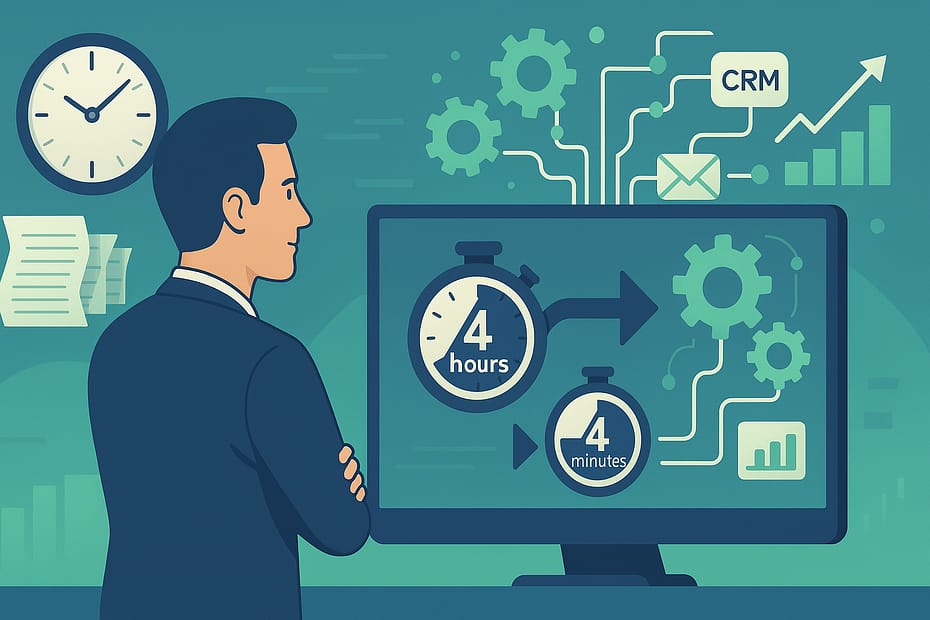
A sales manager recently told me something that stuck: “We went from twenty hours per week of manual work to two hours. Our lead response time dropped from four hours to four minutes.” That dramatic transformation wasn’t magic—it was automation. The reality is that sales teams today have more automation tools available than ever before. But with options like Zapier, Make.com, n8n, and Pipedream, the real challenge isn’t whether you should automate—it’s choosing the right… From Manual to Automated: A Sales Pro’s Guide to Zapier, Make.com, n8n, and Pipedream

APIs Explained for Sales Leaders: Drive Growth Without Extra Headcount

A sales manager recently told me, “I have to copy the same prospect data into five different tools. There has to be a better way.” That frustration is more common than most sales leaders realize, and fortunately, there is a better way. The reality is that sales teams are hemorrhaging productivity due to disconnected systems. Top performers spend hours manually entering data, bouncing between platforms, and correcting inevitable errors. This administrative overhead steals time from… APIs Explained for Sales Leaders: Drive Growth Without Extra Headcount