Skip to content

product

What An MBA Didn’t Teach You About Sales

The sales profession is challenging. You need to work hard at it to succeed. You need to learn from the best. You need to improve your skills continuously. If you think you can sell since you are a hit at parties and have a lot of friends, you may soon find that you are a failure as a salesperson. Blunt truth:

because the sales profession is so hard, you have to focus on doing everything in sales very well, or you will be considered a failure.

I call this blog, Skinned Knees because I try to relate all of the learning that I have done over the past 4+ decades (while skinning my knees in the learning process).

I hope that you learn from my mistakes so that your business will grow!


Energize and Motivate: Essential Tips for an Effective Sales Kickoff Meeting

Before the year comes to a close, it’s time for sales teams and their leaders to prepare for the annual kickoff meeting. Don’t wait until December to start this process. If you have 50 or more people to invite, you may have to plan 6-9 months in advance. If your group is smaller (under 50), you should start planning by late September or early October.

This crucial event sets the stage for the upcoming year, establishing goals, strategies, and the motivation necessary to hit the ground running. Whether you are a salesperson, a sales manager, or the CEO of a small company, organizing an effective kickoff meeting is imperative to ensure a successful year ahead.

The first step in planning your annual sales meeting is to choose an appropriate venue. While it may be tempting to hold the meeting in your usual office space, it’s beneficial to opt for a location outside of your daily work environment. This helps to minimize distractions and fosters a creative atmosphere. 

A nearby hotel or a conference center can serve as an excellent venue. The key is to find a place where your team can focus entirely on the meeting without the usual interruptions from their day-to-day responsibilities.

Once the venue is secured, it’s time to think about who should be in attendance. While the primary focus will be on your sales team, consider including key personnel from other departments such as marketing, IT, and customer service. These individuals play a crucial role in supporting the sales process and can provide valuable insights and updates that will help your sales team achieve success. Additionally, involving them in the kickoff meeting promotes a sense of unity and collaboration across the company.

Read the rest of the article…

Two Tall Guys Talking Sales – How Sales and Marketing Partnerships Drive Lead Generation and Sales Success – Episode 155

As the year draws to a close, sales leaders and professionals are already looking ahead to the next year. In this episode of Two Tall Guys Talking Sales, hosts Sean O’Shaughnessey and Kevin Lawson dig into the perennial challenge of lead generation, the importance of collaborating with marketing, and why proactive planning is essential for sales success. From refining your messaging to building thought leadership, this conversation is packed with strategies to help you drive revenue generation and sharpen your sales processes.

Key Topics Discussed

  • Why Salespeople Always Say “I Need More Leads” (01:00)
  • The Importance of Partnering with Marketing for Effective Sales Strategies (03:40)
  • Going Beyond Marketing—Referrals, Networking, and Thought Leadership (05:07)
  • Leveraging LinkedIn and Personal Branding to Generate Leads (06:25)
  • The Three Things Every Salesperson Really Sells (09:00)
  • Planning with Intention: Mapping the Next 12 Months for Sales Success (12:57)

Key Quotes

  • Sean O’Shaughnessey (01:48): “You as a salesperson… it’s your job to sit with the marketing people you have and map out the next 12 months of how to get better leads and cover your territory more effectively.”
  • Kevin Lawson (03:40): “Go down the hallway, knock on the door and say, here’s what I’m working on, what are you working on, and how can I help? Be a resource, be a partner to marketing.”
  • Sean O’Shaughnessey (09:24): “There are three things you sell: your product, your company, and—most importantly—you.”
  • Kevin Lawson (13:16): “If you’re only giving 50% effort to your professional practice, you can’t expect championship-level results.”

Additional Resources

  • B2B Sales Lab Community – A peer group for sales professionals to exchange best practices and strengthen their sales management and revenue generation capabilities. Go to https://b2b-sales-lab.com/

A Significant Actionable Item from this Podcast

Schedule a working session with your marketing team this week. Map out the next 12 months of sales and marketing activities, focusing on how you’ll generate leads, build messaging, and increase visibility in your target accounts. Even if it starts with a simple spreadsheet, writing down the plan creates accountability and aligns sales strategies with marketing efforts.

Read the rest of the article…

Sales Management with AI: Chat Interfaces vs. Automation Workflows

Sales organizations today face a critical decision: should they rely on interactive chat interfaces like ChatGPT, Claude, or Gemini, or should they focus on automation workflows? The answer isn’t either/or. Each approach has unique strengths, and choosing the right one directly impacts sales processes, productivity, and revenue generation.

The problem many sales teams encounter is “random implementation.” They hear about a new AI tool, adopt it quickly, and use it for the wrong purpose. The result? Chat interfaces get bogged down with repetitive work, and automation gets tasked with jobs that require creativity and nuance. Misuse not only reduces efficiency but also frustrates teams and erodes trust in artificial intelligence altogether.

So how do you know when chat is the right fit? The decision comes down to task complexity and uniqueness. Chat excels in situations that require creativity, flexibility, and human judgment. Four categories consistently stand out:

  • Creative and strategic tasks: proposals, executive messaging, strategic planning, and competitive positioning.
  • Complex problem-solving: sales opportunity strategy sessions, unique customer needs, and crisis management.
  • Learning and development: role-playing objection handling, skill coaching, and competitive intelligence training.
  • Research and analysis: prospect research, market analysis, and strategic planning.
Read the rest of the article…

Transform Your Sales Team: Strategic Compensation Adjustments for Year-End Momentum

Autumn is the time of year for sales leaders, managers, and CEOs to begin laying the groundwork for next year’s success. Have you considered how your current sales compensation plans impact your team’s motivation and productivity? Now is the ideal moment to evaluate, adjust, and deliver these plans, preferably by December 1st. Doing so can significantly influence your team’s drive to close deals in December and build momentum heading into the next fiscal year.

Sales compensation should be motivating and rewarding for employees. It directly shapes your sales team’s behaviors and priorities. An effective plan incentivizes the right actions and deters the wrong ones.

Consider a common pitfall: salespeople holding back deals to inflate their numbers for the following year. Does your current compensation structure inadvertently reward this practice? If so, you’re unintentionally harming your year-end results.

To counter this, strategically incorporate compensation escalators and cliffs into your plan. Escalators progressively reward increased sales performance throughout the year. Higher performance equals higher commission rates, driving your sales team to push forward continually. 

Commission cliffs reset commission rates at the beginning of each year, creating a sense of urgency to close deals before the end of December. Communicating these compensation details clearly by early December ensures your team understands what’s at stake.

Don’t hold your team back!

Another critical compensation consideration is eliminating commission caps. While some organizations cap commissions to control expenses, this practice can backfire dramatically. Caps tell your top-performing salespeople that their exceptional efforts are neither valued nor rewarded appropriately. This demotivates your top talent and encourages them to seek opportunities elsewhere that offer uncapped rewards. 

Removing commission caps signals that the organization fully supports and rewards outstanding performance. Have you considered how much growth your company might achieve if artificial constraints didn’t limit your sales team?

When evaluating compensation, look beyond simple cost containment. Consider the true profitability of incentivizing increased sales volume. Once salespeople reach their targets and enter accelerators, each additional dollar earned typically comes at a lower incremental cost to your organization. 

Sales transactions earlier in the year have already covered the salesperson’s base salary once they have met their annual quota. In fact, at 100% of quota, the salesperson should have covered all their costs and their share of the overall company’s revenue needs. Thus, every extra sale at escalated commission rates still contributes positively to your overall profitability. 

Read the rest of the article…

Hiring for Growth: How to Build a Sales Team That Drives Long-Term Success

Building a successful sales team requires more than just filling open seats with available candidates. Company leadership must strategically align its hiring process with business objectives, market needs, and long-term goals. 

Whether you’re a solopreneur transitioning to a team-based approach or a CEO managing a growing sales force, the principles of intentional recruitment and onboarding remain the same. Hiring the right people is an investment in the future of your business.

One of the most common pitfalls in sales hiring is a lack of intentionality. Too often, small businesses hire out of convenience, choosing candidates from their immediate network or taking the first person who seems interested. While this approach may solve an immediate need, it rarely leads to long-term success. 

Hiring a salesperson means selecting someone who can actively drive growth and represent your brand with competence and integrity. The stakes are even higher when you’re working with a lean team; every hire matters, and mediocrity is not an option.

To avoid these missteps, it’s essential to approach hiring with the same rigor you apply to your sales process. Think of recruiting as a parallel to securing a high-value client. Just as you wouldn’t sell your product without qualifying leads or understanding their needs, you shouldn’t hire without a structured process to evaluate candidates. 

Begin by defining what success looks like for the role. What skills and attributes are non-negotiable? What specific outcomes do you expect this person to achieve within their first 90 days? A clear job description and measurable KPIs set the foundation for finding the right fit.

Cultural alignment is another critical factor. Your salespeople are the face of your business to prospects and customers. Their ability to embody your company’s values and mission can make or break the customer experience. A candidate might have a stellar track record, but if their approach clashes with your team’s culture, the partnership is unlikely to succeed. At the same time, skills and experience must align with the specific demands of the role. For instance, if your goal is aggressive market penetration, you need a hunter mentality, someone skilled in building relationships from scratch and closing deals in uncharted territory.

Read the rest of the article…

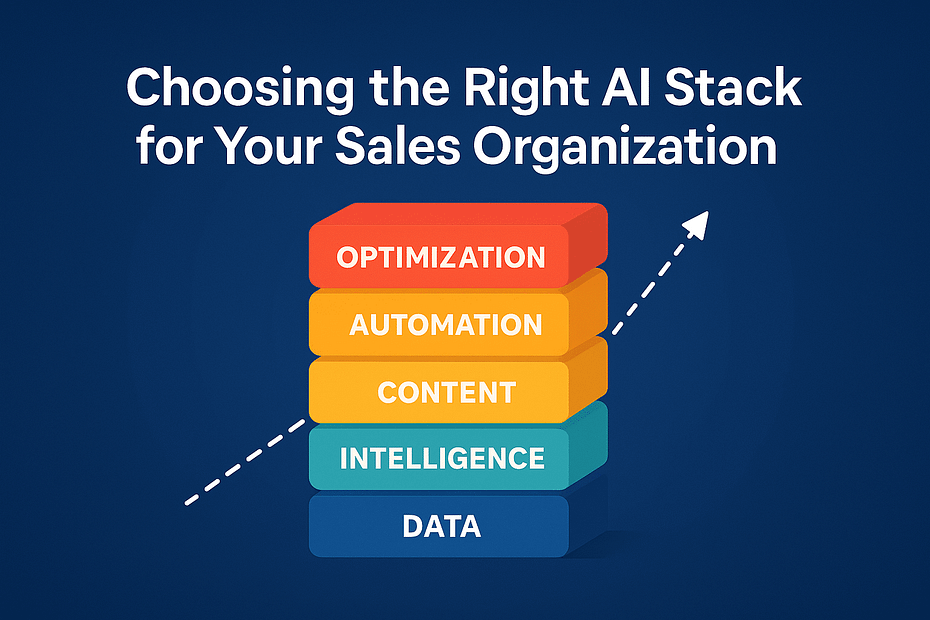
Choosing the Right AI Stack for Your Sales Organization

A VP of Sales recently confided in me: “We have six different AI tools, but our reps are still doing manual work. What went wrong?”

This is the AI tool proliferation problem. Sales leaders often collect tools without a strategy, mistaking a pile of features for a cohesive system. It’s like buying a hammer, screwdriver, saw, and drill without realizing you’re actually trying to build a house. An effective AI stack means integration. When tools work together, they amplify each other’s value. When they don’t, they add complexity, confusion, and wasted money.

Why Strategy Beats Random Adoption

Random tool adoption is rampant across sales organizations. Teams chase shiny new software, often ending up with overlapping features, siloed data, and productivity lost to tool-switching. Instead of solving problems, the stack itself becomes the problem.

But when built strategically, the benefits are profound. Integrated systems reduce manual data entry, accelerate response times, and deliver actionable insights for reps. Three well-chosen, well-connected tools can outperform six isolated ones. Integrated stacks also improve adoption rates by providing consistent interfaces and reducing training overhead.

The Five-Layer AI Stack Framework

To avoid the chaos of random adoption, I use a five-layer framework for structuring sales AI tools:

  1. Data Foundation – Your CRM and data management system, enriched and maintained for accuracy.
  2. Intelligence & Analytics – AI-driven insights, lead scoring, forecasting, and market intelligence.
  3. Automation & Workflow – Sequences, task automation, and cross-platform orchestration.
  4. Content & Communication – AI writing, proposal generation, and customer-facing tools.
  5. Optimization & Learning – Conversation analysis, performance tracking, and continuous improvement.
Read the rest of the article…

Mastering Sales Channels: How to Align Your Strategy for Maximum Impact

Understanding the dynamics of sales channels can transform how businesses approach their markets. Many sales professionals, whether they are salespeople, managers, or CEOs, often miss a critical distinction: the difference between the product they are selling and the value it provides. 

This gap in understanding can lead to suboptimal sales performance, particularly in environments where products are sold through intermediaries, such as distributors, referral partners, or dealer networks. The challenge is not just about knowing your product, but also about understanding how to position it in a way that resonates with every player in the sales chain.

Sales success starts with recognizing who your true customer is. In sales management or channel sales, the end customer is often not the person you interact with directly. Instead, your “customer” might be the intermediary, your distributor, reseller, or even your own sales team. These intermediaries are the ones who ultimately connect your product to its final user. If you don’t understand their challenges, motivations, and context, you risk failing to equip them with the necessary tools to succeed. Are you selling a product’s features, or are you helping them understand how to sell it effectively? This distinction is vital.

When selling through intermediaries, the emphasis should shift from “what the product does” to “how the product can be sold.” Your distributors or referral partners don’t need every technical detail of your product. They need clarity on how it solves problems for their customers, how it fits into their existing offerings, and how they can position it to drive sales. 

The goal is not to overwhelm your partners with information but to provide actionable insights that align with their specific needs. If you’re focusing solely on product features, you’re likely missing the mark.

Salespeople and sales managers must also recognize the game they are playing. Are you selling a commodity, a widely available product, or an exclusive offering? Each scenario demands a different strategy. 

Commodities often compete on price, necessitating bulk sales or value-added services to differentiate themselves. Widely available products often rely on relationships, service quality, or unique add-ons to differentiate themselves. Exclusive products, on the other hand, can often avoid price wars by emphasizing their uniqueness and superior quality. Knowing which game you’re in allows you to tailor your approach and avoid misaligned strategies.

For small businesses and solopreneurs, the challenge lies in effectively managing referral partners. Referral partnerships are a powerful way to generate leads, but they require careful management and oversight. 

Read the rest of the article…

Two Tall Guys Talking Sales – From Comp Plans to Territory Alignment: Sales Strategies Every Leader Needs for Revenue Generation – Episode 153

As the year draws to a close, sales leaders and business owners face a critical challenge: preparing for growth in the year ahead. In this episode of Two Tall Guys Talking Sales, hosts Kevin Lawson and Sean O’Shaughnessey dive deep into sales management strategies that set the stage for long-term sales success. From refining compensation plans and aligning territories to planning product lifecycles and avoiding the dreaded “hockey stick” growth trap, this conversation is packed with insights on business acumen, value selling, and revenue generation strategies that every sales leader should master.

Key Topics Discussed

  • 01:00 – Planning Beyond This Year: Why sales leaders need to start preparing now for next year’s revenue generation and sales processes.
  • 02:11 – Building Smarter Compensation Plans: Evaluating and refining comp structures to drive sales success and attract top talent.
  • 03:13 – Product Lifecycle & AI Readiness: How shifts in markets and technology demand updates to your offerings and messaging.
  • 05:00 – Departmental Alignment for Growth: Understanding how revenue management and sales growth affect every department in your business.
  • 07:12 – Right People, Right Roles: Assessing whether your sales team is positioned for success in the next stage of your growth plan.
  • 11:20 – Avoiding the “Hockey Stick” Trap: Why spreading growth evenly across years is a better long-term sales strategy.

Key Quotes

  • Sean O’Shaughnessey (01:07): “If I asked you to write out your three-year plan, next year already knocks off the first year. Are you one-third of the way there, or do you need to rethink your path?”
  • Kevin Lawson (02:33): “Be planning ahead. Compensation plans aren’t a set-and-forget item—you need to revisit them every year to make sure they’re delivering the right results.”
  • Sean O’Shaughnessey (07:59): “Do I have the right people in the right place in my sales organization for next year? Not every salesperson has to leave, but maybe their role needs to evolve.”
  • Kevin Lawson (11:38): “You don’t want that third year of your plan to be a hockey stick. Don’t put yourself in a position where you suddenly need 40% growth in one year to hit your goals.”

Additional Resources

  • B2B Sales Lab: A peer community for sales leaders and professionals to sharpen strategies, exchange best practices, and get actionable feedback.
  • EOS Framework: For leaders who want to align messaging, sales strategies, and revenue management with long-term goals.

A Significant Actionable Item from this Podcast

Review and finalize your sales compensation plans by December 1st. This gives your team enough time to digest changes, ask questions, and align their sales strategies before the new year begins. Waiting until January leaves your salespeople unprepared, which can delay revenue generation and momentum.

Read the rest of the article…

AI Isn’t Replacing Salespeople, It’s Giving Them a Competitive Edge

AI isn’t replacing salespeople, it’s making them more effective. The real risk isn’t losing your job to AI; it’s losing to a competitor who uses AI better than you do. Sales professionals who integrate AI into their workflow will outperform those who don’t. 

It’s not about technology taking over but about using technology to gain an edge. The market is becoming increasingly competitive, and the most efficient salespeople will emerge victorious.

Time is a salesperson’s most valuable asset. 

Every minute spent on administrative tasks is a minute not spent selling. AI helps reclaim those lost hours. Tools that automate writing, scheduling, and research allow salespeople to focus on what matters: building relationships and closing deals. If you’re not leveraging AI to increase productivity, you’re leaving opportunities on the table.

Sales emails need to be clear and professional. AI-powered writing assistants ensure your messages are polished and effective. A poorly written email can cost you a deal. AI tools catch grammatical mistakes, improve clarity, and even suggest more effective phrasing. This isn’t just about looking professional; it’s about being understood. 

If your message isn’t clear, it won’t convert.

Presentations are another time-consuming task. AI can generate professional decks in minutes. Instead of spending hours designing slides, salespeople can focus on developing effective strategies. AI-powered tools create branded, structured presentations based on simple inputs. This ensures consistency while saving time. Sales professionals who utilize AI for presentations can focus on delivering insights rather than formatting slides.

CRM systems are the backbone of sales operations. AI enhances CRM by automating data entry, tracking customer interactions, and suggesting next steps. Salespeople often struggle with keeping CRM data updated. AI reduces this friction by automatically capturing and organizing information. A well-maintained CRM leads to better forecasting and stronger customer relationships. 

If your CRM doesn’t have AI capabilities, it’s time to upgrade.

AI-driven insights enable sales managers to make more informed decisions, rather than relying on instinct. Managers can use AI to analyze performance trends, identify coaching opportunities, and predict revenue outcomes. AI doesn’t replace leadership; it enhances it. 

Sales managers who adopt AI can build stronger teams and achieve better results. Ignoring AI in sales management is a strategic mistake.

Lead generation is another area where AI adds value. AI-powered tools can analyze vast amounts of data to identify high-potential prospects. Instead of spending hours researching leads, salespeople can receive AI-generated recommendations. This allows for more targeted outreach and higher conversion rates. AI doesn’t just find leads, it finds the right leads.

Sales follow-up is often inconsistent. AI ensures follow-ups happen at the right time with the right message. Automated reminders and AI-generated responses keep deals moving forward. 

A well-timed follow-up can be the difference between closing a deal and losing it. AI helps salespeople stay on top of their pipeline without relying on memory.

Read the rest of the article…

From Manual to Automated: A Sales Pro’s Guide to Zapier, Make.com, n8n, and Pipedream

A sales manager recently told me something that stuck: “We went from twenty hours per week of manual work to two hours. Our lead response time dropped from four hours to four minutes.” That dramatic transformation wasn’t magic—it was automation. The reality is that sales teams today have more automation tools available than ever before. But with options like Zapier, Make.com, n8n, and Pipedream, the real challenge isn’t whether you should automate—it’s choosing the right… From Manual to Automated: A Sales Pro’s Guide to Zapier, Make.com, n8n, and Pipedream