Skip to content

Sales Enablement Tools

What An MBA Didn’t Teach You About Sales

The sales profession is challenging. You need to work hard at it to succeed. You need to learn from the best. You need to improve your skills continuously. If you think you can sell since you are a hit at parties and have a lot of friends, you may soon find that you are a failure as a salesperson. Blunt truth:

because the sales profession is so hard, you have to focus on doing everything in sales very well, or you will be considered a failure.

I call this blog, Skinned Knees because I try to relate all of the learning that I have done over the past 4+ decades (while skinning my knees in the learning process).

I hope that you learn from my mistakes so that your business will grow!


Your Buyer Has AI. You Have AI. Who Wins the Sale?

Episode Summary

AI-powered B2B buyers can research vendors, compare pricing, and challenge your offering before the first sales meeting. In this episode of AI Tools for Sales Pros, Sean O’Shaughnessey explains why artificial intelligence has ended the salesperson’s information advantage but increased the need for judgment, trust, and decision confidence. Learn the four-part Validation Conversation, how to correct questionable Generative AI research without alienating buyers, and which sales enablement tools help navigate complex deals. The result is stronger value selling, better business acumen, and more effective revenue generation.

Major Highlights

  • The buyer has a 200-row AI-generated comparison: why defending features or continuing a product pitch makes the sale harder.
  • Gartner research cited in the episode: 45% of surveyed B2B buyers used Generative AI for a recent purchase, yet 69% want to validate AI insights with a sales rep.
  • Four AI research failure patterns: outdated or invented pricing, confused features, unrealistic implementation assumptions, and accurate answers to the wrong business question.
  • The Validation Conversation: acknowledge the research, trace sources and assumptions, narrow the decision to the factors driving ROI, and co-create a business case with the buying committee.
  • Use ChatGPT, Claude, and Deep Research to role-play the CFO, operations leader, and IT director; treat the findings as hypotheses, not facts.
  • Compare competitive intelligence tools Klue, Crayon, and Kompyte; real-time guidance from Clari Copilot and Aircover; and conversational intelligence from Gong for MEDDPICCC deal reviews.
  • Equip champions with co-authored business cases and digital sales rooms using tools such as Fluint and Dock; monitor what AI says about your firm with Profound or PageCrawl.
  • For sales management and RevOps, measure whether AI-driven productivity gains create more buyer conversations, stronger pipeline velocity, and better sales processes—not just more activity.
Read the rest of the article…

Choosing the Right AI Stack for Your Sales Organization

A VP of Sales recently confided in me: “We have six different AI tools, but our reps are still doing manual work. What went wrong?”

This is the AI tool proliferation problem. Sales leaders often collect tools without a strategy, mistaking a pile of features for a cohesive system. It’s like buying a hammer, screwdriver, saw, and drill without realizing you’re actually trying to build a house. An effective AI stack means integration. When tools work together, they amplify each other’s value. When they don’t, they add complexity, confusion, and wasted money.

Why Strategy Beats Random Adoption

Random tool adoption is rampant across sales organizations. Teams chase shiny new software, often ending up with overlapping features, siloed data, and productivity lost to tool-switching. Instead of solving problems, the stack itself becomes the problem.

But when built strategically, the benefits are profound. Integrated systems reduce manual data entry, accelerate response times, and deliver actionable insights for reps. Three well-chosen, well-connected tools can outperform six isolated ones. Integrated stacks also improve adoption rates by providing consistent interfaces and reducing training overhead.

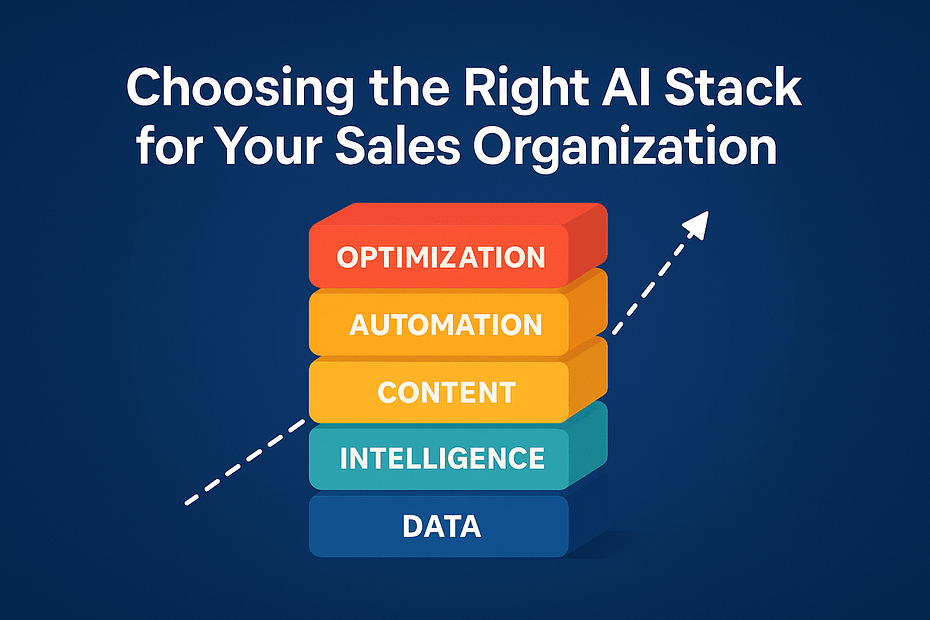
The Five-Layer AI Stack Framework

To avoid the chaos of random adoption, I use a five-layer framework for structuring sales AI tools:

  1. Data Foundation – Your CRM and data management system, enriched and maintained for accuracy.
  2. Intelligence & Analytics – AI-driven insights, lead scoring, forecasting, and market intelligence.
  3. Automation & Workflow – Sequences, task automation, and cross-platform orchestration.
  4. Content & Communication – AI writing, proposal generation, and customer-facing tools.
  5. Optimization & Learning – Conversation analysis, performance tracking, and continuous improvement.
Read the rest of the article…