Skip to content

sales leaders

What An MBA Didn’t Teach You About Sales

The sales profession is challenging. You need to work hard at it to succeed. You need to learn from the best. You need to improve your skills continuously. If you think you can sell since you are a hit at parties and have a lot of friends, you may soon find that you are a failure as a salesperson. Blunt truth:

because the sales profession is so hard, you have to focus on doing everything in sales very well, or you will be considered a failure.

I call this blog, Skinned Knees because I try to relate all of the learning that I have done over the past 4+ decades (while skinning my knees in the learning process).

I hope that you learn from my mistakes so that your business will grow!


The AI Sales Process Map: The Ten-Stage Sales Process Framework

Sales leaders today often fall into the trap of using artificial intelligence tools randomly rather than systematically. This sporadic usage is like owning a Swiss Army knife but only using the bottle opener; you miss out on ninety percent of the available value. AI’s real power comes not from isolated tools but from integrating capabilities across every stage of your sales processes. When mapped correctly, AI accelerates every interaction, shortens sales cycles, and makes revenue generation more predictable.

Random AI adoption leads to inconsistent results. Some reps use it effectively, while others revert to manual methods under pressure, resulting in uneven performance. Systematic AI integration, however, compounds improvements across the entire sales cycle. Data captured at one stage strengthens the next, creating a virtuous cycle of sales success that is scalable, measurable, and sustainable. The outcome is not just faster deals, but stronger business acumen and more consistent revenue management.

The ten-stage AI sales process framework provides a structured way to apply AI:

  1. Prospecting,
  2. Outreach,
  3. Qualification,
  4. Scoping,
  5. Presentation,
  6. Economic Buyer meetings,
  7. Validation Events,
  8. Proposals,
  9. Closing,
  10. Onboarding/expansion.
Read the rest of the article…

The AI Sales Process Map

In this episode of AI Tools for Sales Pros, we explore how systematic process mapping with artificial intelligence transforms sales performance. Rather than using AI sporadically, sales leaders can dramatically accelerate qualification, closing, and overall revenue generation by integrating AI at every stage of their sales processes. We discuss how this approach reduces cycle times, increases accuracy, and enables scalable, predictable results. You’ll walk away with a clear framework for applying AI in a way that compounds benefits over time and drives measurable sales success.

Major Highlights

  • Why random AI adoption leads to inconsistent results and wasted opportunities.
  • How process-based AI integration compounds improvements across all ten sales stages.
  • The ten-stage AI sales process framework encompasses prospecting, onboarding, and expansion.
  • Examples of AI tools like ChatGPT, Gong, ZoomInfo, and Seismic are applied at each stage of the sales cycle.
  • How process integration strengthens messaging, forecasting, and revenue management.
  • The measurable impact of systematic AI use: shorter sales cycles, higher conversion rates, and improved value selling.
  • Customization considerations based on industry, deal complexity, team maturity, and technology stack.
  • A continuous improvement framework for sustaining and scaling AI benefits in sales management.


Read the rest of the article…

Choosing the Right AI Stack for Your Sales Organization

A VP of Sales recently confided in me: “We have six different AI tools, but our reps are still doing manual work. What went wrong?”

This is the AI tool proliferation problem. Sales leaders often collect tools without a strategy, mistaking a pile of features for a cohesive system. It’s like buying a hammer, screwdriver, saw, and drill without realizing you’re actually trying to build a house. An effective AI stack means integration. When tools work together, they amplify each other’s value. When they don’t, they add complexity, confusion, and wasted money.

Why Strategy Beats Random Adoption

Random tool adoption is rampant across sales organizations. Teams chase shiny new software, often ending up with overlapping features, siloed data, and productivity lost to tool-switching. Instead of solving problems, the stack itself becomes the problem.

But when built strategically, the benefits are profound. Integrated systems reduce manual data entry, accelerate response times, and deliver actionable insights for reps. Three well-chosen, well-connected tools can outperform six isolated ones. Integrated stacks also improve adoption rates by providing consistent interfaces and reducing training overhead.

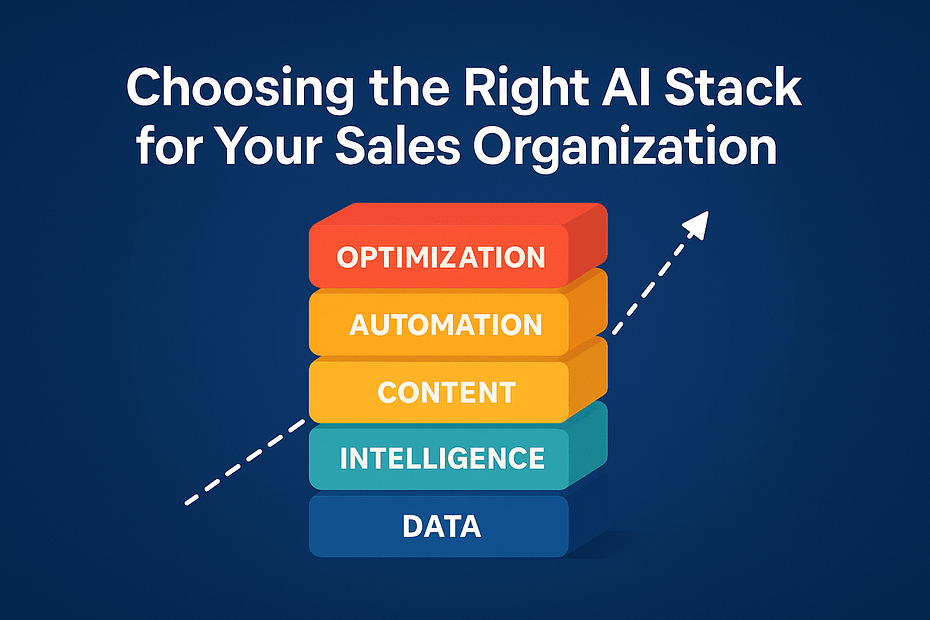
The Five-Layer AI Stack Framework

To avoid the chaos of random adoption, I use a five-layer framework for structuring sales AI tools:

  1. Data Foundation – Your CRM and data management system, enriched and maintained for accuracy.
  2. Intelligence & Analytics – AI-driven insights, lead scoring, forecasting, and market intelligence.
  3. Automation & Workflow – Sequences, task automation, and cross-platform orchestration.
  4. Content & Communication – AI writing, proposal generation, and customer-facing tools.
  5. Optimization & Learning – Conversation analysis, performance tracking, and continuous improvement.
Read the rest of the article…

Two Tall Guys Talking Sales – From Comp Plans to Territory Alignment: Sales Strategies Every Leader Needs for Revenue Generation – Episode 153

As the year draws to a close, sales leaders and business owners face a critical challenge: preparing for growth in the year ahead. In this episode of Two Tall Guys Talking Sales, hosts Kevin Lawson and Sean O’Shaughnessey dive deep into sales management strategies that set the stage for long-term sales success. From refining compensation plans and aligning territories to planning product lifecycles and avoiding the dreaded “hockey stick” growth trap, this conversation is packed with insights on business acumen, value selling, and revenue generation strategies that every sales leader should master.

Key Topics Discussed

  • 01:00 – Planning Beyond This Year: Why sales leaders need to start preparing now for next year’s revenue generation and sales processes.
  • 02:11 – Building Smarter Compensation Plans: Evaluating and refining comp structures to drive sales success and attract top talent.
  • 03:13 – Product Lifecycle & AI Readiness: How shifts in markets and technology demand updates to your offerings and messaging.
  • 05:00 – Departmental Alignment for Growth: Understanding how revenue management and sales growth affect every department in your business.
  • 07:12 – Right People, Right Roles: Assessing whether your sales team is positioned for success in the next stage of your growth plan.
  • 11:20 – Avoiding the “Hockey Stick” Trap: Why spreading growth evenly across years is a better long-term sales strategy.

Key Quotes

  • Sean O’Shaughnessey (01:07): “If I asked you to write out your three-year plan, next year already knocks off the first year. Are you one-third of the way there, or do you need to rethink your path?”
  • Kevin Lawson (02:33): “Be planning ahead. Compensation plans aren’t a set-and-forget item—you need to revisit them every year to make sure they’re delivering the right results.”
  • Sean O’Shaughnessey (07:59): “Do I have the right people in the right place in my sales organization for next year? Not every salesperson has to leave, but maybe their role needs to evolve.”
  • Kevin Lawson (11:38): “You don’t want that third year of your plan to be a hockey stick. Don’t put yourself in a position where you suddenly need 40% growth in one year to hit your goals.”

Additional Resources

  • B2B Sales Lab: A peer community for sales leaders and professionals to sharpen strategies, exchange best practices, and get actionable feedback.
  • EOS Framework: For leaders who want to align messaging, sales strategies, and revenue management with long-term goals.

A Significant Actionable Item from this Podcast

Review and finalize your sales compensation plans by December 1st. This gives your team enough time to digest changes, ask questions, and align their sales strategies before the new year begins. Waiting until January leaves your salespeople unprepared, which can delay revenue generation and momentum.

Read the rest of the article…

Choosing the Right AI Stack for Your Sales Organization

Episode Summary

In this episode of AI Tools for Sales Pros, we explain how to move beyond random AI tool adoption and build a strategic AI stack that drives real sales success. Too many organizations collect disconnected tools, creating data silos, inefficiency, and wasted spend. We introduce a five-layer architecture that aligns with proven sales processes and turns artificial intelligence into an amplifier of business acumen, value selling, and messaging. With the right design, your stack becomes a force multiplier for revenue generation and better revenue management.


Major Highlights

  • The proliferation problem: Why collecting disconnected AI tools without a strategy undermines sales management and slows teams down.
  • The five-layer AI stack framework: Data foundation, intelligence & analytics, automation & workflow, content & communication, optimization & learning—built to streamline sales processes.
  • Sales strategies for integration: How integrated stacks support revenue management, sharpenmessaging, and enable value selling across the funnel.
  • Practical ROI planning: Budget allocation by layer, common pitfalls to avoid, and how to measure time saved, pipeline velocity, and revenue generation impact.
  • Real-world configurations: Small, mid-market, and enterprise examples showing how artificial intelligence scales responsibly.
  • Long-term moat: Early architectural choices in tool selection and integration become durable competitive advantages.


Read the rest of the article…

AI Isn’t Replacing Salespeople, It’s Giving Them a Competitive Edge

AI isn’t replacing salespeople, it’s making them more effective. The real risk isn’t losing your job to AI; it’s losing to a competitor who uses AI better than you do. Sales professionals who integrate AI into their workflow will outperform those who don’t. 

It’s not about technology taking over but about using technology to gain an edge. The market is becoming increasingly competitive, and the most efficient salespeople will emerge victorious.

Time is a salesperson’s most valuable asset. 

Every minute spent on administrative tasks is a minute not spent selling. AI helps reclaim those lost hours. Tools that automate writing, scheduling, and research allow salespeople to focus on what matters: building relationships and closing deals. If you’re not leveraging AI to increase productivity, you’re leaving opportunities on the table.

Sales emails need to be clear and professional. AI-powered writing assistants ensure your messages are polished and effective. A poorly written email can cost you a deal. AI tools catch grammatical mistakes, improve clarity, and even suggest more effective phrasing. This isn’t just about looking professional; it’s about being understood. 

If your message isn’t clear, it won’t convert.

Presentations are another time-consuming task. AI can generate professional decks in minutes. Instead of spending hours designing slides, salespeople can focus on developing effective strategies. AI-powered tools create branded, structured presentations based on simple inputs. This ensures consistency while saving time. Sales professionals who utilize AI for presentations can focus on delivering insights rather than formatting slides.

CRM systems are the backbone of sales operations. AI enhances CRM by automating data entry, tracking customer interactions, and suggesting next steps. Salespeople often struggle with keeping CRM data updated. AI reduces this friction by automatically capturing and organizing information. A well-maintained CRM leads to better forecasting and stronger customer relationships. 

If your CRM doesn’t have AI capabilities, it’s time to upgrade.

AI-driven insights enable sales managers to make more informed decisions, rather than relying on instinct. Managers can use AI to analyze performance trends, identify coaching opportunities, and predict revenue outcomes. AI doesn’t replace leadership; it enhances it. 

Sales managers who adopt AI can build stronger teams and achieve better results. Ignoring AI in sales management is a strategic mistake.

Lead generation is another area where AI adds value. AI-powered tools can analyze vast amounts of data to identify high-potential prospects. Instead of spending hours researching leads, salespeople can receive AI-generated recommendations. This allows for more targeted outreach and higher conversion rates. AI doesn’t just find leads, it finds the right leads.

Sales follow-up is often inconsistent. AI ensures follow-ups happen at the right time with the right message. Automated reminders and AI-generated responses keep deals moving forward. 

A well-timed follow-up can be the difference between closing a deal and losing it. AI helps salespeople stay on top of their pipeline without relying on memory.

Read the rest of the article…

Two Tall Guys Talking Sales – How Sales Leaders Use CRMs to Align Sales Processes, Value Selling, and Revenue Management – Episode 152

In this episode of Two Tall Guys Talking Sales, hosts Kevin Lawson and Sean O’Shaughnessey build on last week’s discussion of qualification methodologies and take the conversation further—into how these frameworks should live inside your CRM. From aligning sales processes with the buyer’s journey to enforcing accountability at each stage, this conversation offers practical strategies that every sales leader and salesperson can implement. Expect a deep dive into sales management, revenue generation, sales processes, and… 

Intro to Automation: Make.com, Zapier, n8n, and String from Pipedream for Sales Pros

In this episode of AI Tools for Sales Pros, we dive into the critical decision of selecting the right automation platform for your sales organization. From Zapier’s simplicity to Make.com’s visual workflow design, from n8n’s open-source flexibility to Pipedream’s developer-friendly tools, each platform offers unique advantages—and pitfalls—for sales teams. We examine how team skills, budget, and complexity influence the right choice and share real-world results from companies that achieved dramatic efficiency gains. By the end, you’ll know how to align platform capabilities with your team’s technical comfort and long-term automation strategy.


Major Highlights

  • Why choosing the right automation platform is one of the most important technology decisions for sales teams.
  • The hidden costs of mismatched platforms include budget waste, abandoned projects, and migration headaches.
  • A breakdown of the four leading automation tools:
  • Zapier: User-friendly pioneer with the largest integration library.
  • Make.com: Visual workflow builder for advanced, high-volume automation.
  • n8n: An open-source powerhouse offering unlimited flexibility and cost efficiency.
  • Pipedream (including String): Developer-friendly with real-time processing power.
  • Key criteria to consider: team technical comfort, use case complexity, budget, scale, and integration requirements.
  • Practical implementation strategies for each platform, including quick wins and longer-term adoption.
  • How multi-platform strategies can be deployed and when they make sense.

  • Read the rest of the article…

    From Manual to Automated: A Sales Pro’s Guide to Zapier, Make.com, n8n, and Pipedream

    A sales manager recently told me something that stuck: “We went from twenty hours per week of manual work to two hours. Our lead response time dropped from four hours to four minutes.” That dramatic transformation wasn’t magic—it was automation. The reality is that sales teams today have more automation tools available than ever before. But with options like Zapier, Make.com, n8n, and Pipedream, the real challenge isn’t whether you should automate—it’s choosing the right… 

    Transforming Quota-Setting: Strategies for Sales Leaders to Optimize Performance and Revenue

    Quota-setting is one of the most misunderstood elements of sales leadership. Too often, it’s treated as a spreadsheet exercise or a top-down directive, rather than a strategic lever that drives behavior, performance, and growth.

    Whether you’re leading a team of 20 or you’re the founder managing three reps, how you define quotas has a direct impact on your revenue trajectory and your team’s motivation.

    So, where do you start?

    With timing. If you’re not delivering quotas to your team until February or March, you’re already behind. Salespeople need clarity by December. That gives them runway to plan, prioritize, and hit the ground running in January. Delayed quotas create confusion and stall momentum. To achieve a strong Q1, you need to equip your team early.

    Quota-setting varies depending on the size of your company. Larger teams offer more flexibility. With 10 or more reps, you can spread risk, balance performance, and model averages. You’ll have top performers who consistently overdeliver, alongside newer reps who are still ramping up. The law of averages works in your favor. You can afford some variance. Smaller teams don’t have that luxury.

    When you’re running a small team, maybe two or three reps or founder-led sales, every individual matters. One person missing quota can tank your number.

    You can’t rely on averages. You need precision.

    That means tying quotas to actual relationships, known opportunities, and real probability. It’s not about slicing up a target evenly. It’s about assigning numbers based on what’s realistically achievable in each territory or account list.

    Territory design plays a big role here. Whether it’s geographic, vertical, or named accounts, quota must reflect the market potential. You can’t expect equal performance from unequal opportunity. If Rep A has 500 viable accounts and Rep B has 50, their quotas shouldn’t look the same unless you have data that says Rep B’s accounts are closer to your Ideal Client Profile. Use available market data to inform the number. Don’t assign quotas in a vacuum. 

    In larger organizations, quotas often originate from the top down, typically from finance. The CEO and CFO commit a growth number to the board, investors, or in public filings to the SEC. They have no choice but to pass it down. It’s not uncommon for the sales team to receive the number without context. That’s a problem. If you’re in a leadership role, you need to pressure test that number. Can your team realistically hit it? If not, what additional resources are required?

    • More headcount?
    • Better enablement?
    • Marketing support?

    In large organizations where the quota is driven by investor expectations, the VP of Sales must establish an organization well before the new year that achieves this year’s goal, while also meeting the expectation of growth for the next year. Planning ahead, sometimes years in advance, is part of the job.

    Read the rest of the article…