Skip to content

sales managers

What An MBA Didn’t Teach You About Sales

The sales profession is challenging. You need to work hard at it to succeed. You need to learn from the best. You need to improve your skills continuously. If you think you can sell since you are a hit at parties and have a lot of friends, you may soon find that you are a failure as a salesperson. Blunt truth:

because the sales profession is so hard, you have to focus on doing everything in sales very well, or you will be considered a failure.

I call this blog, Skinned Knees because I try to relate all of the learning that I have done over the past 4+ decades (while skinning my knees in the learning process).

I hope that you learn from my mistakes so that your business will grow!


Differentiating Through Value: Mastering the Art of Consumable Sales

Navigating the competitive landscape of consumable sales calls for a thoughtful and kind-hearted approach. Salespeople, sales managers, and CEOs of small companies should remember that their role is about more than just making transactions. In a market where products often seem very alike in quality and price, what truly sets you apart is your ability to consistently show value. So, how can you create lasting relationships with your customers, even when many options are available?

Consider the analogy of fast-food giants like Burger King and McDonald’s. Both offer similar products, yet they each have a dedicated customer base. The key lies in creating a unique selling proposition that resonates with your target audience. 

As a salesperson, your goal is to become indispensable to your customers. This means transforming from a mere vendor to a trusted advisor who is deeply integrated into the customer’s business operations.

Become Part of Their Team

A critical part of this integration is understanding what a “gatherer” is. A gatherer is more than just an account manager. They build a close, almost inseparable bond with the customer. They become a trusted part of the customer’s team, often turning to them for advice and solving problems together. Building this kind of trust requires a genuine understanding of the customer’s business, enabling you to offer insights and solutions that extend beyond the products you provide.

In the realm of consumable sales, where products are used and replaced regularly, the salesperson’s value lies in their ability to maintain and continually grow the relationship. This involves not just selling a product but also selling yourself and your company. Your expertise, reliability, and ability to anticipate and solve problems become the key differentiators. When customers face challenges, they should instinctively think of you as the go-to person for solutions, regardless of minor price differences or delivery times.

To attain this trusted advisor status, you must focus on three core elements: 

  1. the product, 
  2. the company, 
  3. yourself. 

While the product and the company are essential, the most significant value often comes from you as the salesperson. Your ability to understand the prospect’s needs, guide their purchasing decisions, and challenge them to think differently about their business can set you apart from the competition.

Read the rest of the article…

The Evolution of Sales: Scaling from 10 to 100 Customers

The journey of a business unfolds as a story of growth, change, and ongoing adaptation. As salespeople, sales managers, and CEOs, we all share the ups and downs that come with this path. One of the most exciting moments in sales is the shift from landing your first ten customers to growing your family of clients to 50 or even 100. This milestone is truly a game-changer, shaping the future direction of your business.

When you’re starting, your focus is on acquiring those first ten customers. You’re trying to find your footing in the market, identify your target audience, and refine your product or service offering. You might be customizing your product or service for each customer to ensure it fits their specific needs. However, as you aim for the next level of growth, you need to start thinking about systemizing your sales process. 

To grow successfully, it’s helpful to have a standardized product or service. While customizing can be useful when you’re just starting out, it can become hard to manage and slow you down as your customer base expands. 

Focus on creating a product or service that you can sell over and over again with just small tweaks. This approach simplifies your sales process and makes it easier for others to sell your offerings, too.

Read the rest of the article…

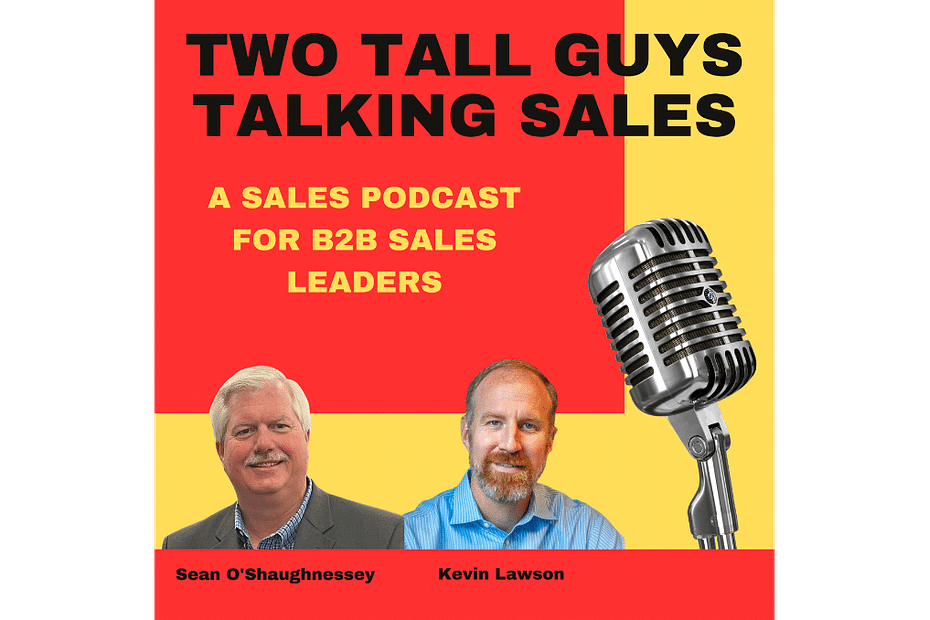
Two Tall Guys Talking Sales – The First 90 Days as a Sales Leader: Proven Strategies for Sales Management Success – Episode 157

When a company hires or promotes its first sales manager, expectations run high, but clarity can be low. In this episode of Two Tall Guys Talking Sales, hosts Sean O’Shaughnessey and Kevin Lawson unpack what the first 90 days should look like for a new sales leader. Whether you’re a CEO onboarding a new manager or that manager stepping into the role themselves, this discussion provides practical guidance on setting realistic expectations, building trust, and establishing the foundation for long-term sales success and revenue growth.

Key Topics Discussed

  • Setting Realistic Expectations as an Owner (02:00)
    Kevin explores how CEOs should frame success during the first 90 days, emphasizing the importance of patience, trust-building, and understanding that sales management transformation takes time.
  • Avoiding the “Fix This First” Trap (06:30)
    Sean cautions business owners against dumping old personnel problems on new leaders, explaining why cleaning up someone else’s mess undermines early business acumen and trust.
  • Building Relationships and Learning the Business (08:30)
    Sean shares tactical advice for new sales managers: conduct one-on-ones, ride along with reps, and build rapport across departments, marketing, operations, and finance, to master internal sales processes and interdepartmental alignment.
  • Understanding Internal and External Tools (11:12)
    Kevin discusses discovering hidden tools and levers, people, systems, vendor programs, or product configurations that can immediately improve team performance and value-selling opportunities.
  • Repackaging and Aligning Offers to the Market (12:30)
    The hosts outline how sales leaders can rethink product structures and messaging to better serve customer needs, thereby improving revenue management and profitability.

Key Quotes

  • “Trust is a currency. It has to be earned by customers, by salespeople, by peers, and you can’t buy it in the first 30 days.”,  Kevin Lawson (03:00)
  • “Don’t make your new sales leader the bad guy. If there’s a tough personnel decision, handle it before they start.”,  Sean O’Shaughnessey (07:00)
  • “Learn your company inside and out. If you don’t know who runs manufacturing or how the supply chain works, you can’t lead your salespeople effectively.”,  Sean O’Shaughnessey (10:00)
  • “You might have 20 products, but 100 possible solutions. The smart leader finds ways to repackage and sell in ways the customer actually values.”,  Kevin Lawson (13:00)

Additional Resources

  • Episodes on sales onboarding, marketing alignment, and ideal customer profiling (ICP) were referenced throughout the conversation.
  • Explore more insights and tools for sales leaders at b2b-sales-lab.com.

A Significant Actionable Item from this Podcast

Create a 90-Day Integration Plan.
If you’re a new sales manager, spend your first month listening and learning. Conduct one-on-ones with every salesperson, schedule cross-department meetings, and document what each function needs from sales. In the second month, identify process gaps and start designing improvements. By the third month, implement one or two visible wins, such as improving forecasting accuracy or clarifying sales messaging, to demonstrate value and build momentum.

Read the rest of the article…

From 10 to 100 Customers: Scaling Your Sales Process for Growth

For founders of companies, the journey of a business is a narrative of evolution, growth, and constant adaptation. As salespeople, sales managers, and CEOs, we are all too familiar with the challenges and triumphs that punctuate this journey. In the world of sales, one of the most critical turning points is the transition from acquiring your first ten customers to expanding your customer base to 50 or even 100. This pivotal moment sets the trajectory of a business and is a key focus of our discussion.

When you’re starting, the founding team is focused on acquiring those first ten customers. They’re trying to find their footing in the market, identify their target audience, and refine their product or service offering. You might be customizing your product or service for each customer to ensure it fits their specific needs. However, as you aim for the next level of growth, it’s crucial to start thinking about systemizing your sales process. This will ensure efficiency and prepare you for the next level of growth. 

To scale effectively, company leaders need to standardize their product or service offering. While customization can be beneficial in the early stages, it becomes impractical and inefficient as your customer base grows. The key here is to create a product or service that can be sold repeatedly with minimal adjustments. This streamlines the sales process, making it easier for others to sell the product or service.

In the early stages of a business, the founders might be the ones doing all the selling. But as the company grows, this becomes less feasible. To reach a larger number of customers, you need to bring others on board to sell for you. This is where standardization comes into play. By standardizing your product or service, you make it easier for others to understand and sell it. 

Read the rest of the article…

Mastering Sales Channels: How to Align Your Strategy for Maximum Impact

Understanding the dynamics of sales channels can transform how businesses approach their markets. Many sales professionals, whether they are salespeople, managers, or CEOs, often miss a critical distinction: the difference between the product they are selling and the value it provides. 

This gap in understanding can lead to suboptimal sales performance, particularly in environments where products are sold through intermediaries, such as distributors, referral partners, or dealer networks. The challenge is not just about knowing your product, but also about understanding how to position it in a way that resonates with every player in the sales chain.

Sales success starts with recognizing who your true customer is. In sales management or channel sales, the end customer is often not the person you interact with directly. Instead, your “customer” might be the intermediary, your distributor, reseller, or even your own sales team. These intermediaries are the ones who ultimately connect your product to its final user. If you don’t understand their challenges, motivations, and context, you risk failing to equip them with the necessary tools to succeed. Are you selling a product’s features, or are you helping them understand how to sell it effectively? This distinction is vital.

When selling through intermediaries, the emphasis should shift from “what the product does” to “how the product can be sold.” Your distributors or referral partners don’t need every technical detail of your product. They need clarity on how it solves problems for their customers, how it fits into their existing offerings, and how they can position it to drive sales. 

The goal is not to overwhelm your partners with information but to provide actionable insights that align with their specific needs. If you’re focusing solely on product features, you’re likely missing the mark.

Salespeople and sales managers must also recognize the game they are playing. Are you selling a commodity, a widely available product, or an exclusive offering? Each scenario demands a different strategy. 

Commodities often compete on price, necessitating bulk sales or value-added services to differentiate themselves. Widely available products often rely on relationships, service quality, or unique add-ons to differentiate themselves. Exclusive products, on the other hand, can often avoid price wars by emphasizing their uniqueness and superior quality. Knowing which game you’re in allows you to tailor your approach and avoid misaligned strategies.

For small businesses and solopreneurs, the challenge lies in effectively managing referral partners. Referral partnerships are a powerful way to generate leads, but they require careful management and oversight. 

Read the rest of the article…

AI Isn’t Replacing Salespeople, It’s Giving Them a Competitive Edge

AI isn’t replacing salespeople, it’s making them more effective. The real risk isn’t losing your job to AI; it’s losing to a competitor who uses AI better than you do. Sales professionals who integrate AI into their workflow will outperform those who don’t. 

It’s not about technology taking over but about using technology to gain an edge. The market is becoming increasingly competitive, and the most efficient salespeople will emerge victorious.

Time is a salesperson’s most valuable asset. 

Every minute spent on administrative tasks is a minute not spent selling. AI helps reclaim those lost hours. Tools that automate writing, scheduling, and research allow salespeople to focus on what matters: building relationships and closing deals. If you’re not leveraging AI to increase productivity, you’re leaving opportunities on the table.

Sales emails need to be clear and professional. AI-powered writing assistants ensure your messages are polished and effective. A poorly written email can cost you a deal. AI tools catch grammatical mistakes, improve clarity, and even suggest more effective phrasing. This isn’t just about looking professional; it’s about being understood. 

If your message isn’t clear, it won’t convert.

Presentations are another time-consuming task. AI can generate professional decks in minutes. Instead of spending hours designing slides, salespeople can focus on developing effective strategies. AI-powered tools create branded, structured presentations based on simple inputs. This ensures consistency while saving time. Sales professionals who utilize AI for presentations can focus on delivering insights rather than formatting slides.

CRM systems are the backbone of sales operations. AI enhances CRM by automating data entry, tracking customer interactions, and suggesting next steps. Salespeople often struggle with keeping CRM data updated. AI reduces this friction by automatically capturing and organizing information. A well-maintained CRM leads to better forecasting and stronger customer relationships. 

If your CRM doesn’t have AI capabilities, it’s time to upgrade.

AI-driven insights enable sales managers to make more informed decisions, rather than relying on instinct. Managers can use AI to analyze performance trends, identify coaching opportunities, and predict revenue outcomes. AI doesn’t replace leadership; it enhances it. 

Sales managers who adopt AI can build stronger teams and achieve better results. Ignoring AI in sales management is a strategic mistake.

Lead generation is another area where AI adds value. AI-powered tools can analyze vast amounts of data to identify high-potential prospects. Instead of spending hours researching leads, salespeople can receive AI-generated recommendations. This allows for more targeted outreach and higher conversion rates. AI doesn’t just find leads, it finds the right leads.

Sales follow-up is often inconsistent. AI ensures follow-ups happen at the right time with the right message. Automated reminders and AI-generated responses keep deals moving forward. 

A well-timed follow-up can be the difference between closing a deal and losing it. AI helps salespeople stay on top of their pipeline without relying on memory.

Read the rest of the article…

Turning Around Sales Performance: Strategies for CEOs and Sales Managers to Foster Internal Alignment

Navigating a sales turnaround isn’t just about fixing numbers; it’s about transforming the business. It’s about realigning expectations, rebuilding internal trust, and creating a structured, sustainable path forward. 

If you’re a CEO, sales manager, or a key salesperson in your organization, the pressure to reverse a sales slump can feel overwhelming. However, the truth is that turnarounds aren’t made in a sprint; they’re built through clarity, consistency, and effective communication.

Too often, sales leaders make the mistake of focusing only on the downward trend. They get caught up in the urgency of the numbers and forget that the real challenge lies in managing upward, setting expectations with executive leadership, and aligning them with reality. 

If your sales team is underperforming, your internal stakeholders are your new audience. Just as with external prospects, you need to manage their expectations with a clear, actionable plan.

The process starts with a shift in mindset. 

Instead of viewing upper management as critics, think of them as clients. What do they need to believe in this turnaround? What information do they need to trust your leadership? Start by building a high-level outline. Avoid over-engineering the details in the early stages. Focus on where you want to go, then reverse-engineer the steps to get there.

Every turnaround starts from a rear position. That means your first job is to stop the downward momentum. Before you can scale revenue, you need to stabilize it. That requires a clear definition of success, agreed upon by everyone involved. 

  • Are you trying to double revenue in 12 months? 
  • Or just return to last year’s baseline? 
  • Is that goal realistic given your market, team, and resources? 

If not, revise it. A stretch goal is fine. A fantasy is not.

Read the rest of the article…

From Reporting to Coaching: Elevate Your One-on-One Sales Meetings to Drive Performance and Trust

A one-on-one sales meeting is not a reporting meeting. It’s not about reviewing what already happened. And it’s definitely not about the manager doing most of the talking. The purpose of a one-on-one pipeline review is to develop the salesperson, surface challenges, and accelerate opportunities. If your one-on-ones are anything less, you’re leaving performance on the table.

Sales leaders often default to micromanagement. 

Especially when the rep is new or struggling. But that approach backfires. It creates dependency and stifles problem-solving. The goal is to coach your reps into leading the meeting. That shift changes everything. When reps own the agenda and bring forward deal-level insights, they’re forced to think critically. That’s where growth happens.

If you’re leading a sales team or are a CEO playing the role of sales manager, you need to establish a clear structure. But the rep does the prep. You define the meeting cadence and format. Weekly or bi-weekly, depending on your velocity. You outline the sections: committed deals, stalled deals, and at-risk deals. 

But the rep fills in the content. They come to the meeting ready to walk you through each opportunity, with specific updates and clear asks.

Preparation is non-negotiable. For both sides. 

The salesperson should have updated their CRM before the meeting. The manager should have reviewed that data in advance. If either party shows up unprepared, the meeting becomes reactive. 

A waste of time. And it erodes trust quickly. 

Reps notice when you haven’t read the notes. They know when you’re winging it. And if they feel their effort isn’t valued, they’ll stop putting in the effort.

You want to create a culture where preparation is expected and rewarded. 

The fastest way to management failure is to ask questions that could have been answered by reading the CRM. Instead, use that time: 

  • To probe deeper. 
  • Ask about the deal strategy. 
  • Challenge assumptions. 
  • Help salespeople spot gaps they missed. 

That’s where your experience has real value.

It’s tempting to jump in and solve the problem. Especially when you see the red flags before the rep does. But resist the urge. Let them talk it through. Coach them toward the insight. Your job isn’t to close the deal; it’s to build someone who can. That means teaching them how to identify weak spots, how to pressure test a deal, and how to re-engage a stalled buyer. The real value of one-on-ones is in that development.

Think about how you coach. 

Are you diagnosing for them? Or are you helping them diagnose for themselves? When a rep says “this deal is solid, no issues,” that’s a red flag. Every deal has risk. Your job is to help them uncover it. Ask: “What’s the biggest thing that could derail this?” Or “What’s the last thing the buyer said that gave you pause?” These questions surface the truth. And they teach reps to self-assess more effectively.

There’s a fine line between coaching and grading. You want reps to be honest about their pipeline without fear of judgment. 

If a deal is weak, that’s not a character flaw. It’s a coaching moment. 

Read the rest of the article…

Two Tall Guys Talking Sales – Managing the Maverick: How to Lead Top Sales Performers Without Breaking Team Culture – Episode 146

When a top-performing salesperson refuses to follow the rules, tensions flare, and your culture might suffer. In this episode of Two Tall Guys Talking Sales, hosts Kevin Lawson and Sean O’Shaughnessey tackle a question straight from their B2B Sales Lab community: What do you do with a sales rockstar who drives the rest of the team nuts? If you’ve ever struggled with managing high-output, low-alignment team members, this conversation is packed with valuable insights, practical… Two Tall Guys Talking Sales – Managing the Maverick: How to Lead Top Sales Performers Without Breaking Team Culture – Episode 146