Skip to content

sales managers

What An MBA Didn’t Teach You About Sales

The sales profession is challenging. You need to work hard at it to succeed. You need to learn from the best. You need to improve your skills continuously. If you think you can sell since you are a hit at parties and have a lot of friends, you may soon find that you are a failure as a salesperson. Blunt truth:

because the sales profession is so hard, you have to focus on doing everything in sales very well, or you will be considered a failure.

I call this blog, Skinned Knees because I try to relate all of the learning that I have done over the past 4+ decades (while skinning my knees in the learning process).

I hope that you learn from my mistakes so that your business will grow!


From Reporting to Coaching: Elevate Your One-on-One Sales Meetings to Drive Performance and Trust

A one-on-one sales meeting is not a reporting meeting. It’s not about reviewing what already happened. And it’s definitely not about the manager doing most of the talking. The purpose of a one-on-one pipeline review is to develop the salesperson, surface challenges, and accelerate opportunities. If your one-on-ones are anything less, you’re leaving performance on the table.

Sales leaders often default to micromanagement. 

Especially when the rep is new or struggling. But that approach backfires. It creates dependency and stifles problem-solving. The goal is to coach your reps into leading the meeting. That shift changes everything. When reps own the agenda and bring forward deal-level insights, they’re forced to think critically. That’s where growth happens.

If you’re leading a sales team or are a CEO playing the role of sales manager, you need to establish a clear structure. But the rep does the prep. You define the meeting cadence and format. Weekly or bi-weekly, depending on your velocity. You outline the sections: committed deals, stalled deals, and at-risk deals. 

But the rep fills in the content. They come to the meeting ready to walk you through each opportunity, with specific updates and clear asks.

Preparation is non-negotiable. For both sides. 

The salesperson should have updated their CRM before the meeting. The manager should have reviewed that data in advance. If either party shows up unprepared, the meeting becomes reactive. 

A waste of time. And it erodes trust quickly. 

Reps notice when you haven’t read the notes. They know when you’re winging it. And if they feel their effort isn’t valued, they’ll stop putting in the effort.

You want to create a culture where preparation is expected and rewarded. 

The fastest way to management failure is to ask questions that could have been answered by reading the CRM. Instead, use that time: 

  • To probe deeper. 
  • Ask about the deal strategy. 
  • Challenge assumptions. 
  • Help salespeople spot gaps they missed. 

That’s where your experience has real value.

It’s tempting to jump in and solve the problem. Especially when you see the red flags before the rep does. But resist the urge. Let them talk it through. Coach them toward the insight. Your job isn’t to close the deal; it’s to build someone who can. That means teaching them how to identify weak spots, how to pressure test a deal, and how to re-engage a stalled buyer. The real value of one-on-ones is in that development.

Think about how you coach. 

Are you diagnosing for them? Or are you helping them diagnose for themselves? When a rep says “this deal is solid, no issues,” that’s a red flag. Every deal has risk. Your job is to help them uncover it. Ask: “What’s the biggest thing that could derail this?” Or “What’s the last thing the buyer said that gave you pause?” These questions surface the truth. And they teach reps to self-assess more effectively.

There’s a fine line between coaching and grading. You want reps to be honest about their pipeline without fear of judgment. 

If a deal is weak, that’s not a character flaw. It’s a coaching moment. 

Read the rest of the article…

Two Tall Guys Talking Sales – Managing the Maverick: How to Lead Top Sales Performers Without Breaking Team Culture – Episode 146

When a top-performing salesperson refuses to follow the rules, tensions flare, and your culture might suffer. In this episode of Two Tall Guys Talking Sales, hosts Kevin Lawson and Sean O’Shaughnessey tackle a question straight from their B2B Sales Lab community: What do you do with a sales rockstar who drives the rest of the team nuts? If you’ve ever struggled with managing high-output, low-alignment team members, this conversation is packed with valuable insights, practical… 

Two Tall Guys Talking Sales – Future-Proofing Your Sales Career with AI, Strategy, and Smarter Workflows – Episode 144

Is artificial intelligence coming for your sales job? Not if you understand the power of business acumen, value selling, and strategic adoption of tools that amplify, not replace, human expertise. In this high-impact episode of Two Tall Guys Talking Sales, Kevin and Sean tackle the loud claims of AI-induced layoffs with a grounded, practical message for salespeople and sales managers: evolve or fall behind. This is not a doomsday episode; it’s a wake-up call, a… 

Two Tall Guys Talking Sales – Elevate Your Sales Game with B2B Sales Lab: A New Resource for Revenue Growth – Episode 141

When sales professionals hit a roadblock, where do they turn? In this episode of Two Tall Guys Talking Sales, Kevin Lawson and Sean O’Shaughnessey unveil an exciting new initiative: B2B Sales Lab, a private peer networking community designed to support salespeople, sales managers, and business owners in their journey toward revenue generation excellence. This isn’t just a conversation; rather, we are offering an invitation to join something powerful. If you’ve ever felt alone in a… 

The Key to Profitable Sales Organizations: Understanding and Adhering to the Sales Process

Many salespeople, sales managers, and CEOs face a unique problem. This issue concerns the sales process, particularly when specific steps are skipped. The challenge is common among sales teams across various industries, and there are different perspectives on its causes and solutions.

This issue is concerning since, according to Harvard Business Review, 28% of companies that master at least three stages of their sales process will see an increase in revenue growth. (https://hbr.org/2015/01/companies-with-a-formal-sales-process-generate-more-revenue). That same study states that companies that had trained their sales managers to manage their pipelines saw their revenue grow 9% faster than those that didn’t. But not just any training will do. Sales managers need targeted training to address specific pipeline management challenges.

Sometimes, the sales process might seem tedious, and salespeople may skip steps out of impatience or eagerness to close a deal. However, skipping these steps can lead to further complications down the line. When a sales team is not following the process that has been identified, it can disrupt the team’s rhythm and efficiency. Some might argue that this is a sign that the process needs to change or that more training is required.

This issue extends beyond the sales team. When a company hires a fractional VP of sales, it brings an outside perspective to evaluate its sales process. The fractional VP will often encounter resistance from the existing team, who may feel their industry is unique. While every business has its distinctive elements, the fundamentals of a sales process are universal.

Read the rest of the article…

The Three Pillars of Sales Success: Ideal Client Profiles, Effective Messaging, and Aspirational Offers

Let’s start this article with a rhetorical question to the sales professionals, sales managers, or CEOs: Have you ever found yourself guilty of sending messages to prospects without fully considering their specific needs or how your offer aligns with them?

If so, you’re not alone—this is a common pitfall in sales. The good news is, it’s entirely fixable by developing a straightforward, strategic approach.

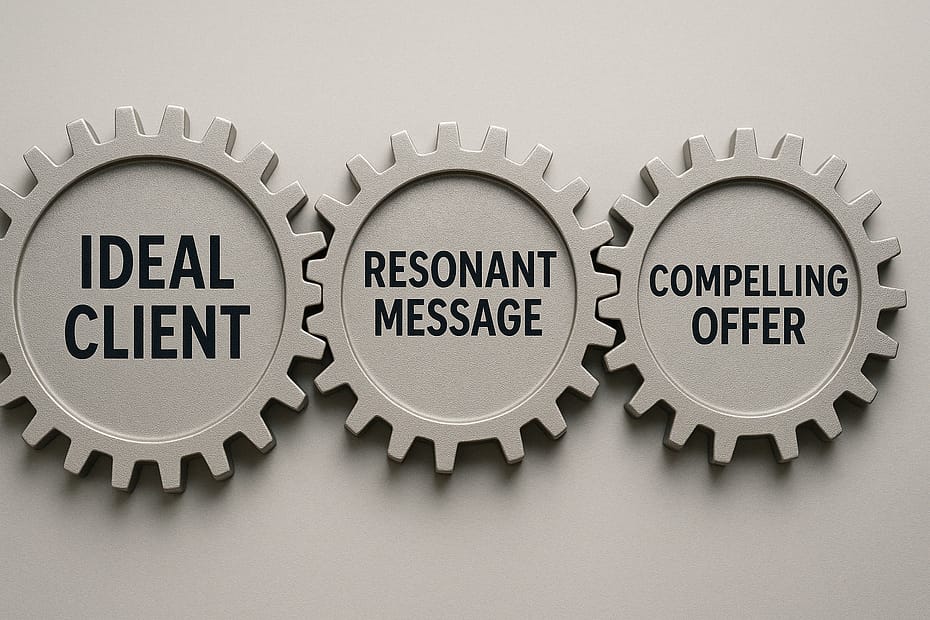
An effective sales strategy hinges on three core components: defining your ideal client profile (ICP), crafting a resonant message, and presenting a compelling offer. These elements are interconnected. Mastering their alignment will significantly enhance your sales effectiveness.

Ideal Client Profile

Let’s start with the ideal client profile. How well do you know the companies you’re targeting? Identifying your ideal customer is foundational to your entire sales approach. It’s not enough to say that your market is “small businesses” or “tech companies.” Instead, think about your best clients—the ones you genuinely enjoy working with, who value your product, and who generate profitable, sustainable business. Think about companies that rarely devalue your product or service by asking for a discount. What do these clients have in common?

Now that you have your favorite customers from above, reflect on your top five or ten accounts. Are they in the same industry? Do they share similar challenges or company structures? Perhaps they all have common goals that your product consistently solves. Pinpoint these commonalities. This process will help you create a precise and actionable ideal client profile.

But don’t stop at company-level characteristics. Remember, even in B2B sales, you’re ultimately selling to individuals. Identify the specific roles or buyers within these organizations that are responsible for making buying decisions. Who are these decision-makers? What motivates them personally and professionally? Do they all have the same kind of college education? Do they all have similar career paths? Understanding the people behind the logo makes your outreach more personal, targeted, and effective.

What is your message?

Once you’ve developed a clear picture of your ideal client and the people within those companies, the next step is crafting a message that reflects your value-selling message. This message is how you communicate your value proposition—it’s the bridge between your product and your prospect’s needs. Too often, sales messaging falls flat because it focuses heavily on the seller rather than the buyer. Statements that emphasize “we,” “I,” or “our product” rarely resonate deeply. Instead, effective messaging highlights the customer’s perspective, clearly communicating the benefits they will experience.

Read the rest of the article…

Why Cold Calling is Dead: The Shift to Relationship-Based Selling

Building an effective sales pipeline requires a shift in strategy. Traditional cold calling has become increasingly ineffective, with decision-makers ignoring unsolicited calls and emails.

In the spring of 2021, Bank of America Corp.’s Merrill Lynch Wealth Management unit banned trainee brokers from making cold calls. According to the Wall Street Journal, it is hard to succeed with cold phone calls in an era when no one picks up. Merrill executives said personal referrals lead to a response around 40% of the time, but less than 2% of people who are cold-called even answer the phone.

Sales teams must adopt a more strategic approach, focusing on relationships rather than volume-based outreach. The key is leveraging existing networks to create warm introductions, significantly improving engagement rates and overall success.

Cold outreach has become expensive and inefficient, and the time spent dialing numbers, leaving voicemails, and sending emails that never get opened results in diminishing returns. Many executives no longer answer unknown calls, and email filters automatically sort cold outreach into spam. Even when messages get through, recipients are skeptical, assuming they are generated by automation rather than a genuine human connection. In reality, sales professionals must find a better way to reach their target audience.

Relationship-based selling offers a more effective alternative. Salespeople should focus on leveraging their connections instead of reaching out to strangers. This approach involves identifying key contacts who can provide warm introductions to potential prospects. These “super connectors” are individuals with strong networks and the ability to facilitate meaningful introductions. By tapping into these relationships, sales teams can bypass the skepticism associated with cold outreach and start conversations with credibility.

Read the rest of the article…

Becoming a Trusted Advisor: Solve Problems, Not Just Sell Products

In B2B sales and sales leadership, problem-solving is an art that goes beyond selling a product or service. The secret to becoming a trusted advisor is addressing business problems, not just selling a product. This concept resonates with salespeople, sales managers, and small business CEOs who sell themselves or manage a team of salespeople. 

Sales is not just about pushing a product or closing a deal; it’s about forging relationships, understanding businesses and their unique challenges, and offering solutions to these problems. The role of a trusted advisor is not to sell a product and become a trusted advisor, but rather to become a trusted advisor who can sell a product. 

The reward for earning trusted advisor status is immeasurable. It is fantastic to receive a call from a client asking for advice on solving problems they have never discussed with you. Imagine having relationships that stand the test of time and outlast competition and challenges. 

So, how does one become a trusted advisor and solve problems for clients rather than just selling them a great product? It starts with building a relationship from scratch. When starting with a prospect list or an ideal client profile, the goal is not to find anyone who will respond but to seek opportunities to build meaningful relationships. 

The cornerstone of these relationships is reliability. 

  • Are you always punctual? 
  • Do you cancel at the last minute? 
  • Do you forget to return phone calls? 

These behaviors erode trust. On the other hand, showing up when needed, providing solutions even when they are not directly related to your product or service, and connecting clients to others who can help them are behaviors that build trust. 

Becoming a trusted advisor also involves understanding and curiosity about the client’s business. Do you ask questions about how the prospective company makes and loses money, how it dealt with past challenges like the pandemic, and how it deals with current challenges like rising inflation or supply chain disruption? The aim is to understand the client’s business, challenges, and competitors and offer insights and parallels to other companies. 

Read the rest of the article…

Two Tall Guys Talking Sales – Sales Prospecting: Are You Chasing Leads or Cultivating Success? – E127

In this episode of Two Tall Guys Talking Sales, Kevin Lawson and Sean O’Shaughnessey dive into the art of sales prospecting using an unusual but powerful analogy—chasing butterflies versus building a garden. Are you tirelessly running after leads or cultivating an environment where ideal prospects naturally come to you? Learn how to create a long-term strategy for consistent revenue growth by positioning your business as the go-to solution for your ideal customers. Key Topics Discussed:…