
Skip to content

sales technology

What An MBA Didn’t Teach You About Sales

The sales profession is challenging. You need to work hard at it to succeed. You need to learn from the best. You need to improve your skills continuously. If you think you can sell since you are a hit at parties and have a lot of friends, you may soon find that you are a failure as a salesperson. Blunt truth:

because the sales profession is so hard, you have to focus on doing everything in sales very well, or you will be considered a failure.

I call this blog, Skinned Knees because I try to relate all of the learning that I have done over the past 4+ decades (while skinning my knees in the learning process).

I hope that you learn from my mistakes so that your business will grow!


AI Prospecting Agents: Build More Pipeline Without Adding More SDRs

One of the more frustrating realities in modern sales is that a company can invest heavily in technology and still leave its best salespeople doing work that should never require their time.

The CRM is open. So is LinkedIn. There is an intent-data platform in another tab, a contact database in another, a sales engagement platform somewhere else, and perhaps a conversation intelligence tool running in the background.

The company has a technology stack. What it may not have is a prospecting system.

That distinction matters.

A collection of tools still depends on someone remembering which accounts matter, noticing when a former champion changes jobs, deciding which buying signals deserve attention, researching the account, moving information between systems, writing the message, and following up. When people are the integration layer connecting all those systems, the company has not really automated prospecting. It has simply given its salespeople more software to operate.

The Prospecting Advantage Has Changed

Traditional outbound sales was built around scarcity. Finding contact information, researching a company, and uncovering a credible reason to approach someone required significant effort. That made volume difficult and valuable.

Artificial intelligence changed those economics.

Today, generating another email is nearly free. Finding another prospect is relatively easy. AI can produce hundreds or thousands of messages faster than a sales team could ever review them. That does not make those messages valuable.

When volume becomes inexpensive, volume stops being a competitive advantage. Relevance becomes the scarce resource.

We need to evolve our systems away from asking, “How can we send more outreach?” Rather, we need to be thinking of, “How can we identify the people who deserve our attention right now and give our salespeople something useful to say when they contact them?”

A modern prospecting system therefore has to answer five questions continuously:

  1. Who should we pursue?
  2. Why should we pursue them now?
  3. What should we say?
  4. Which channel and timing gives us the best chance of engagement?
  5. When should a human salesperson enter the conversation?

The fifth question is particularly important.

Read the rest of the article…


How Bad CRM Data Breaks AI, Sales Processes, and Pipeline Growth

Most sales leaders do not have a prospecting problem. They have a data-confidence problem disguised as a prospecting problem.

The team is working. Reps are calling, emailing, sequencing, researching, and updating the CRM. But when the data is stale, duplicated, incomplete, or legally questionable, every downstream motion becomes weaker. Outreach gets slower. Messaging becomes less precise. Sales processes become harder to manage. Forecasts become less reliable. AI recommendations become faster, but not necessarily smarter.

That is the real issue with B2B sales intelligence today. Too many companies still evaluate data providers with a phonebook mentality. They ask who has the most contacts, the biggest database, the broadest coverage, or the lowest cost per seat. Those questions are easy to compare, but they rarely answer the question that matters: will this data perform against our ICP, in our market, inside our sales stack?

Artificial intelligence raises the standard. AI tools depend on clean, structured, identity-resolved data. If the CRM has three versions of the same person, five versions of the same account, outdated titles, invalid email addresses, disconnected phone numbers, and inconsistent fields, AI will not fix the problem. It will operationalize the problem.

Identity resolution is the missing discipline. It is the ability to recognize that the same person or company appears across multiple systems and create one authoritative record. Without it, lead scoring, personalization, enrichment, intent data, pipeline analysis, and Revenue management all become suspect.

This is why sales management must treat data infrastructure as a strategic operating issue, not a software-administration issue. Bad data burns money in several directions at once. You pay for the data subscription. You pay reps to manually verify what the subscription should have solved. You pay sales operations to clean up the mess. Then you lose revenue because your team is working on bad records while competitors are already in the right relationships.

Read the rest of the article…

AI Will Not Fix Sales Problems Built on Fragmented CRM Data

Most sales leaders are asking the wrong question about artificial intelligence.

They ask which AI tool to buy, which platform has the best features, which automation will save the most time, or which sales technology will help their reps move faster. Those questions matter, but they are downstream from the real issue.

The more important question is: Does your CRM provide AI with enough trusted context to make useful recommendations?

If the answer is no, the next tool will not solve the problem. It will accelerate the confusion.

AI cannot reason well from fractured data. If account history lives in email, proposal tools, LinkedIn messages, spreadsheets, call notes, support tickets, and half-completed CRM fields, the AI is not operating from a complete commercial picture. It is guessing from fragments. A faster guess is still a guess.

That is why the CRM must evolve from a passive system of record into an active system of action. The old CRM was built to store yesterday’s activity. The modern CRM has to help shape tomorrow’s decisions.

A strong CRM foundation gives sellers a complete account context before a call. It helps managers understand pipeline risk without relying only on rep opinion. It allows AI to recommend next steps because the recommendation is grounded in actual customer history, not generic sales theory. It gives the organization leverage because the patterns learned in one deal can improve the next similar deal.

Read the rest of the article…

From CRM Debt to a Cognitive Revenue Engine: Reclaiming Selling Time with AI

Most B2B sales teams don’t have a talent problem. They have a capacity problem.

Administrative drag is quietly stripping selling time: CRM updates, stakeholder mapping, duplicate cleanup, meeting summaries, and the constant “what should I say next?” work that should not be consuming a senior seller’s day. The downstream damage is bigger than annoyance. Forecast accuracy declines, coaching becomes reactive, and revenue management turns into a negotiation with incomplete data.

Artificial intelligence can fix this, but only if you use it with the right operating model.

Benjamin Todd’s articleHow not to lose your job to AI” makes the point that AI doesn’t simply eliminate jobs; it shifts where value concentrates. As routine tasks become cheap, the remaining human bottlenecks become more valuable. Todd’s ATM example is the cleanest version of the idea: ATMs reduced the need for “money counting,” but the overall demand for human banking roles didn’t collapse. The job shifted toward customer-facing work and higher-leverage conversations.

In B2B sales, our “money counting” is CRM entry, list building, and manual research. Our high-leverage work is business acumen, strategic influence, stakeholder alignment, and value selling. The problem is that most teams have it backwards: humans do the hardest input work (research, logging, hygiene), then AI writes the customer-facing messages. That combination produces drained sellers and generic messaging.

A better model is: Automate the input, humanize the output.

Read the rest of the article…

Building a Zero-Cost AI Sales Stack: How to Validate Value Before You Spend a Dollar

Most sales leaders today feel the tension between innovation and fiscal responsibility. You know artificial intelligence can accelerate productivity, clarify messaging, and drive revenue generation. You also know your competitors are implementing AI-driven sales processes and reaping the benefits. Yet you are expected to somehow produce results without the budget to experiment, test, or validate new technology.

This pressure creates the classic chicken-and-egg dilemma. You cannot get budget approval without demonstrating value, but you cannot demonstrate value without access to capable tools. That tension often leaves sales leaders paralyzed, observing advancements but unable to participate. It is an exhausting cycle that erodes confidence and slows down organizational progress.

The good news is that modern software economics have shifted. You no longer need an enterprise-level budget to run meaningful AI pilots. Instead, today’s freemium models allow teams to build real workflows, automate real processes, and create real sales success with no financial risk. These free tiers exist because vendors want you to become reliant on the workflow, meaning you can use that dynamic to your advantage as you design early-stage pilots.

A practical approach for sales management is to treat free AI tools as validation engines rather than long-term solutions. You begin with lightweight experimentation, focusing on a single friction point that slows your team. Whether the issue involves pre-call research, drafting follow-up emails, or scoring inbound leads, AI can automate repetitive tasks, freeing your sellers to focus on value selling. The goal is not perfection; it is measurement.

Read the rest of the article…

How AI-Powered Contact Enrichment Transforms B2B Sales Conversations

In today’s fast-paced B2B world, sales teams can no longer afford to waste hours gathering prospect data manually. Artificial intelligence has enabled the automation of contact enrichment, transforming basic contact records into comprehensive profiles rich in actionable business intelligence.

Contact enrichment powered by AI doesn’t just make your team faster; it makes them smarter. By combining multiple data sources into unified profiles, your sales organization gains the kind of business acumen that enables precision-targeted messaging and true value selling. The difference between a generic pitch and a relevant, consultative conversation often comes down to the quality and depth of the data your team has at its fingertips.

Platforms like Clay, Clearbit, Apollo, and ZoomInfo give sales leaders visibility into company size, funding rounds, leadership changes, technology stacks, and even recent business developments. This transforms your approach from transactional outreach to consultative engagement rooted in strategic intelligence. The outcome is faster response times, higher conversion rates, and more meaningful sales conversations.

The beauty of these systems lies in their integration with CRMs like HubSpot, Salesforce, or Pipedrive. Automated workflows ensure that every new lead entry is enriched in real-time with firmographic and behavioral insights. This is how sales teams reduce their research time from hours to minutes while maintaining the quality of personalized outreach that customers expect.

Read the rest of the article…
Automating Sales Workflows: When to Use Automation Over Chat

In sales management, there’s often some confusion about when to use artificial intelligence chat interfaces versus automation workflows. Chat interfaces are ideal for creative problem-solving, learning, and strategic research, while automation excels in repetitive, high-volume, data-driven sales tasks. The trick is to recognize when consistency and scalability are more important than customization.

Automation delivers consistent execution, eliminates human error, and operates 24/7. Sales leaders can rely on it for triggered communications, data synchronization across systems, CRM updates, and compliance tasks that require accuracy and complete audit trails. By moving these routine tasks into automated workflows, sales teams free up valuable time for relationship building, revenue generation, and refining sales strategies.

Real-world examples highlight the impact: a team once spent three hours daily crafting manual follow-up emails. Shifting to automated sequences not only saved time but also improved messaging consistency and pipeline response rates. Similarly, another team utilized automation to synchronize sales data across six systems, thereby eliminating bottlenecks and enabling sellers to focus fully on sales.

Hybrid approaches really take things to the next level! By merging human creativity in chat interactions with the quick and precise power of automation, businesses can craft workflows that beautifully balance personalized service with the ability to grow. This type of teamwork enhances value-driven selling, sharpens business skills, and accelerates revenue management throughout the sales journey.

Read the rest of the article…

Sales Management with AI: Chat Interfaces vs. Automation Workflows

Sales organizations today face a critical decision: should they rely on interactive chat interfaces like ChatGPT, Claude, or Gemini, or should they focus on automation workflows? The answer isn’t either/or. Each approach has unique strengths, and choosing the right one directly impacts sales processes, productivity, and revenue generation.

The problem many sales teams encounter is “random implementation.” They hear about a new AI tool, adopt it quickly, and use it for the wrong purpose. The result? Chat interfaces get bogged down with repetitive work, and automation gets tasked with jobs that require creativity and nuance. Misuse not only reduces efficiency but also frustrates teams and erodes trust in artificial intelligence altogether.

So how do you know when chat is the right fit? The decision comes down to task complexity and uniqueness. Chat excels in situations that require creativity, flexibility, and human judgment. Four categories consistently stand out:

  • Creative and strategic tasks: proposals, executive messaging, strategic planning, and competitive positioning.
  • Complex problem-solving: sales opportunity strategy sessions, unique customer needs, and crisis management.
  • Learning and development: role-playing objection handling, skill coaching, and competitive intelligence training.
  • Research and analysis: prospect research, market analysis, and strategic planning.
Read the rest of the article…

Transform Your Sales Team: Strategic Compensation Adjustments for Year-End Momentum

Autumn is the time of year for sales leaders, managers, and CEOs to begin laying the groundwork for next year’s success. Have you considered how your current sales compensation plans impact your team’s motivation and productivity? Now is the ideal moment to evaluate, adjust, and deliver these plans, preferably by December 1st. Doing so can significantly influence your team’s drive to close deals in December and build momentum heading into the next fiscal year.

Sales compensation should be motivating and rewarding for employees. It directly shapes your sales team’s behaviors and priorities. An effective plan incentivizes the right actions and deters the wrong ones.

Consider a common pitfall: salespeople holding back deals to inflate their numbers for the following year. Does your current compensation structure inadvertently reward this practice? If so, you’re unintentionally harming your year-end results.

To counter this, strategically incorporate compensation escalators and cliffs into your plan. Escalators progressively reward increased sales performance throughout the year. Higher performance equals higher commission rates, driving your sales team to push forward continually. 

Commission cliffs reset commission rates at the beginning of each year, creating a sense of urgency to close deals before the end of December. Communicating these compensation details clearly by early December ensures your team understands what’s at stake.

Don’t hold your team back!

Another critical compensation consideration is eliminating commission caps. While some organizations cap commissions to control expenses, this practice can backfire dramatically. Caps tell your top-performing salespeople that their exceptional efforts are neither valued nor rewarded appropriately. This demotivates your top talent and encourages them to seek opportunities elsewhere that offer uncapped rewards. 

Removing commission caps signals that the organization fully supports and rewards outstanding performance. Have you considered how much growth your company might achieve if artificial constraints didn’t limit your sales team?

When evaluating compensation, look beyond simple cost containment. Consider the true profitability of incentivizing increased sales volume. Once salespeople reach their targets and enter accelerators, each additional dollar earned typically comes at a lower incremental cost to your organization. 

Sales transactions earlier in the year have already covered the salesperson’s base salary once they have met their annual quota. In fact, at 100% of quota, the salesperson should have covered all their costs and their share of the overall company’s revenue needs. Thus, every extra sale at escalated commission rates still contributes positively to your overall profitability. 

Read the rest of the article…

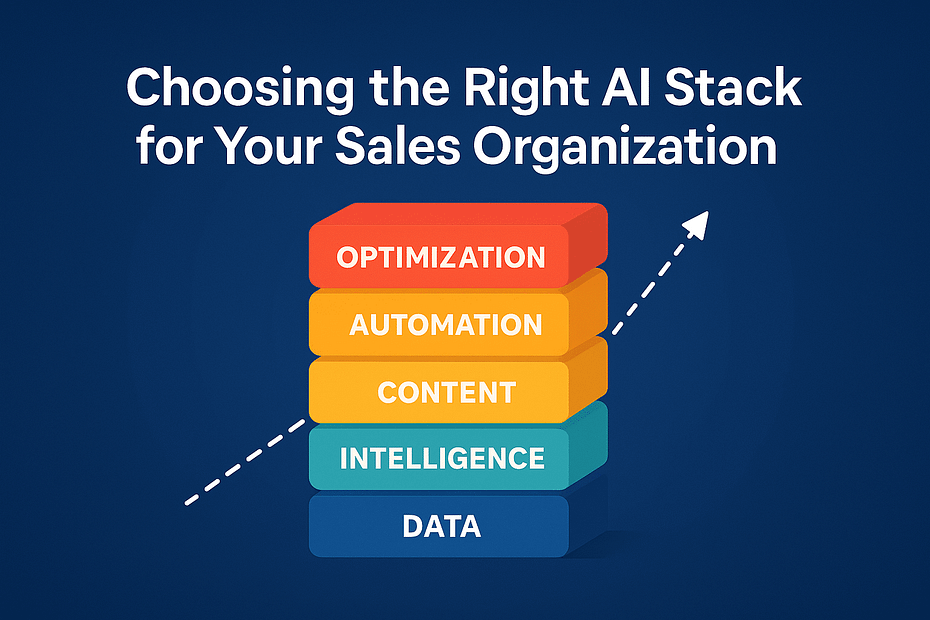
Choosing the Right AI Stack for Your Sales Organization

A VP of Sales recently confided in me: “We have six different AI tools, but our reps are still doing manual work. What went wrong?”

This is the AI tool proliferation problem. Sales leaders often collect tools without a strategy, mistaking a pile of features for a cohesive system. It’s like buying a hammer, screwdriver, saw, and drill without realizing you’re actually trying to build a house. An effective AI stack means integration. When tools work together, they amplify each other’s value. When they don’t, they add complexity, confusion, and wasted money.

Why Strategy Beats Random Adoption

Random tool adoption is rampant across sales organizations. Teams chase shiny new software, often ending up with overlapping features, siloed data, and productivity lost to tool-switching. Instead of solving problems, the stack itself becomes the problem.

But when built strategically, the benefits are profound. Integrated systems reduce manual data entry, accelerate response times, and deliver actionable insights for reps. Three well-chosen, well-connected tools can outperform six isolated ones. Integrated stacks also improve adoption rates by providing consistent interfaces and reducing training overhead.

The Five-Layer AI Stack Framework

To avoid the chaos of random adoption, I use a five-layer framework for structuring sales AI tools:

  1. Data Foundation – Your CRM and data management system, enriched and maintained for accuracy.
  2. Intelligence & Analytics – AI-driven insights, lead scoring, forecasting, and market intelligence.
  3. Automation & Workflow – Sequences, task automation, and cross-platform orchestration.
  4. Content & Communication – AI writing, proposal generation, and customer-facing tools.
  5. Optimization & Learning – Conversation analysis, performance tracking, and continuous improvement.
Read the rest of the article…