Skip to content

schedule

What An MBA Didn’t Teach You About Sales

The sales profession is challenging. You need to work hard at it to succeed. You need to learn from the best. You need to improve your skills continuously. If you think you can sell since you are a hit at parties and have a lot of friends, you may soon find that you are a failure as a salesperson. Blunt truth:

because the sales profession is so hard, you have to focus on doing everything in sales very well, or you will be considered a failure.

I call this blog, Skinned Knees because I try to relate all of the learning that I have done over the past 4+ decades (while skinning my knees in the learning process).

I hope that you learn from my mistakes so that your business will grow!


Mastering Sales in the Digital Age: A Case Study on Megan O’Hara

The sales landscape constantly evolves, and the tools and techniques used to reach potential clients are continually refined and reimagined. One such innovative approach to sales and marketing is pioneered by salespeople and sales managers leveraging technology to add value to their client relationships and boost their sales figures. 

Megan O’Hara, an executive solution specialist in Columbus, Ohio, is at the forefront of this movement. She has developed a unique method of reaching out to clients that adds value to their lives, increases her customer access, and builds her credibility. This method is simple yet impactful: Megan sends a weekly tech tip in a short video format every Monday.

This approach is designed to keep her name at the top of her clients’ minds. In a world where attention spans are increasingly limited and competition for customer attention is fierce, being the first person a client thinks of when they need a product or service is vital. By sending out these tech tips, Megan is providing a valuable service to her clients and ensuring that she remains at the forefront of their minds.

The success of this approach is evident in the response Megan has received from her clients. Many have contacted her after receiving her tech tips, expressing appreciation for her added value to their lives and initiating further business conversations. This is a clear testament to the power of this approach in building strong client relationships and driving sales.

Read the rest of the article…


Maximizing Productivity in Sales Meetings: Key Principles and Best Practices

Sales meetings are the lifeblood of any sales-driven organization, providing an essential forum for communication, collaboration, and strategy development. Yet, despite their significance, many salespeople, managers, and CEOs struggle to conduct productive and efficient meetings. This issue often stems from a lack of understanding of key meeting principles and best practices, particularly in the areas of time management, content planning, and participant engagement.

The adage “time is money” holds especially true in sales. Every minute counts, and wasted time equates to lost opportunities. This is why punctuality is of the utmost importance. A meeting that starts late or runs over time is disrespectful to participants and detrimental to the team’s overall productivity. 

To avoid this pitfall, sales leaders should ensure they always arrive early to meetings and start them on time, without exception. This requires careful planning and preparation, as well as a commitment to respecting the time and schedules of others. The same principle applies to the end of the meeting. Sales leaders should always strive to conclude meetings on time, which requires careful meeting agenda management and a willingness to keep discussions focused and on track.

Content planning is another crucial aspect of effective meeting management. Just as a ship needs a compass to navigate the seas, a meeting needs an agenda to guide its proceedings. A well-crafted agenda provides a clear structure for the meeting and helps to keep discussions focused and productive. It also sets clear expectations for participants and helps to ensure that all relevant topics are covered.

Read the rest of the article…

From Education to Improvement: The Essential Elements of Effective Sales Meetings

The importance of effective internal sales meetings with your sales team cannot be overstated. These meetings are not just about discussing individual deals or pipelines but serve a much larger purpose. They are opportunities for education, alignment, and improvement. They are a platform where the entire sales ecosystem comes together to discuss what’s happening in the industry, target market, or the company and how to move in the same direction.

A key reason for having larger quarterly meetings is education. As a sales leader or a CEO, the goal should be to make the sales team more effective and knowledgeable about ongoing developments. This can be achieved by inviting guest speakers, working on sales messaging, or understanding what’s happening in a particular vertical. However, these meetings should not be held just because the quarter came up. They should have a purpose and should add value to the team. If the same information can be shared through a well-written email or a quick update on Zoom, then there is no need for a meeting.

One effective practice for these meetings is role plays. This is a great way to practice and improve skills. However, it’s important to conduct these role plays correctly. There should be three roles: a customer, a seller, and an observer. The customer should be competent, the seller should sell something, and the observer should observe. After each role-play, feedback should be provided on what was done well and what could be improved.

However, while conducting these meetings, it is important to avoid a few pitfalls. One such pitfall is not having enough variation in the meeting for different learning types. If the meeting only consists of slides or videos, it might not cater to everyone’s learning style. Therefore, mixing up the media and providing breaks is important to keep the team engaged.

Read the rest of the article…

Enhancing Sales Performance Through Effective One-on-One Coaching Meetings

The effectiveness of sales management is paramount, particularly in how sales managers support their team members to enhance performance. The nuanced relationship between a salesperson and their manager can significantly influence their success, a topic that is gaining traction among CEOs and sales leaders seeking to maximize their team’s capabilities. One-on-one meetings between sales managers and salespeople are not just routine check-ins but pivotal moments that can define a sales team’s success trajectory. These interactions… 

From Crisis to Control: Managing Expectations in Sales Leadership

The concept of “managing up” emphasizes the importance of aligning a sales team’s objectives with the expectations of upper management. This approach is particularly crucial during periods of sales turnaround, where the usual metrics might falter and innovative, agile responses are required. “Managing up” involves treating higher management as an internal customer whose needs must be understood and met with the same diligence as those of external clients. For sales leaders, this means crafting a… 

Proactive Coaching: The Key to Unlocking Exceptional Sales Performance

A shift is occurring away from simply correcting problems after they’ve happened toward a more proactive and developmental approach to coaching sales teams. This evolution in strategy empowers sales leaders, CEOs, and managers to not only meet but also exceed their targets through effective team management and personal development. The concept of continuous improvement in sales begins with a focus on coaching. Unlike traditional reactive methods, modern sales leadership emphasizes coaching as a tool for… 

The Follow-Up Formula: Driving Sales Success in the New Year – Video 7 of the New Year Motivation Series

Effective follow-up is essential for sales success in the New Year, as emphasized in a video series covering best practices. Promptly thanking clients, utilizing a CRM efficiently, scheduling the next meeting immediately, and adapting follow-up strategies to industry rhythms are crucial steps. These actions distinguish a good sales year from a fantastic one, underlining the importance of follow-up in building relationships and achieving sales targets.

Elevating Product Knowledge: Creating Sales Growth in the New Year – Video 2 of the New Year Motivation Series

In today’s evolving business environment, continuous improvement of sales strategies is crucial. Comprehensive product knowledge and understanding the unique value of offerings are essential. Regular product training, client scenario practice, and creating a product FAQ are recommended. Tailoring conversations to decision-makers and integrating new features and client success stories can enhance sales effectiveness.

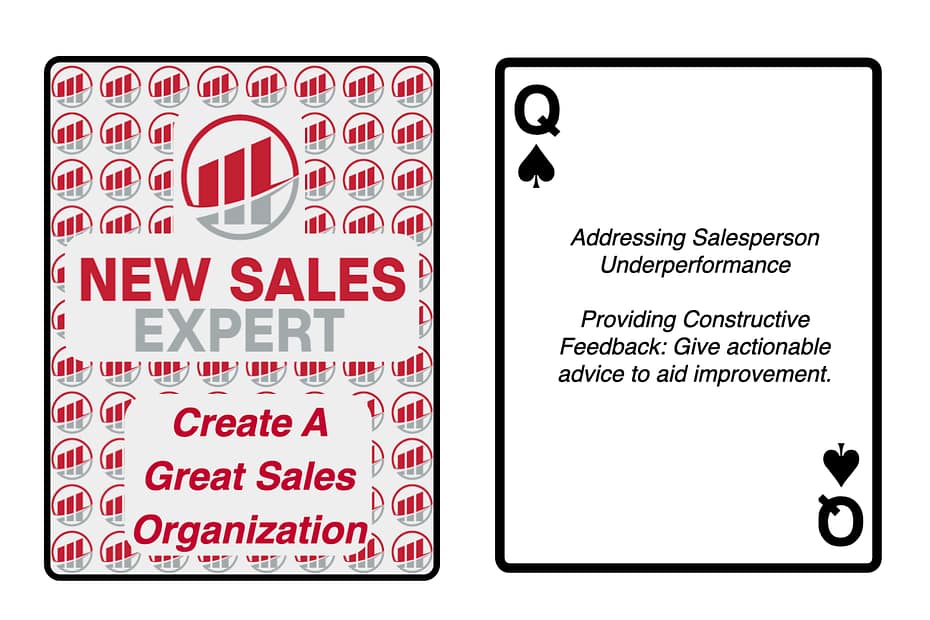
Queen of Spades: Providing Constructive Feedback: Give Actionable Advice to Aid Improvement

In B2B sales, where every interaction and every closed deal matters, providing constructive feedback is not merely an addendum to the daily operations—it is a pivotal aspect of the sales narrative, a determinant of success. The intricacy of feedback, however, cannot be overstated. It is a craft that, when honed, can propel the underperforming to new heights of achievement and the proficient to unprecedented mastery. The Anatomy of Actionable Feedback Consider the feedback mechanism as…