Skip to content

target audience

What An MBA Didn’t Teach You About Sales

The sales profession is challenging. You need to work hard at it to succeed. You need to learn from the best. You need to improve your skills continuously. If you think you can sell since you are a hit at parties and have a lot of friends, you may soon find that you are a failure as a salesperson. Blunt truth:

because the sales profession is so hard, you have to focus on doing everything in sales very well, or you will be considered a failure.

I call this blog, Skinned Knees because I try to relate all of the learning that I have done over the past 4+ decades (while skinning my knees in the learning process).

I hope that you learn from my mistakes so that your business will grow!


Differentiating Through Value: Mastering the Art of Consumable Sales

Navigating the competitive landscape of consumable sales calls for a thoughtful and kind-hearted approach. Salespeople, sales managers, and CEOs of small companies should remember that their role is about more than just making transactions. In a market where products often seem very alike in quality and price, what truly sets you apart is your ability to consistently show value. So, how can you create lasting relationships with your customers, even when many options are available?

Consider the analogy of fast-food giants like Burger King and McDonald’s. Both offer similar products, yet they each have a dedicated customer base. The key lies in creating a unique selling proposition that resonates with your target audience. 

As a salesperson, your goal is to become indispensable to your customers. This means transforming from a mere vendor to a trusted advisor who is deeply integrated into the customer’s business operations.

Become Part of Their Team

A critical part of this integration is understanding what a “gatherer” is. A gatherer is more than just an account manager. They build a close, almost inseparable bond with the customer. They become a trusted part of the customer’s team, often turning to them for advice and solving problems together. Building this kind of trust requires a genuine understanding of the customer’s business, enabling you to offer insights and solutions that extend beyond the products you provide.

In the realm of consumable sales, where products are used and replaced regularly, the salesperson’s value lies in their ability to maintain and continually grow the relationship. This involves not just selling a product but also selling yourself and your company. Your expertise, reliability, and ability to anticipate and solve problems become the key differentiators. When customers face challenges, they should instinctively think of you as the go-to person for solutions, regardless of minor price differences or delivery times.

To attain this trusted advisor status, you must focus on three core elements: 

  1. the product, 
  2. the company, 
  3. yourself. 

While the product and the company are essential, the most significant value often comes from you as the salesperson. Your ability to understand the prospect’s needs, guide their purchasing decisions, and challenge them to think differently about their business can set you apart from the competition.

Read the rest of the article…

The Evolution of Sales: Scaling from 10 to 100 Customers

The journey of a business unfolds as a story of growth, change, and ongoing adaptation. As salespeople, sales managers, and CEOs, we all share the ups and downs that come with this path. One of the most exciting moments in sales is the shift from landing your first ten customers to growing your family of clients to 50 or even 100. This milestone is truly a game-changer, shaping the future direction of your business.

When you’re starting, your focus is on acquiring those first ten customers. You’re trying to find your footing in the market, identify your target audience, and refine your product or service offering. You might be customizing your product or service for each customer to ensure it fits their specific needs. However, as you aim for the next level of growth, you need to start thinking about systemizing your sales process. 

To grow successfully, it’s helpful to have a standardized product or service. While customizing can be useful when you’re just starting out, it can become hard to manage and slow you down as your customer base expands. 

Focus on creating a product or service that you can sell over and over again with just small tweaks. This approach simplifies your sales process and makes it easier for others to sell your offerings, too.

Read the rest of the article…

From 10 to 100 Customers: Scaling Your Sales Process for Growth

For founders of companies, the journey of a business is a narrative of evolution, growth, and constant adaptation. As salespeople, sales managers, and CEOs, we are all too familiar with the challenges and triumphs that punctuate this journey. In the world of sales, one of the most critical turning points is the transition from acquiring your first ten customers to expanding your customer base to 50 or even 100. This pivotal moment sets the trajectory of a business and is a key focus of our discussion.

When you’re starting, the founding team is focused on acquiring those first ten customers. They’re trying to find their footing in the market, identify their target audience, and refine their product or service offering. You might be customizing your product or service for each customer to ensure it fits their specific needs. However, as you aim for the next level of growth, it’s crucial to start thinking about systemizing your sales process. This will ensure efficiency and prepare you for the next level of growth. 

To scale effectively, company leaders need to standardize their product or service offering. While customization can be beneficial in the early stages, it becomes impractical and inefficient as your customer base grows. The key here is to create a product or service that can be sold repeatedly with minimal adjustments. This streamlines the sales process, making it easier for others to sell the product or service.

In the early stages of a business, the founders might be the ones doing all the selling. But as the company grows, this becomes less feasible. To reach a larger number of customers, you need to bring others on board to sell for you. This is where standardization comes into play. By standardizing your product or service, you make it easier for others to understand and sell it. 

Read the rest of the article…

Mastering Sales Channels: How to Align Your Strategy for Maximum Impact

Understanding the dynamics of sales channels can transform how businesses approach their markets. Many sales professionals, whether they are salespeople, managers, or CEOs, often miss a critical distinction: the difference between the product they are selling and the value it provides. 

This gap in understanding can lead to suboptimal sales performance, particularly in environments where products are sold through intermediaries, such as distributors, referral partners, or dealer networks. The challenge is not just about knowing your product, but also about understanding how to position it in a way that resonates with every player in the sales chain.

Sales success starts with recognizing who your true customer is. In sales management or channel sales, the end customer is often not the person you interact with directly. Instead, your “customer” might be the intermediary, your distributor, reseller, or even your own sales team. These intermediaries are the ones who ultimately connect your product to its final user. If you don’t understand their challenges, motivations, and context, you risk failing to equip them with the necessary tools to succeed. Are you selling a product’s features, or are you helping them understand how to sell it effectively? This distinction is vital.

When selling through intermediaries, the emphasis should shift from “what the product does” to “how the product can be sold.” Your distributors or referral partners don’t need every technical detail of your product. They need clarity on how it solves problems for their customers, how it fits into their existing offerings, and how they can position it to drive sales. 

The goal is not to overwhelm your partners with information but to provide actionable insights that align with their specific needs. If you’re focusing solely on product features, you’re likely missing the mark.

Salespeople and sales managers must also recognize the game they are playing. Are you selling a commodity, a widely available product, or an exclusive offering? Each scenario demands a different strategy. 

Commodities often compete on price, necessitating bulk sales or value-added services to differentiate themselves. Widely available products often rely on relationships, service quality, or unique add-ons to differentiate themselves. Exclusive products, on the other hand, can often avoid price wars by emphasizing their uniqueness and superior quality. Knowing which game you’re in allows you to tailor your approach and avoid misaligned strategies.

For small businesses and solopreneurs, the challenge lies in effectively managing referral partners. Referral partnerships are a powerful way to generate leads, but they require careful management and oversight. 

Read the rest of the article…

The Three Pillars of Sales Success: Ideal Client Profiles, Effective Messaging, and Aspirational Offers

Let’s start this article with a rhetorical question to the sales professionals, sales managers, or CEOs: Have you ever found yourself guilty of sending messages to prospects without fully considering their specific needs or how your offer aligns with them?

If so, you’re not alone—this is a common pitfall in sales. The good news is, it’s entirely fixable by developing a straightforward, strategic approach.

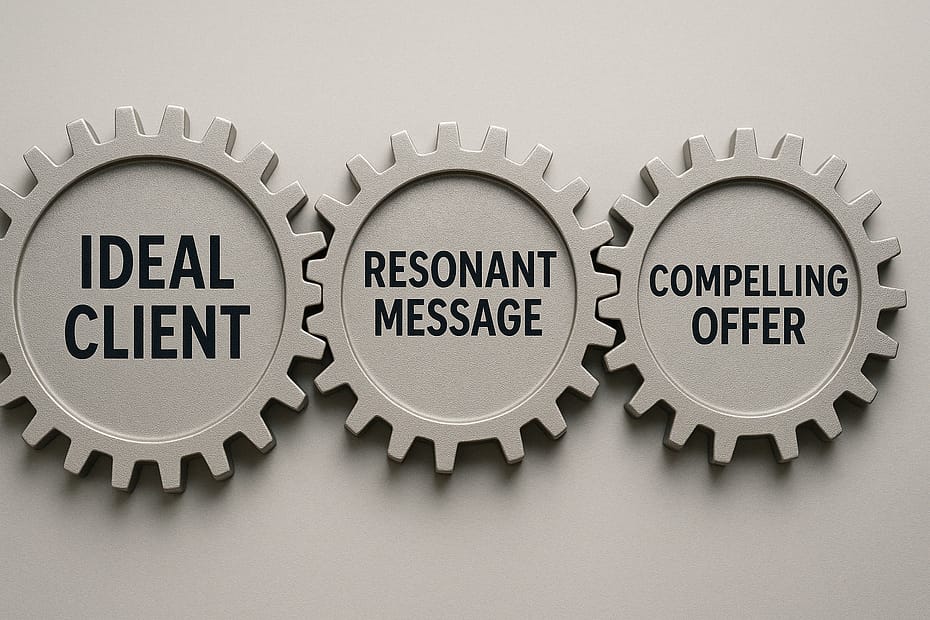
An effective sales strategy hinges on three core components: defining your ideal client profile (ICP), crafting a resonant message, and presenting a compelling offer. These elements are interconnected. Mastering their alignment will significantly enhance your sales effectiveness.

Ideal Client Profile

Let’s start with the ideal client profile. How well do you know the companies you’re targeting? Identifying your ideal customer is foundational to your entire sales approach. It’s not enough to say that your market is “small businesses” or “tech companies.” Instead, think about your best clients—the ones you genuinely enjoy working with, who value your product, and who generate profitable, sustainable business. Think about companies that rarely devalue your product or service by asking for a discount. What do these clients have in common?

Now that you have your favorite customers from above, reflect on your top five or ten accounts. Are they in the same industry? Do they share similar challenges or company structures? Perhaps they all have common goals that your product consistently solves. Pinpoint these commonalities. This process will help you create a precise and actionable ideal client profile.

But don’t stop at company-level characteristics. Remember, even in B2B sales, you’re ultimately selling to individuals. Identify the specific roles or buyers within these organizations that are responsible for making buying decisions. Who are these decision-makers? What motivates them personally and professionally? Do they all have the same kind of college education? Do they all have similar career paths? Understanding the people behind the logo makes your outreach more personal, targeted, and effective.

What is your message?

Once you’ve developed a clear picture of your ideal client and the people within those companies, the next step is crafting a message that reflects your value-selling message. This message is how you communicate your value proposition—it’s the bridge between your product and your prospect’s needs. Too often, sales messaging falls flat because it focuses heavily on the seller rather than the buyer. Statements that emphasize “we,” “I,” or “our product” rarely resonate deeply. Instead, effective messaging highlights the customer’s perspective, clearly communicating the benefits they will experience.

Read the rest of the article…