Skip to content

team

What An MBA Didn’t Teach You About Sales

The sales profession is challenging. You need to work hard at it to succeed. You need to learn from the best. You need to improve your skills continuously. If you think you can sell since you are a hit at parties and have a lot of friends, you may soon find that you are a failure as a salesperson. Blunt truth:

because the sales profession is so hard, you have to focus on doing everything in sales very well, or you will be considered a failure.

I call this blog, Skinned Knees because I try to relate all of the learning that I have done over the past 4+ decades (while skinning my knees in the learning process).

I hope that you learn from my mistakes so that your business will grow!


From CRM Debt to a Cognitive Revenue Engine: Reclaiming Selling Time with AI

Most B2B sales teams don’t have a talent problem. They have a capacity problem.

Administrative drag is quietly stripping selling time: CRM updates, stakeholder mapping, duplicate cleanup, meeting summaries, and the constant “what should I say next?” work that should not be consuming a senior seller’s day. The downstream damage is bigger than annoyance. Forecast accuracy declines, coaching becomes reactive, and revenue management turns into a negotiation with incomplete data.

Artificial intelligence can fix this, but only if you use it with the right operating model.

Benjamin Todd’s articleHow not to lose your job to AI” makes the point that AI doesn’t simply eliminate jobs; it shifts where value concentrates. As routine tasks become cheap, the remaining human bottlenecks become more valuable. Todd’s ATM example is the cleanest version of the idea: ATMs reduced the need for “money counting,” but the overall demand for human banking roles didn’t collapse. The job shifted toward customer-facing work and higher-leverage conversations.

In B2B sales, our “money counting” is CRM entry, list building, and manual research. Our high-leverage work is business acumen, strategic influence, stakeholder alignment, and value selling. The problem is that most teams have it backwards: humans do the hardest input work (research, logging, hygiene), then AI writes the customer-facing messages. That combination produces drained sellers and generic messaging.

A better model is: Automate the input, humanize the output.

Read the rest of the article…

Instant Follow-Up in Field Sales: How AI Eliminates Post-Meeting Lag

Field sales doesn’t lose deals in the meeting. It loses deals after the meeting when a buyer asks a high-stakes question, you promise to “get back to them,” and the response shows up after the moment has passed. That delay kills momentum and quietly downgrades you from advisor to administrator.

In 2026, the buyer often has access to comparable information. Your differentiation is contextual insight delivered with speed. If your follow-up arrives hours later (or worse, it arrives days later), you’re not doing value selling, you’re doing cleanup. That’s the Administrative Tax: notes, recap emails, CRM updates, and retrieval work that should not be done manually by your highest-paid revenue generator.

Artificial intelligence changes the operating model. The goal isn’t “better summaries.” It’s an Instant Field Response: capture what matters in the room, retrieve the right internal assets, and draft a precise follow-up while you’re still in the parking lot. When AI handles the science (capture, entity recognition, semantic search, and drafting), you reclaim the art: listening, reading intent, and leading the decision.

Read the rest of the article…

What Kind of Sales Coach Are You?

Repeatable revenue comes from a coachable system, and a coachable system starts with clarity on “why” the salesperson wins.

Most sales managers try to scale results by cloning the top producer. That works only when the top producer is running a repeatable motion, with controls, standards, and decision points that the team can execute under pressure. When it’s personality-driven, you end up managing a talent show instead of a pipeline.

If the sales manager can’t explain why their cadence works, why they qualify the way they do, why they push back on certain requests, then they’re operating on instinct. Instinct can close deals, but it can’t be trained, forecasted, or improved.

Actionable takeaway: write the 5–7 moves that create forward motion, then add the one-sentence “why” behind each move. That becomes the start of a real operating system: something you can inspect in 1:1s, reinforce in pipeline reviews, and measure over time.

If you’re leading a team, the decision is simple: are you building a program that survives turnover, or rewarding heroics that disappear the moment the top rep changes seats?

Read the rest of the article…

Why AI in B2B Sales Fails at the Last Mile and How to Fix It

Most conversations about AI in B2B sales focus on speed. Fewer focus on control. That is the blind spot.

AI can produce drafts, summaries, research, and follow-up frameworks in seconds. That part is real. But the final 20%, the last mile, is where revenue quality is either protected or destroyed. That final layer requires human judgment: context, timing, risk assessment, and the decision of what should happen next.

The central operating issue in sales today is not effort. It is an allocation. Too many high-value salespeople are spending prime hours on low-value administrative work. CRM cleanup. Internal updates. Document hunting. Manual transcription. Reformatting information that should already be structured. That is a sales management design flaw, not a rep discipline issue.

When sales organizations fix this, performance changes fast. More customer-facing time creates more trust-building interactions. More trust creates better access, stronger positioning, and better conversion outcomes. This is not theoretical. It is how revenue generation compounds in real markets.

The right model is not “AI only.” It is a hybrid model: deterministic automation for correctness, AI for speed and language quality, human oversight for business judgment.

Deterministic systems should control anything that must be exact: pricing, contract elements, offer logic, approval rules, and data integrity. AI should then layer natural language, personalization, and messaging refinement on top of verified inputs. This is how you scale value selling without introducing preventable errors.

If your team is still using AI as a standalone drafting tool, you are under-leveraging it. If your team is sending AI output without last-mile review, you are overexposing the business. The goal is not automation theater. The goal is repeatable, high-confidence sales processes that increase throughput without compromising trust.

Read the rest of the article…

The Producer Mindset: Tech-Led, Human-Centric Selling for Faster Pipeline Velocity

Administrative drag is not an inconvenience. It’s a structural failure in modern B2B sales that quietly taxes performance, slows pipeline velocity, and degrades your ability to show up sharp for buyers.

The pattern is predictable. You earn a hard-won meeting with an executive. You know you need a tailored deck that speaks to their priorities. Then reality hits: marketing is backlogged, design is unavailable, and you’re left formatting slides at night like a part-time desktop publisher. That’s the sales tax: time and energy spent on non-selling work that steals capacity from revenue generation.

This is the Tollbooth Effect in action. You build momentum in discovery, then you hit the system’s plaza: CRM updates, meeting notes cleanup, searching old folders for case studies, and wrestling with presentation software. The deal cools while you “pay.” Your edge dulls, not because you can’t sell, but because the operating model forces you into manual labor at the worst possible moment.

The fix isn’t working harder. It’s changing the role you play in the workflow.

In the Producer Mindset, your highest value isn’t typing, formatting, or slide layout. Your highest values are judgment, strategy, and human connection, and those can’t be automated. Technology should lead on mechanics while you stay accountable for truth, tone, and impact. This is a tech-led, human-centric approach: AI accelerates the work, but you control the meaning.

Read the rest of the article…

Two Tall Guys Talking Sales Podcast – Your Sales Team’s LinkedIn Profiles Are Costing You Deals: Fix the Trust Signals – Episode 173

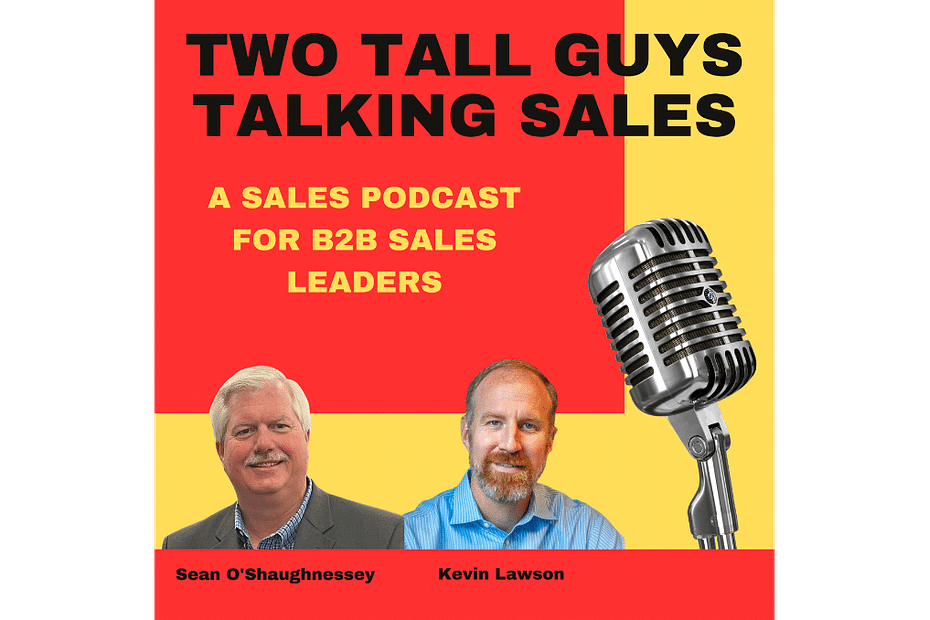
Sales leaders don’t lose deals on product. They lose them on trust signals—especially the ones buyers pick up before the second conversation even happens. In this episode of Two Tall Guys Talking Sales, Kevin Lawson and Sean O’Shaughnessey break down how your team’s digital presence either reinforces credibility or quietly undermines it. The throughline is simple: your sellers’ profiles and posts are part of sales management, part Messaging, and part Revenue management, because they shape… Two Tall Guys Talking Sales Podcast – Your Sales Team’s LinkedIn Profiles Are Costing You Deals: Fix the Trust Signals – Episode 173

Zombie Deals in B2B Sales: How AI Improves Forecast Accuracy and Coaching

Zombie deals aren’t a pipeline nuisance. They’re a leadership problem with a math problem attached.

A deal that sits in “Proposal” for months doesn’t just cloud your forecast. It steals capacity. Every hour a rep spends nurturing a flatlined opportunity is an hour not spent creating new demand, advancing real deals, or improving customer trust. Multiply that across a team, and you get the same symptom every quarter: missed numbers, reactive hiring decisions, and management time wasted on interrogations that create more friction than clarity.

The common response is predictable: more pipeline discipline. More required fields. More approvals. Longer forecast calls. More “updates.” That feels like control, but it’s usually just activity theater. It increases administrative drag and reduces selling time, exactly the opposite of what revenue management needs.

The fix is a mindset shift: move from intuition to evidence.

Read the rest of the article…

The Dual Blueprint Requirement: Why Growth Demands Two Plans, Not One

Launching a company or steering one through a merger, turnaround, or major transition requires clarity about how value will be created and, just as importantly, how revenue will actually be generated.

Many leadership teams recognize the need for a Business Plan, but overlook that sustainable growth requires a second, complementary plan. The main breakdown is not the strategy itself, but the assumption that strategy automatically creates revenue. Bridging strategy and revenue requires a distinct plan for that conversion, targeting a different audience.

The Business Plan sets direction from the top down. The Sales Plan is validated by demonstrating how that direction can become actual revenue from the bottom up.

Both are essential. Neither works in isolation.

The Business Plan: Charting the Course (Top-Down)

The Business Plan exists to answer specific questions for a particular audience. Its primary readers are CEOs, CFOs, bankers, private equity partners, and venture investors. These stakeholders are evaluating risk, scale, and return. They want to know where the company is going and why the destination is worth the journey.

At its core, the Business Plan articulates strategic intent. It defines the mission, the long-term objectives, and the differentiated value proposition that the company believes the market will reward. It frames the opportunity in language that aligns leadership, capital, and governance.

Market analysis in this context is necessarily high-level. It focuses on the total addressable market, industry dynamics, competitive positioning, and macro trends. The goal is not to explain how every deal will be won, but to establish that a meaningful opportunity exists and that the company has a credible right to pursue it.

Financial projections follow the same logic. They are built on broad assumptions: projected market share, average selling price, renewal and retention rates, inflation, and multi-year revenue targets. These numbers are directional. They signal ambition and scale rather than operational certainty.

Read the rest of the article…

Admin Drag Is Killing Your Sales Capacity: How to Reclaim Selling Time With AI

Episode 23 of “AI Tools for Sales Pros” is built around a reality most leadership teams have started to feel in their gut. Buying AI does not increase revenue. It might increase activity, content volume, and dashboard noise, but revenue generation improves only when you reclaim selling time and redeploy it into the actions that move deals forward.

The executive version of the problem is simple. Your tech stack cost keeps rising. Your board wants proof that those investments translate into pipeline quality, cycle-time reduction, win-rate improvement, and improved margins. “Are we getting value?” is the polite question. “Where is the revenue?” is what they ask when patience runs out. This is a revenue management problem, not a software problem.

Most B2B companies are operating with a hidden productivity ceiling. Salespeople spend roughly a third of their time on revenue-producing work. The rest disappears into administrative drag: CRM updates, transcript cleanup, internal coordination, re-entering data across tools, searching for collateral, chasing security documentation, fixing records, and managing handoffs. None of that is value selling. Most of it is friction disguised as “process.”

A useful way to see it is the Tollbooth Effect. One approval feels reasonable. One form feels harmless. One handoff feels like good governance. Together, they turn selling into paperwork. The rep has a strong discovery call and a clear hypothesis. Momentum is real. Then they hit the toll plaza: systems require updates, internal teams need briefings, fields need to be filled, and the same information gets retyped because two systems disagree on the truth. By the time the rep finishes paying the tolls, urgency has cooled, follow-up becomes generic, and the deal loses its edge.

Read the rest of the article…