Skip to content

workflow automation

What An MBA Didn’t Teach You About Sales

The sales profession is challenging. You need to work hard at it to succeed. You need to learn from the best. You need to improve your skills continuously. If you think you can sell since you are a hit at parties and have a lot of friends, you may soon find that you are a failure as a salesperson. Blunt truth:

because the sales profession is so hard, you have to focus on doing everything in sales very well, or you will be considered a failure.

I call this blog, Skinned Knees because I try to relate all of the learning that I have done over the past 4+ decades (while skinning my knees in the learning process).

I hope that you learn from my mistakes so that your business will grow!


AI Prospecting Agents: Build More Pipeline Without Adding More SDRs

One of the more frustrating realities in modern sales is that a company can invest heavily in technology and still leave its best salespeople doing work that should never require their time.

The CRM is open. So is LinkedIn. There is an intent-data platform in another tab, a contact database in another, a sales engagement platform somewhere else, and perhaps a conversation intelligence tool running in the background.

The company has a technology stack. What it may not have is a prospecting system.

That distinction matters.

A collection of tools still depends on someone remembering which accounts matter, noticing when a former champion changes jobs, deciding which buying signals deserve attention, researching the account, moving information between systems, writing the message, and following up. When people are the integration layer connecting all those systems, the company has not really automated prospecting. It has simply given its salespeople more software to operate.

The Prospecting Advantage Has Changed

Traditional outbound sales was built around scarcity. Finding contact information, researching a company, and uncovering a credible reason to approach someone required significant effort. That made volume difficult and valuable.

Artificial intelligence changed those economics.

Today, generating another email is nearly free. Finding another prospect is relatively easy. AI can produce hundreds or thousands of messages faster than a sales team could ever review them. That does not make those messages valuable.

When volume becomes inexpensive, volume stops being a competitive advantage. Relevance becomes the scarce resource.

We need to evolve our systems away from asking, “How can we send more outreach?” Rather, we need to be thinking of, “How can we identify the people who deserve our attention right now and give our salespeople something useful to say when they contact them?”

A modern prospecting system therefore has to answer five questions continuously:

  1. Who should we pursue?
  2. Why should we pursue them now?
  3. What should we say?
  4. Which channel and timing gives us the best chance of engagement?
  5. When should a human salesperson enter the conversation?

The fifth question is particularly important.

Read the rest of the article…


Your Sales Compensation Plan Is Quietly Managing Your Sales Team

A salesperson reaches the final week of the quarter with a major opportunity ready to close. Legal has approved the agreement. The customer is prepared to move forward but asks for a 15 percent discount.

The salesperson understands what the discount does to margin. So does the sales manager. Finance knows as well. Yet the salesperson is measured on revenue, the manager needs the deal to make the quarterly forecast, and neither is directly rewarded for protecting margin.

The discount is approved. The deal closes. The commission increases. Everyone celebrates.

The company may have just paid someone extra to give away its profit.

No one acted dishonestly. The compensation plan worked precisely as designed. That is the problem.

Compensation Is a Management System

Most companies treat sales compensation as an administrative process. Leadership creates a plan, finance calculates payments, and managers resolve disputes when the numbers do not match expectations.

That view misses the strategic role compensation plays.

A compensation plan influences which customers salespeople pursue, how aggressively they discount, whether they favor one-year or multi-year agreements, how they collaborate, and whether they prioritize new business, renewals, margin, or market share.

What the company pays for will eventually outweigh what its leaders say they value.

Many sales leaders inherited plans that accumulated years of exceptions, temporary accelerators, regional variations, product overlays, split-credit rules, and special arrangements. The resulting spreadsheet may be technically functional while being strategically incoherent.

The warning signs are familiar:

Salespeople maintain private spreadsheets because they do not trust their commission statements.

Managers spend time resolving payout disputes instead of coaching pipeline.

Quotas are created by adding a percentage to last year’s number rather than analyzing territory potential.

A handful of top performers benefit from every contest while most of the team decides the competition is irrelevant.

These are not motivation problems. They are design problems that consume selling time, reduce margin, and erode trust.

Read the rest of the article…

From CRM Debt to a Cognitive Revenue Engine: Reclaiming Selling Time with AI

Most B2B sales teams don’t have a talent problem. They have a capacity problem.

Administrative drag is quietly stripping selling time: CRM updates, stakeholder mapping, duplicate cleanup, meeting summaries, and the constant “what should I say next?” work that should not be consuming a senior seller’s day. The downstream damage is bigger than annoyance. Forecast accuracy declines, coaching becomes reactive, and revenue management turns into a negotiation with incomplete data.

Artificial intelligence can fix this, but only if you use it with the right operating model.

Benjamin Todd’s articleHow not to lose your job to AI” makes the point that AI doesn’t simply eliminate jobs; it shifts where value concentrates. As routine tasks become cheap, the remaining human bottlenecks become more valuable. Todd’s ATM example is the cleanest version of the idea: ATMs reduced the need for “money counting,” but the overall demand for human banking roles didn’t collapse. The job shifted toward customer-facing work and higher-leverage conversations.

In B2B sales, our “money counting” is CRM entry, list building, and manual research. Our high-leverage work is business acumen, strategic influence, stakeholder alignment, and value selling. The problem is that most teams have it backwards: humans do the hardest input work (research, logging, hygiene), then AI writes the customer-facing messages. That combination produces drained sellers and generic messaging.

A better model is: Automate the input, humanize the output.

Read the rest of the article…

Admin Drag Is Killing Your Sales Capacity: How to Reclaim Selling Time With AI

Episode 23 of “AI Tools for Sales Pros” is built around a reality most leadership teams have started to feel in their gut. Buying AI does not increase revenue. It might increase activity, content volume, and dashboard noise, but revenue generation improves only when you reclaim selling time and redeploy it into the actions that move deals forward.

The executive version of the problem is simple. Your tech stack cost keeps rising. Your board wants proof that those investments translate into pipeline quality, cycle-time reduction, win-rate improvement, and improved margins. “Are we getting value?” is the polite question. “Where is the revenue?” is what they ask when patience runs out. This is a revenue management problem, not a software problem.

Most B2B companies are operating with a hidden productivity ceiling. Salespeople spend roughly a third of their time on revenue-producing work. The rest disappears into administrative drag: CRM updates, transcript cleanup, internal coordination, re-entering data across tools, searching for collateral, chasing security documentation, fixing records, and managing handoffs. None of that is value selling. Most of it is friction disguised as “process.”

A useful way to see it is the Tollbooth Effect. One approval feels reasonable. One form feels harmless. One handoff feels like good governance. Together, they turn selling into paperwork. The rep has a strong discovery call and a clear hypothesis. Momentum is real. Then they hit the toll plaza: systems require updates, internal teams need briefings, fields need to be filled, and the same information gets retyped because two systems disagree on the truth. By the time the rep finishes paying the tolls, urgency has cooled, follow-up becomes generic, and the deal loses its edge.

Read the rest of the article…

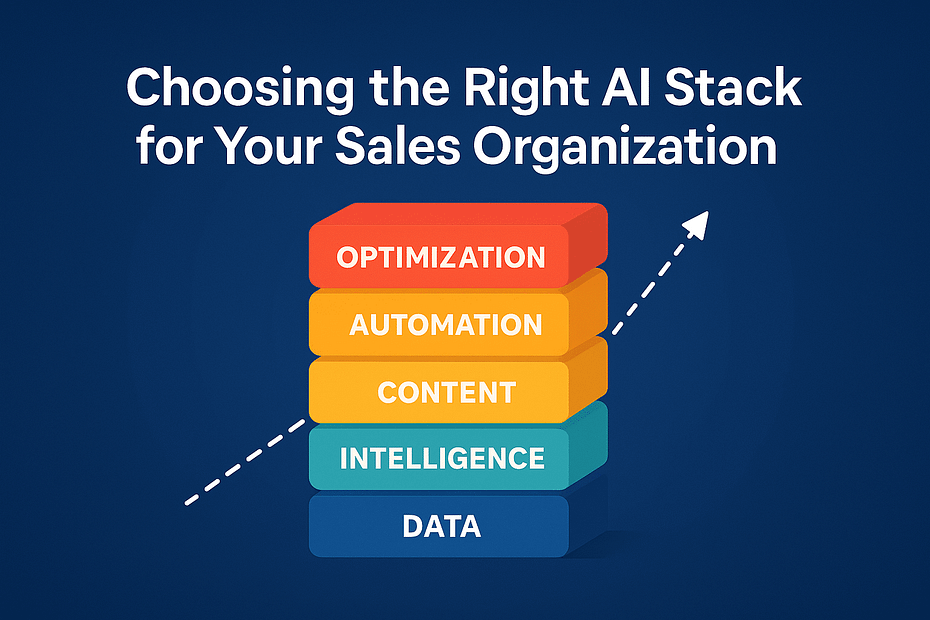
Choosing the Right AI Stack for Your Sales Organization

A VP of Sales recently confided in me: “We have six different AI tools, but our reps are still doing manual work. What went wrong?”

This is the AI tool proliferation problem. Sales leaders often collect tools without a strategy, mistaking a pile of features for a cohesive system. It’s like buying a hammer, screwdriver, saw, and drill without realizing you’re actually trying to build a house. An effective AI stack means integration. When tools work together, they amplify each other’s value. When they don’t, they add complexity, confusion, and wasted money.

Why Strategy Beats Random Adoption

Random tool adoption is rampant across sales organizations. Teams chase shiny new software, often ending up with overlapping features, siloed data, and productivity lost to tool-switching. Instead of solving problems, the stack itself becomes the problem.

But when built strategically, the benefits are profound. Integrated systems reduce manual data entry, accelerate response times, and deliver actionable insights for reps. Three well-chosen, well-connected tools can outperform six isolated ones. Integrated stacks also improve adoption rates by providing consistent interfaces and reducing training overhead.

The Five-Layer AI Stack Framework

To avoid the chaos of random adoption, I use a five-layer framework for structuring sales AI tools:

  1. Data Foundation – Your CRM and data management system, enriched and maintained for accuracy.
  2. Intelligence & Analytics – AI-driven insights, lead scoring, forecasting, and market intelligence.
  3. Automation & Workflow – Sequences, task automation, and cross-platform orchestration.
  4. Content & Communication – AI writing, proposal generation, and customer-facing tools.
  5. Optimization & Learning – Conversation analysis, performance tracking, and continuous improvement.
Read the rest of the article…

From Manual to Automated: A Sales Pro’s Guide to Zapier, Make.com, n8n, and Pipedream

A sales manager recently told me something that stuck: “We went from twenty hours per week of manual work to two hours. Our lead response time dropped from four hours to four minutes.” That dramatic transformation wasn’t magic—it was automation. The reality is that sales teams today have more automation tools available than ever before. But with options like Zapier, Make.com, n8n, and Pipedream, the real challenge isn’t whether you should automate—it’s choosing the right… 

APIs Explained for Sales Leaders: Drive Growth Without Extra Headcount

A sales manager recently told me, “I have to copy the same prospect data into five different tools. There has to be a better way.” That frustration is more common than most sales leaders realize, and fortunately, there is a better way. The reality is that sales teams are hemorrhaging productivity due to disconnected systems. Top performers spend hours manually entering data, bouncing between platforms, and correcting inevitable errors. This administrative overhead steals time from…