Skip to content

goals

What An MBA Didn’t Teach You About Sales

The sales profession is challenging. You need to work hard at it to succeed. You need to learn from the best. You need to improve your skills continuously. If you think you can sell since you are a hit at parties and have a lot of friends, you may soon find that you are a failure as a salesperson. Blunt truth:

because the sales profession is so hard, you have to focus on doing everything in sales very well, or you will be considered a failure.

I call this blog, Skinned Knees because I try to relate all of the learning that I have done over the past 4+ decades (while skinning my knees in the learning process).

I hope that you learn from my mistakes so that your business will grow!


The Three Pillars of Sales Success: Ideal Client Profiles, Effective Messaging, and Aspirational Offers

Let’s start this article with a rhetorical question to the sales professionals, sales managers, or CEOs: Have you ever found yourself guilty of sending messages to prospects without fully considering their specific needs or how your offer aligns with them?

If so, you’re not alone—this is a common pitfall in sales. The good news is, it’s entirely fixable by developing a straightforward, strategic approach.

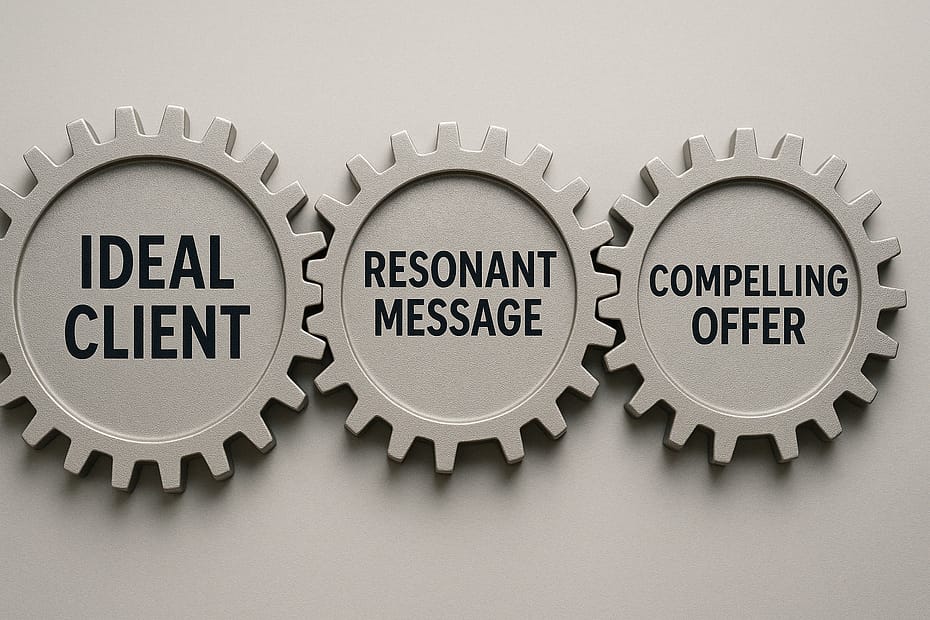
An effective sales strategy hinges on three core components: defining your ideal client profile (ICP), crafting a resonant message, and presenting a compelling offer. These elements are interconnected. Mastering their alignment will significantly enhance your sales effectiveness.

Ideal Client Profile

Let’s start with the ideal client profile. How well do you know the companies you’re targeting? Identifying your ideal customer is foundational to your entire sales approach. It’s not enough to say that your market is “small businesses” or “tech companies.” Instead, think about your best clients—the ones you genuinely enjoy working with, who value your product, and who generate profitable, sustainable business. Think about companies that rarely devalue your product or service by asking for a discount. What do these clients have in common?

Now that you have your favorite customers from above, reflect on your top five or ten accounts. Are they in the same industry? Do they share similar challenges or company structures? Perhaps they all have common goals that your product consistently solves. Pinpoint these commonalities. This process will help you create a precise and actionable ideal client profile.

But don’t stop at company-level characteristics. Remember, even in B2B sales, you’re ultimately selling to individuals. Identify the specific roles or buyers within these organizations that are responsible for making buying decisions. Who are these decision-makers? What motivates them personally and professionally? Do they all have the same kind of college education? Do they all have similar career paths? Understanding the people behind the logo makes your outreach more personal, targeted, and effective.

What is your message?

Once you’ve developed a clear picture of your ideal client and the people within those companies, the next step is crafting a message that reflects your value-selling message. This message is how you communicate your value proposition—it’s the bridge between your product and your prospect’s needs. Too often, sales messaging falls flat because it focuses heavily on the seller rather than the buyer. Statements that emphasize “we,” “I,” or “our product” rarely resonate deeply. Instead, effective messaging highlights the customer’s perspective, clearly communicating the benefits they will experience.

Read the rest of the article…


Stop Guessing. Start Assessing: The First Step Toward Sales Growth

Are you feeling stuck in your sales organization? You’re not alone. Many founders, CEOs, and sales leaders eventually hit an invisible wall—a growth plateau. Key deals slip away. Your top salesperson, who carries far too much weight, starts to burn out.

In these moments, the instinct is often to push harder. But what’s needed isn’t more hustle. It’s clarity. And clarity starts with a strategic sales assessment.

What a Sales Assessment Means

Too often, leaders see assessments as formalities—checklists that confirm what they already believe. That’s a mistake. An accurate sales assessment is diagnostic. It reveals what’s working, what’s broken, and what’s missing.

Revenue growth doesn’t always mean you’re on the right path. Many companies are growing despite misalignment, not because of strategic execution. Are your sales activities aligned with your market opportunity? Are you pursuing the right prospects with the right message? Or are you just getting lucky?

Read the rest of the article…

Stop Guessing, Start Growing: How Strategic Sales Assessments Drive Real Revenue

You’ll eventually hit a wall if you’re running a sales organization—or wearing multiple hats as founder, CEO, and sales manager. That wall is often invisible until growth stalls, key deals slip through the cracks, or your top salesperson burns out. So, what’s the next move? It’s not more hustle. It’s assessment.

A sales assessment isn’t about checking boxes. It’s about understanding where you are, how you operate, and what’s holding you back. Too many small business leaders assume they’re doing fine because revenue is growing or the team is hitting their quotas. But are you growing at the rate your market allows? Are your sales activities aligned with your long-term goals? Are you building a repeatable system, or are you just getting lucky?

Let’s get tactical. A sales plan isn’t just a revenue target. It’s your go-to-market strategy. It defines your audience, your message, and your motion. It answers why you’re talking to those prospects and what value you’re bringing to them. Without a plan, you’re reacting instead of executing. You’re chasing leads instead of building a pipeline.

If you’re a small company—perhaps under $30 million in revenue—and selling into a national market, chances are your market potential is hundreds of millions, maybe billions. That means your market share is a rounding error, which means there’s room to grow. The question is: Are you operating in a way that allows you to capture that growth?

Even if you’re running lean, you should benchmark your performance against top-tier organizations. Not because you’re competing with them directly, but because they set the standard. What are they doing that you’re not? Where are they more efficient? How do they structure their teams? You’re leaving money on the table if you’re not asking those questions.

Read the rest of the article…

Two Tall Guys Talking Sales – Know Your Numbers: A Sales Leader’s Guide to Growth Metrics – E132

As Q2 kicks into full gear, it’s time to pause and reflect—are you ahead, on pace, or falling behind on your sales targets? In this insightful episode of Two Tall Guys Talking Sales, hosts Kevin Lawson and Sean O’Shaughnessey unpack one of a sales leader’s most crucial yet often overlooked responsibilities: knowing your numbers. With equal parts practical advice and strategic vision, this conversation walks you through the foundational metrics every sales leader should track—customer… 

Why Cold Calling is Dead: The Shift to Relationship-Based Selling

Building an effective sales pipeline requires a shift in strategy. Traditional cold calling has become increasingly ineffective, with decision-makers ignoring unsolicited calls and emails.

In the spring of 2021, Bank of America Corp.’s Merrill Lynch Wealth Management unit banned trainee brokers from making cold calls. According to the Wall Street Journal, it is hard to succeed with cold phone calls in an era when no one picks up. Merrill executives said personal referrals lead to a response around 40% of the time, but less than 2% of people who are cold-called even answer the phone.

Sales teams must adopt a more strategic approach, focusing on relationships rather than volume-based outreach. The key is leveraging existing networks to create warm introductions, significantly improving engagement rates and overall success.

Cold outreach has become expensive and inefficient, and the time spent dialing numbers, leaving voicemails, and sending emails that never get opened results in diminishing returns. Many executives no longer answer unknown calls, and email filters automatically sort cold outreach into spam. Even when messages get through, recipients are skeptical, assuming they are generated by automation rather than a genuine human connection. In reality, sales professionals must find a better way to reach their target audience.

Relationship-based selling offers a more effective alternative. Salespeople should focus on leveraging their connections instead of reaching out to strangers. This approach involves identifying key contacts who can provide warm introductions to potential prospects. These “super connectors” are individuals with strong networks and the ability to facilitate meaningful introductions. By tapping into these relationships, sales teams can bypass the skepticism associated with cold outreach and start conversations with credibility.

Read the rest of the article…

Turning Competition into Opportunity: A Guide for Success in Sales

Competition in B2B sales isn’t your enemy. It’s your greatest catalyst for growth and innovation in today’s dynamic market landscape. Have you considered how viewing competitors as opportunities rather than threats could transform your sales approach? Let me show you why this mindset shift matters for your bottom line.

Think beyond the obvious when identifying your competition. Your real rivals aren’t just companies selling similar products or services. They’re anyone competing for your prospect’s budget allocation. This includes businesses offering solutions with capabilities or price points different from yours and other priorities within the prospect. The competitive landscape extends far beyond your direct market segment.

The most formidable opponent often lurks in the shadows of customer inertia. This “no-decision” competitor manifests as your prospect’s resistance to change. It’s the comfort zone that whispers, “Maybe later,” or “What we have works fine.” Understanding this psychological barrier is crucial for your sales strategy.

You need a systematic approach to analyzing and outmaneuvering your competition. Start with an honest assessment of your position in the market. What unique value do you bring to your customers? Where do you consistently outperform others? This self-awareness forms the foundation of your competitive strategy.

Know your competition inside and out. Study their strengths, weaknesses, market positioning, and customer relationships. Your competitive analysis must go deeper than surface-level observations. Map out how their strengths align with your weaknesses. This intelligence helps you craft more compelling value propositions and sales approaches.

Read the rest of the article…

Two Tall Guys Talking Sales – The Motivation Formula: Achieving Big Wins in Sales – E116

This episode of Two Tall Guys Talking Sales delivers powerful insights into staying motivated and setting actionable sales goals. Sean and Kevin expertly weave relatable analogies with proven strategies to help you master the art of self-motivation and goal achievement. Whether you’re working towards a personal milestone or aiming to inspire your team, this episode provides the tools to elevate your performance. Tune in and take control of your sales journey today!

Two Tall Guys Talking Sales – Future-Proofing Your Sales with the Right Tech Stack – E115

This episode of Two Tall Guys Talking Sales is a must-listen for anyone looking to future-proof their business. Kevin and Sean offer practical advice and actionable strategies to help you streamline operations, adopt cutting-edge technologies, and align your team for success. Whether you’re planning for 2025 or 2035, the insights shared in this episode will set you on the path to achieving your goals.

Adapting to the New Sales Landscape: The Importance of Omni-Channel Outreach

Are you still relying on trade shows as your primary sales driver? The sales landscape has undergone a seismic shift. Those packed convention halls and endless rows of booths no longer serve as the bedrock of business development they once were.

Let’s talk about what works in today’s sales environment. Building an effective outbound pipeline isn’t just an option anymore – it’s your survival toolkit. But here’s the challenge: how do you stand out in a market where everyone’s fighting for attention?

Your unique value proposition makes all the difference. Yet many sales professionals miss a crucial point: your value proposition isn’t static. What resonates with a manufacturing client might fall flat with a distribution company. Have you tailored your message to address each industry’s pain points?

Think about your last prospecting campaign. Did you give up after four or five attempts? Research shows it takes 12 to 16 touches before prospects typically respond. This gap between persistence and practice often determines success or failure in modern sales.

The game has changed. Your prospects live in an omnichannel world. They check email between Zoom calls, scroll LinkedIn during lunch, and scan their phones throughout the day. How are you showing up in their digital world?

Consider this: every unanswered email or phone call might be a messaging problem. Are you talking about your features when you should be solving your prospects’ problems? Your prospects don’t care about your product specifications. They care about their challenges, their goals, and their bottom line.

Read the rest of the article…

Balancing Act: Networking, Direct Prospecting, and Customer Referrals for Revenue Growth

Is your sales pipeline running dry? We’ve all been there.

Let me share a personal story that might resonate with you. After spending months securing a major deal, I found myself staring at an empty pipeline. The celebration of landing that giant whale quickly became a stark reality check. This experience taught me an invaluable lesson about sustainable sales growth.

Revenue generation isn’t just about closing deals—it’s about maintaining a consistent flow of opportunities. Your success depends on mastering the art of prospecting, yet many salespeople struggle with this fundamental skill. Are you dedicating enough time to building your pipeline, or are you caught in the feast-and-famine cycle?

The most effective sales professionals understand that prospecting isn’t a one-dimensional activity. Think of your prospecting strategy as a carefully orchestrated symphony, where different elements work together to create a harmonious result. Direct outreach and network-based approaches each play their unique roles in this composition.

Visualize a three-legged stool symbolizing the three-pronged approach to sales: networking and referrals, direct prospecting, and existing customers. Each of these legs supports growing your business and consistently achieving your revenue goals.

Consider how a software company might approach this dual strategy. While tracking metrics for direct outreach is straightforward, measuring networking success requires a different lens. How many new relationships have you cultivated? Which dormant connections have you rekindled? These indicators matter just as much as your cold call statistics.

I recently spoke with a consulting professional who shared an interesting perspective on networking metrics. Rather than counting sales pitches, he measures success by the number of times he naturally introduces his services in conversations. This subtle shift transforms aggressive selling into educational opportunities. Have you considered how this approach might work in your context?

Your prospecting strategy must align with your target audience’s expectations and behaviors. Waiting for inbound leads isn’t a strategy—it’s a recipe for inconsistent results. When you prospect through your network, the goal isn’t to ask for immediate business. Instead, you’re planting seeds for future opportunities through strategic introductions.

Read the rest of the article…