Skip to content

pain

What An MBA Didn’t Teach You About Sales

The sales profession is challenging. You need to work hard at it to succeed. You need to learn from the best. You need to improve your skills continuously. If you think you can sell since you are a hit at parties and have a lot of friends, you may soon find that you are a failure as a salesperson. Blunt truth:

because the sales profession is so hard, you have to focus on doing everything in sales very well, or you will be considered a failure.

I call this blog, Skinned Knees because I try to relate all of the learning that I have done over the past 4+ decades (while skinning my knees in the learning process).

I hope that you learn from my mistakes so that your business will grow!


Stop Wasting 70% of Your Day: Reclaiming Active Selling Time with Agentic AI

Episode Summary

In this episode of AI Tools for Sales Pros, Sean O'Shaughnessey examines the administrative tax quietly draining sales productivity, revenue generation, and sales success across B2B teams. Using the story of a high-performing sales rep trapped in post-meeting digital grunt work, the episode shows how manual CRM updates, travel coordination, expense reporting, and fragmented sales processes keep reps away from the work that actually creates value.

Sean introduces the Agentic Transformation, a shift from simple automation to AI-powered orchestration that allows sales teams to use artificial intelligence to reduce low-value tasks and increase high-value selling time.

The episode gives sales leaders a practical path for using orchestration tools like n8n and Make.com to improve sales management, business acumen, messaging, value selling, and revenue management.

Major Highlights

The episode opens with the core problem facing many B2B sales teams: sellers are spending too much of their week on administrative work instead of active selling. Manual CRM hygiene, follow-up documentation, receipt management, travel logistics, and calendar coordination are not minor inconveniences. They represent a measurable drag on revenue generation.

The episode reframes the role of AI in sales. The goal is not to replace the salesperson. The goal is to amplify the salesperson by moving low-value mechanical execution away from humans and into well-designed agentic systems.

Sean introduces Agentic Transformation as the next stage beyond basic automation. Instead of rigid workflows that follow simple linear logic, agentic systems use artificial intelligence and large language models to interpret unstructured information, reason through context, and execute multi-step actions across the sales tech stack.

The episode lays out a five-stage path to agentic maturity: Foundations, Context and Engagement, Automation, Autonomous Solutions, and Orchestration. For most sales leaders, the immediate opportunity is stage three: automating high-friction administrative work so sales professionals can reclaim meaningful selling time.

The larger message is that the future of B2B sales is not humans versus AI. It is humans amplified by AI. The strongest teams will use artificial intelligence to protect human energy for trust-building, strategic judgment, business acumen, and value selling.

Read the rest of the article…
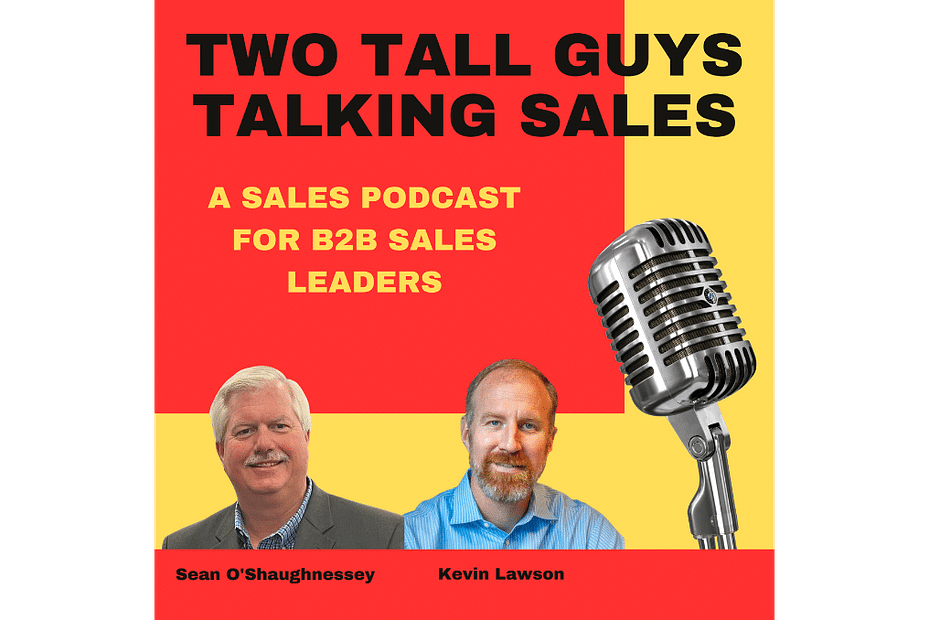

Two Tall Guys Talking Sales Podcast – Pipeline Hygiene, Forecast Accuracy, and Sales Success in Q2 – Episode 183

In this episode of Two Tall Guys Talking Sales, Kevin Lawson and Sean O’Shaughnessey turn an informal B2B Sales Lab office-hours conversation into a sharp discussion on pipeline hygiene, forecast accuracy, and the habits that separate serious sellers from hopeful ones. What starts as a conversation about cleaning up Q2 quickly becomes a broader lesson in sales management, business acumen, and personal accountability. They dig into why sloppy CRM data creates bad decisions, why aspirational close dates damage credibility, and why real sales success still comes back to disciplined sales processes and direct customer contact. For sales professionals, sales leaders, and anyone responsible for revenue generation, this episode is a practical reset.

Key Topics Discussed

Why pipeline hygiene matters right now (02:11)
Kevin opens with a blunt point: whether you are ahead, behind, or exactly on plan, now is the time to clean up your pipeline. Dead leads need to be removed, stalled opportunities need clear next steps, and unrealistic deals need to be moved to a timeline that reflects reality. This is more than administration. It is the foundation of reliable sales management and cleaner revenue management.

The danger of aspirational forecasting (08:08)
Sean and Kevin take aim at one of the oldest problems in selling: the fantasy close date. They explain why putting deals into the quarter just to make the pipeline look healthier undermines trust, makes leadership harder, and creates unnecessary scrutiny. Good forecasting is not about optimism. It is about judgment, honest messaging, and the discipline to call a deal what it is.

How to handle slipped deals before they slip again (06:00)
Sean breaks down what a slipped deal really means. If an opportunity slips once, it may be explainable. If it slips twice, the seller needs to challenge the underlying need, timing, and pain more aggressively. That turns the conversation from passive deal chasing into value selling, where the seller must re-establish why the problem matters now.

What accurate CRM ownership really signals (10:38)
Sean makes the standard clear: if your name is on the deal, the record should reflect your best understanding of reality. That includes dates, scope, amount, risks, and notes. He also draws an important distinction between uncertainty and carelessness. Missing information can be understandable. Failing to document what you do know is not. This is where disciplined sales processes and professional credibility meet.

How strong sellers earn trust and promotion opportunities (14:27)
The conversation shifts from data quality to career trajectory. Sean argues that sellers who forecast accurately, exceed quota, and help others improve naturally build the reputation that leads to advancement. Kevin reinforces that when a manager asks you to teach the rest of the team how you work, that is one of the clearest signals that your approach is working.

The KPIs that actually move performance (17:55)
As they wrap up, Kevin and Sean focus on useful performance indicators. Not vanity metrics. Not activity for activity’s sake. They emphasize developing new relationships, preparing for meetings, asking for next steps, requesting the order, requesting referrals, and increasing one-to-one customer conversations. The point is simple: better sales strategies come from better behaviors, repeated consistently.

Key Quotes

Kevin Lawson (08:26)
“Aspirational close date is absolute garbage.”

Sean O’Shaughnessey (10:38)
“Your name is on the deal… I expect it to be an accurate representation as you understand it.”

Sean O’Shaughnessey (19:13)
“The metric that always works, always, always works is if you’re talking to a customer, you’re probably doing good things.”

Kevin Lawson (17:04)
“He really cares about how many people he helped get to President’s Club.”

Additional Resources

B2B Sales Lab
Sean and Kevin refer throughout the episode to the B2B Sales Lab community, a peer environment for salespeople, sales leaders, and sales professionals who want to sharpen execution, exchange insight, and improve sales success through practical discussion.

Previous episode featuring Joe English (16:53)
Kevin references the March 31 episode with Joe English, particularly around leadership, development, and the idea that strong leaders measure success by how many people they help reach top performance.

A Significant Actionable Item from this Podcast

Run a hard review of every open deal and lead in your CRM this week. Remove dead opportunities, reset unrealistic close dates, document the real blockers, and assign a next step with a deadline. Then identify every deal that has slipped more than once and ask a tougher question: what is the real business pain of not solving this now? That one exercise improves messaging, strengthens forecast credibility, and gives you a cleaner base for revenue generation in the quarter ahead.

Read the rest of the article…

Two Tall Guys Talking Sales Podcast – Sales Success Starts Here: Find Customer Pain, Align Goals, Win Bigger Deals – Episode 180

This episode of Two Tall Guys Talking Sales gets to the heart of a mistake too many sellers make: they confuse product talk with real value. Kevin Lawson and Sean O’Shaughnessey unpack the difference between pain and goals, then push the conversation further into what actually matters in sales success, understanding how buyers measure outcomes, how decisions get made, and how to connect your offer to revenue generation, business acumen, and meaningful results. This is not a discussion about clever wording. It is a discussion about how better sales strategies, sharper messaging, and stronger value selling lead to better sales management and more credible revenue management conversations. If you sell into complex environments, this episode will sharpen the way you think about sales processes and how customers justify change.

Key Topics Discussed

Pain vs. goals in the buying decision (01:00)
Sean breaks down the practical difference between a problem someone can tolerate and a goal important enough to fund. That distinction matters because many stalled deals are not really lost deals; they were never priority deals in the first place.

Why value selling must be framed in the customer’s terms (05:00)
Kevin argues that buyers do not care about features, benefits, or polished collateral unless those things connect to outcomes they actually measure. This is a strong lesson in messaging, sales processes, and how sales success depends on tying effort to business value.

How to quantify what matters to the buyer (08:00)
The conversation shifts into measurement. Kevin explains that whether you start with pain or start with goals, the real work is quantifying the impact. That means understanding the individual persona, how they are evaluated, what drives their bonus, and what creates personal and professional value for them.

Small deals are often pain deals. Big deals are usually goal deals. (10:00)
Sean makes an important distinction for sellers working on larger opportunities. Small purchases often solve immediate operational pain. Larger purchases require alignment with broader corporate priorities, capital allocation, and the economics of long-term return.

How value selling connects cost, payoff, and timing (11:00)
Sean brings the discussion back to core business acumen: what does it cost to live with the problem, what does it cost to solve it, and what is the payback? That is where revenue management, value selling, and serious sales strategies stop being theory and start becoming executive-level conversations.

Key Quotes

Kevin Lawson (00:01)
“Don’t get wrapped around the axle on words, but get wrapped around the axle on how you’re gonna create value for your next deal.”

Kevin Lawson (07:03)
“Our job as salespeople is to create insights around what value we bring.”

Kevin Lawson (09:16)
“People don’t buy the project, they buy the outcome.”

Sean O’Shaughnessey (09:45)
“Drills are about putting holes in something else. Buying a drill is worthless.”

Sean O’Shaughnessey (11:37)
“How much does it cost to put up with it, and how much does it cost to solve it?”

Additional Resources

B2B Sales Lab
A private community for sales professionals who want help solving real sales problems in a non-public setting.
b2b-sales-lab.com

A Significant Actionable Item from this Podcast

Take one active opportunity in your pipeline and force yourself to answer three questions in writing: Is this deal driven by pain or by a goal? How is that pain or goal quantified in business terms? Who inside the account actually has the authority to fund the solution?

That exercise sounds simple, but it exposes weak sales thinking fast. It improves messaging, strengthens value selling, and helps you determine whether you are dealing with a tolerated inconvenience or a real business priority. In practical terms, it will make your sales processes more disciplined and improve your ability to pursue revenue-generating opportunities that can actually close.

Read the rest of the article…

Reclaiming 15 Hours a Week: The Sales Professional’s Guide to Surviving and Thriving in the Age of AI

Episode Summary

If you feel like your CRM is turning great sellers into tired administrators, you’re not imagining it. This episode breaks down the administrative drag that steals selling time, distorts forecasts, and quietly taxes revenue generation.

We introduce a practical artificial intelligence approach: automate the inputs, then humanize the output so your messaging stays authentic and effective.

The outcome is simple: higher-quality sales processes, stronger sales management decisions, and better Sales success without adding headcount.


Major Highlights

  • The real productivity crisis in B2B sales: administrative drag, CRM debt, and the “technology trap” of too many tools that create more manual work.
  • Why the old brute-force model is breaking: buyers self-educate earlier, competitors respond faster, and generic messaging gets ignored.
  • The core principle: Automate the Input, Humanize the Output. Use AI for research, data capture, and workflow execution while humans control judgment, voice, and value selling nuance.
  • How Benjamin Todd’s “human bottlenecks” framework applies to sales: as AI automates routine work, business acumen, strategic leadership, and complex social intelligence become more valuable.
  • Orchestration engines (n8n and Make.com) as the nervous system: connecting CRM, email, LinkedIn, and transcripts into cohesive sales strategies and repeatable sales processes.
  • Cognitive Prospecting: use AI listening posts to detect triggers (exec hires, funding, cost containment signals) and arrive with a “why now” dossier instead of starting from scratch.
  • One-to-One-at-Scale outreach: generate hyper-relevant drafts from a strategic brief and prospect dossiers, then apply a human “smell test” so messaging lands.
  • Immediate Recap workflows: transcripts flow into structured CRM updates, follow-up tasks, and recap email drafts, accelerating deal momentum and improving revenue management.
  • Always-On Hygiene: AI deduplication and fuzzy matching to reduce bad data, improve forecasting, and protect downstream automation quality.
  • Predictive intelligence and deal risk: revenue intelligence platforms flag risk signatures earlier than human inspection, improving pipeline accuracy and resource allocation.
  • Sales management evolution: managers move from pipeline inspectors to augmented coaches using call analysis to focus coaching where it changes outcomes.
  • The practical end state: more selling time, faster follow-up, improved win rates, and a human-AI centaur model where humans own the last mile.
Read the rest of the article…

From CRM Debt to a Cognitive Revenue Engine: Reclaiming Selling Time with AI

Most B2B sales teams don’t have a talent problem. They have a capacity problem.

Administrative drag is quietly stripping selling time: CRM updates, stakeholder mapping, duplicate cleanup, meeting summaries, and the constant “what should I say next?” work that should not be consuming a senior seller’s day. The downstream damage is bigger than annoyance. Forecast accuracy declines, coaching becomes reactive, and revenue management turns into a negotiation with incomplete data.

Artificial intelligence can fix this, but only if you use it with the right operating model.

Benjamin Todd’s article “How not to lose your job to AI” makes the point that AI doesn’t simply eliminate jobs; it shifts where value concentrates. As routine tasks become cheap, the remaining human bottlenecks become more valuable. Todd’s ATM example is the cleanest version of the idea: ATMs reduced the need for “money counting,” but the overall demand for human banking roles didn’t collapse. The job shifted toward customer-facing work and higher-leverage conversations.

In B2B sales, our “money counting” is CRM entry, list building, and manual research. Our high-leverage work is business acumen, strategic influence, stakeholder alignment, and value selling. The problem is that most teams have it backwards: humans do the hardest input work (research, logging, hygiene), then AI writes the customer-facing messages. That combination produces drained sellers and generic messaging.

A better model is: Automate the input, humanize the output.

Read the rest of the article…

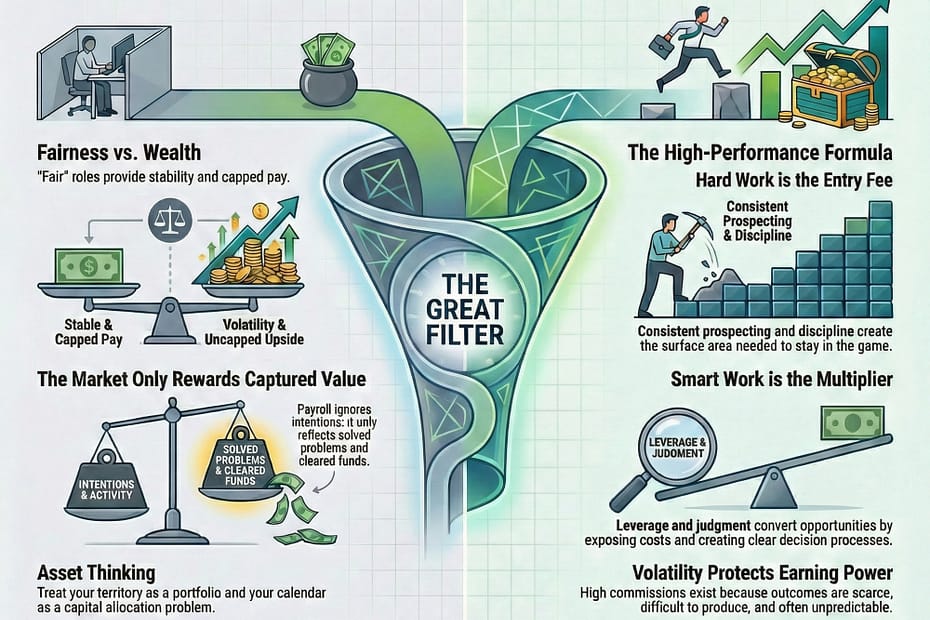
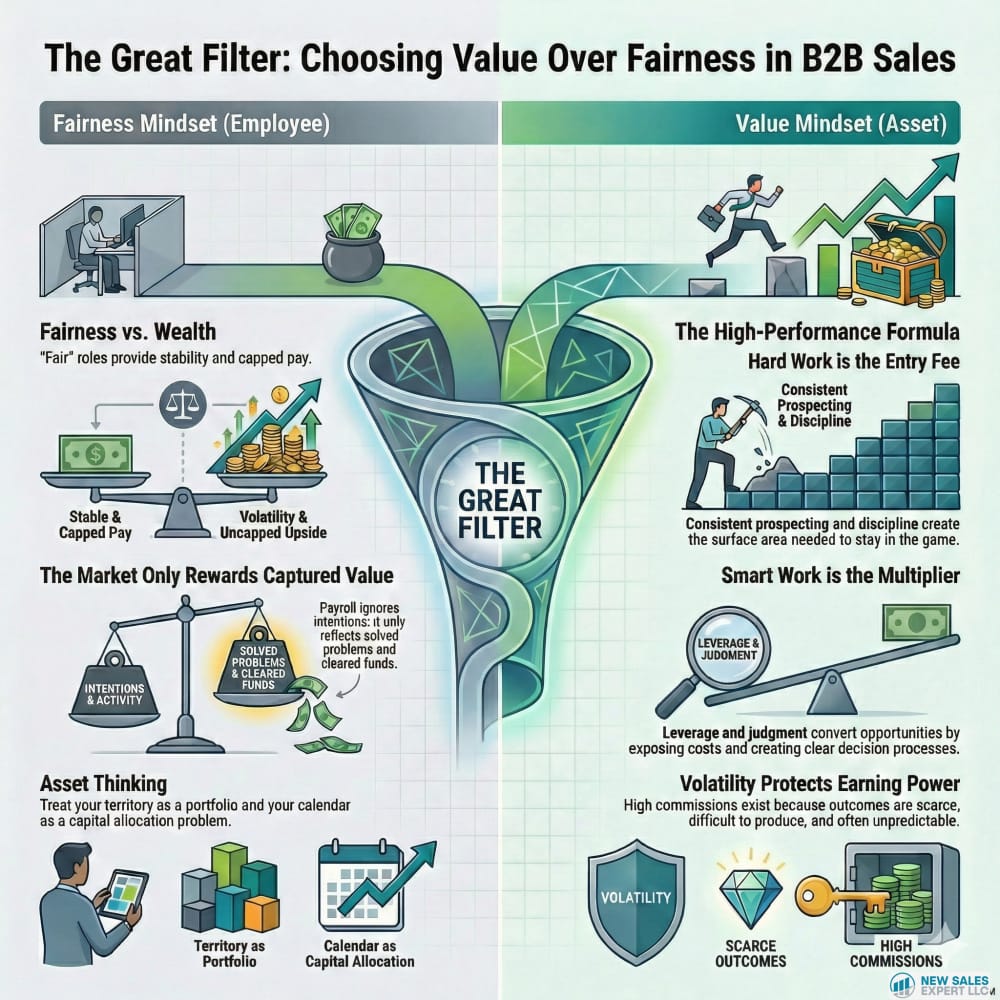
The Great Filter – Why Most People Should Quit B2B Sales Today

If you want fairness, choose a role where performance is measured by compliance and consistency. If you want wealth, stay in sales and accept the only rule that matters: compensation follows captured value.

Walk into any growth-stage B2B sales organization, and you see two populations immediately:

  • One group is stuck in grievance. They stare at the CRM, explain shortfalls with lead quality, territory math, product gaps, or “unrealistic quota.” They want a manager to prescribe the playbook and then validate the effort. Their mindset is hourly, even when they’re paid a salary plus commission.
  • The other group is operating a different model. They talk about leverage, pipeline physics, conversion rates, deal control, and enterprise value. They create their own opportunities. They build customer confidence and earn the right to ask for a decision. They are not looking for comfort. They are looking for the wire.

If you identify with the first group, here’s the most respectful advice I can give you: exit sales on purpose. Move into HR, operations, finance, project management, enablement, customer success, analytics, or any role where the exchange is stable and the scorecard is predictable. Those functions matter. They are important and critical to most companies. They keep companies alive. They are also structurally designed to be fairer.

Sales is designed to be variable, value-based, and exposed. That’s the point.

The safety-net trap

Most people walk into sales carrying the wrong conditioning. School teaches that effort should correlate with reward. Show up, do the work, get the grade. Many corporate functions reinforce it. Do the tasks, hit the process metrics, stay inside the lines, and get the raise.

That conditioning becomes a trap the moment you step into a quota role.

In “fair” roles, compensation tracks your cost and your consistency. Your output is capped by your time, so your income is capped by a band. It’s stable, and it’s a ceiling.

Sales is different because it’s one of the few places left where pay can scale with impact. You are not paid for effort. You are paid for outcomes. That makes it feel brutal to people who want certainty, and it feels like freedom to people who want upside.

The moment you need the world to be fair, sales will punish you. The moment you accept the model, sales becomes one of the most rational games in business.

B2B Sales is rewarding because it isn’t easy or fair
Read the rest of the article…

Why B2B Sales Teams Miss Targets: An AI Operating Model to Eliminate Admin Drag

Episode Summary

In this episode of AI Tools for Sales Pros, we tackle the hidden operational drag limiting revenue generation across B2B teams: highly paid sellers spending most of their week on administrative work instead of customer conversations. The conversation reframes this as a sales management and revenue management problem, not a rep effort problem, and outlines how artificial intelligence and AI orchestration can reverse the trend.

You’ll hear a practical shift from “artisan sales” toward a Cognitive Revenue Engine where automation handles data-heavy tasks, and people focus on value selling, messaging, judgment, and trust. The result is a more scalable model for Sales success built on better Sales processes, stronger Business acumen, and faster execution.

Major Highlights

  • The core bottleneck in modern B2B selling is not activity volume; it is administrative drag that consumes prime selling time and weakens pipeline momentum.
  • Most teams are trapped in a Technology Trap: adding tools without orchestration, which increases complexity and reduces real customer-facing capacity.
  • The strategic shift is from “human-led, tech-assisted” to “tech-led, human-centric,” where AI handles repetitive data entry, and sellers own high-value decisions.
  • The Autonomous Revenue Engine is presented as an integrated operating model, not a single app—combining data hygiene, automation workflows, and AI content support.
  • No-code orchestration platforms (for example, Make.com, Zapier, n8n) are the connective layer that turns disconnected tools into coordinated execution.
  • Signal-Based Selling replaces manual account research with AI-powered monitoring for buying triggers, strategic shifts, and timely engagement opportunities.
  • The “Editor-in-Chief” model upgrades seller productivity: AI drafts and structures; humans validate, refine, and personalize quickly.
  • Always-On Hygiene is non-negotiable: deduplication, normalization, and CRM integrity are prerequisites for reliable AI outputs and budget efficiency.
  • The 80/20 “last mile” principle remains central: AI can handle the first 80%, but human context, empathy, and risk judgment determine deal quality.
  • A deterministic hybrid model protects trust by keeping facts and pricing rules-based while using AI for language and speed.
Read the rest of the article…

Sixty-Second Slide Review: Use AI to Build Better Slide Decks and Win Back Selling Time

Episode Summary

It’s late Thursday, and you’re stuck building a “pivotal” executive deck with no marketing support, no design help, and no extra hours—so you pay the hidden sales tax: administrative drag that steals selling time and dulls your edge.

In today’s B2B environment, the problem isn’t effort; it’s the Tollbooth Effect—manual CRM updates, document hunting, and slide formatting that cools deals and slows revenue generation.

This episode lays out a practical AI-augmented productivity suite approach that turns you into an editor-in-chief: AI handles structure and mechanics, you handle judgment, tone, and human impact. The result is faster, cleaner messaging, stronger sales processes, and more time for real revenue management work.

Major Highlights

  • The “sales tax” is real: administrative drag and internal processes consume the majority of a seller’s week, starving revenue-generating activity and limiting Sales success.
  • The Tollbooth Effect: momentum from discovery dies when the system forces manual labor—CRM hygiene, notes cleanup, and deck formatting—right when you should be advancing the deal.
  • The Producer Mindset shift: your value is strategy, business acumen, and human connection; technology executes content creation and formatting at machine speed.
  • The workflow: use tools like Microsoft Copilot or Gemini for Workspace to turn transcripts and notes into structured inputs; then generate a slide-by-slide narrative from a strategic brief.
  • The human-in-the-loop protocol: you are not the author, you are the editor—review each slide for accuracy, tone, and the emotional reality behind the buyer’s problem.
  • The Sixty-Second Slide Review: compress a four-hour deck build into a ten-minute strategic review, improving responsiveness and increasing pipeline velocity.
  • Tool paths across ecosystems: PowerPoint automation via VBA generation, Google Slides creation via Gemini Canvas with export, and Keynote creation via AppleScript—same outcome, different environment.
  • Why it matters: reclaiming selling time compounds into higher output, better value selling conversations, and a visible “halo effect” from professional, fast follow-up.
  • Clean data is the multiplier: “always-on hygiene” turns your CRM into a trustworthy source of truth, improving the accuracy of AI-generated outputs and strengthening customer confidence.
  • AI fluency is not coding: it’s orchestrating tools to produce insight and execution—practical sales strategies that let you move faster without losing the human center.
Read the rest of the article…

The Producer Mindset: Tech-Led, Human-Centric Selling for Faster Pipeline Velocity

Administrative drag is not an inconvenience. It’s a structural failure in modern B2B sales that quietly taxes performance, slows pipeline velocity, and degrades your ability to show up sharp for buyers.

The pattern is predictable. You earn a hard-won meeting with an executive. You know you need a tailored deck that speaks to their priorities. Then reality hits: marketing is backlogged, design is unavailable, and you’re left formatting slides at night like a part-time desktop publisher. That’s the sales tax: time and energy spent on non-selling work that steals capacity from revenue generation.

This is the Tollbooth Effect in action. You build momentum in discovery, then you hit the system’s plaza: CRM updates, meeting notes cleanup, searching old folders for case studies, and wrestling with presentation software. The deal cools while you “pay.” Your edge dulls, not because you can’t sell, but because the operating model forces you into manual labor at the worst possible moment.

The fix isn’t working harder. It’s changing the role you play in the workflow.

In the Producer Mindset, your highest value isn’t typing, formatting, or slide layout. Your highest values are judgment, strategy, and human connection, and those can’t be automated. Technology should lead on mechanics while you stay accountable for truth, tone, and impact. This is a tech-led, human-centric approach: AI accelerates the work, but you control the meaning.

Read the rest of the article…

Generate Custom Proposals in Seconds from CRM Data

Episode Summary

Most B2B teams are still paying a hidden “sales tax” every time a proposal gets requested: hours of document assembly, copy-paste errors, and slow internal processes that kill deal momentum. This episode reframes proposal creation from an artisan craft into Strategic Response Management (SRM), where proposals become a dynamic asset and the rep becomes the producer, not the typist.

Using AI and automation as the nervous system of your sales stack, you can move from “Friday afternoon panic” to a 60-second executive review. The outcome is simple: faster response, cleaner Messaging, stronger Value selling, and more consistent Revenue generation.

Major Highlights

  • The real problem isn’t proposals. It’s the momentum gap created when internal processes delay a buyer-ready moment.
  • Why “The Artisan Trap” is outdated: 80% of most proposals are recycled boilerplate masquerading as personalization.
  • Strategic Response Management (SRM): proposals as a continuously improved system, not a static Word document.
  • How the modern sales stack works as a “nervous system”: CRM status change triggers automated assembly, data pulls, pricing, and version control.
  • Where artificial intelligence actually belongs: rewriting the executive summary using the prospect’s own words and tailoring proof points, without breaking brand standards.
  • The “60-Second Review” operating model: reps edit and approve instead of starting from a blank page.
  • Context-rich alerting: interactive proposals that show engagement data so sales management can coach deal strategy instead of proofreading.
  • Standards before Automation: AI amplifies what you already do, so sloppy Sales processes just get faster.
  • Impact examples: faster proposal creation, improved win rates, and better Revenue management through speed and relevance.
  • The Document Friction Audit: a simple way to quantify the hours lost per deal and identify what to automate first.
Read the rest of the article…