
Skip to content

two tall guys talking sales

What An MBA Didn’t Teach You About Sales

The sales profession is challenging. You need to work hard at it to succeed. You need to learn from the best. You need to improve your skills continuously. If you think you can sell since you are a hit at parties and have a lot of friends, you may soon find that you are a failure as a salesperson. Blunt truth:

because the sales profession is so hard, you have to focus on doing everything in sales very well, or you will be considered a failure.

I call this blog, Skinned Knees because I try to relate all of the learning that I have done over the past 4+ decades (while skinning my knees in the learning process).

I hope that you learn from my mistakes so that your business will grow!


Two Tall Guys Talking Sales Podcast – With Great Pipeline Power Comes Great Responsibility: Fix Your Sales Forecast – Episode 185

Two Tall Guys Talking Sales hosts Kevin Lawson and Sean O’Shaughnessey tackle one of the most overlooked drivers of sales success: forecast accuracy. This episode goes beyond the usual conversation about CRM hygiene and quota pressure to get to the real issue: salespeople and sales managers carry critical information that the rest of the company depends on for hiring, staffing, planning, and revenue generation. Sean and Kevin argue that forecasting is not administrative overhead. It is a direct reflection of discovery quality, business acumen, value selling, and the discipline of running strong sales processes. If you want sharper sales management, more credible messaging, and a more reliable path to revenue management, this conversation is worth your time.

Key Topics Discussed

Why forecasting is a leadership responsibility, not just a sales task (00:00)
Sean opens with a memorable analogy: with great power comes great responsibility. Salespeople hold information no one else in the company has—what is likely to close, when it will close, what the buyer needs, and what revenue is actually coming. That knowledge creates an obligation to communicate with accuracy.

How poor forecast data affects hiring, staffing, and company decisions (02:00)
Kevin makes the stakes clear. Forecast data is not trapped inside the sales department. Executive teams use it to make staffing decisions, resource plans, and growth bets. When the data is weak, the business makes bad decisions.

Why discovery is the foundation of accurate forecasting (05:00)
Sean ties forecasting directly to discovery. If you do not ask tough questions early, you will eventually pay for it later in the sales cycle. Strong discovery clarifies the customer’s business drivers, strengthens messaging, improves value selling, and makes forecast confidence more credible.

Why sales strategies fail when pipeline discipline is weak (08:07)
Kevin connects forecasting to pipeline reality. Leaders cannot force a number into existence simply because they want growth. If the top of the funnel, qualification discipline, and relationship development are not in place, the revenue generation target is a fantasy, not a strategy.

Why customers buy outcomes, not features (09:21)
Both hosts reinforce a central truth of value selling: buyers care much more about business impact than about technical specifications. The real issue is not the drill, but the hole—and even more than that, what the hole allows them to accomplish.

How inaccurate forecasting damages real people and real businesses (13:13)
Sean closes with a story from early in his career that shows the human cost of bad forecasting. A low forecast contributed to layoffs that, in hindsight, were unnecessary. It is a sharp reminder that revenue management is not theoretical. Accuracy matters.

Key Quotes

Sean O’Shaughnessey (00:00)
“One of the wisest men in all of sales is a gentleman by the name of Stan Lee.”

Kevin Lawson (02:02)
“The entire company is basing its hiring and staffing decisions on your data.”

Kevin Lawson (03:25)
“You have to ask tough questions early.”

Sean O’Shaughnessey (07:46)
“You document all that, and you tell your boss the truth. It’s as simple as that.”

Kevin Lawson (11:20)
“Put the date that the customer should buy based on the insight you’ve gleaned, not the date that you want them to buy.”

Sean O’Shaughnessey (12:00)
“You don’t sell the drill, you sell the hole, and more importantly than that, you sell what goes through the hole.”

Additional Resources

B2B Sales Lab
Sean references the B2B Sales Lab community as a place for sales professionals and sales managers to ask questions, refine their thinking, and improve their skills in areas such as forecasting, sales processes, and revenue generation.

Chris Cocca on the importance of Discover
Sean mentions episode 85 featuring Chris Cocca, particularly his point that discovery is the most important part of the sales process. https://sites.libsyn.com/458454/transforming-opportunities-chris-coccas-insights-on-perfecting-the-discovery-meeting

A Significant Actionable Item from this Podcast

Audit your current pipeline and rewrite the expected close date for every meaningful deal based on buyer evidence, not seller hope.

That means looking at each opportunity and asking: What business issue is driving this purchase? Who has validated the urgency? What internal steps does the customer still need to complete? What evidence supports the date in CRM? This one habit sharpens sales management, improves forecast reliability, strengthens messaging, and forces better value selling. Most missed forecasts are not caused by bad luck. They are caused by untested assumptions that stayed in the pipeline too long.

Read the rest of the article…
Two Tall Guys Talking Sales Podcast – Pipeline Hygiene, Forecast Accuracy, and Sales Success in Q2 – Episode 183

In this episode of Two Tall Guys Talking Sales, Kevin Lawson and Sean O’Shaughnessey turn an informal B2B Sales Lab office-hours conversation into a sharp discussion on pipeline hygiene, forecast accuracy, and the habits that separate serious sellers from hopeful ones. What starts as a conversation about cleaning up Q2 quickly becomes a broader lesson in sales management, business acumen, and personal accountability. They dig into why sloppy CRM data creates bad decisions, why aspirational close dates damage credibility, and why real sales success still comes back to disciplined sales processes and direct customer contact. For sales professionals, sales leaders, and anyone responsible for revenue generation, this episode is a practical reset.

Key Topics Discussed

Why pipeline hygiene matters right now (02:11)
Kevin opens with a blunt point: whether you are ahead, behind, or exactly on plan, now is the time to clean up your pipeline. Dead leads need to be removed, stalled opportunities need clear next steps, and unrealistic deals need to be moved to a timeline that reflects reality. This is more than administration. It is the foundation of reliable sales management and cleaner revenue management.

The danger of aspirational forecasting (08:08)
Sean and Kevin take aim at one of the oldest problems in selling: the fantasy close date. They explain why putting deals into the quarter just to make the pipeline look healthier undermines trust, makes leadership harder, and creates unnecessary scrutiny. Good forecasting is not about optimism. It is about judgment, honest messaging, and the discipline to call a deal what it is.

How to handle slipped deals before they slip again (06:00)
Sean breaks down what a slipped deal really means. If an opportunity slips once, it may be explainable. If it slips twice, the seller needs to challenge the underlying need, timing, and pain more aggressively. That turns the conversation from passive deal chasing into value selling, where the seller must re-establish why the problem matters now.

What accurate CRM ownership really signals (10:38)
Sean makes the standard clear: if your name is on the deal, the record should reflect your best understanding of reality. That includes dates, scope, amount, risks, and notes. He also draws an important distinction between uncertainty and carelessness. Missing information can be understandable. Failing to document what you do know is not. This is where disciplined sales processes and professional credibility meet.

How strong sellers earn trust and promotion opportunities (14:27)
The conversation shifts from data quality to career trajectory. Sean argues that sellers who forecast accurately, exceed quota, and help others improve naturally build the reputation that leads to advancement. Kevin reinforces that when a manager asks you to teach the rest of the team how you work, that is one of the clearest signals that your approach is working.

The KPIs that actually move performance (17:55)
As they wrap up, Kevin and Sean focus on useful performance indicators. Not vanity metrics. Not activity for activity’s sake. They emphasize developing new relationships, preparing for meetings, asking for next steps, requesting the order, requesting referrals, and increasing one-to-one customer conversations. The point is simple: better sales strategies come from better behaviors, repeated consistently.

Key Quotes

Kevin Lawson (08:26)
“Aspirational close date is absolute garbage.”

Sean O’Shaughnessey (10:38)
“Your name is on the deal… I expect it to be an accurate representation as you understand it.”

Sean O’Shaughnessey (19:13)
“The metric that always works, always, always works is if you’re talking to a customer, you’re probably doing good things.”

Kevin Lawson (17:04)
“He really cares about how many people he helped get to President’s Club.”

Additional Resources

B2B Sales Lab
Sean and Kevin refer throughout the episode to the B2B Sales Lab community, a peer environment for salespeople, sales leaders, and sales professionals who want to sharpen execution, exchange insight, and improve sales success through practical discussion.

Previous episode featuring Joe English (16:53)
Kevin references the March 31 episode with Joe English, particularly around leadership, development, and the idea that strong leaders measure success by how many people they help reach top performance.

A Significant Actionable Item from this Podcast

Run a hard review of every open deal and lead in your CRM this week. Remove dead opportunities, reset unrealistic close dates, document the real blockers, and assign a next step with a deadline. Then identify every deal that has slipped more than once and ask a tougher question: what is the real business pain of not solving this now? That one exercise improves messaging, strengthens forecast credibility, and gives you a cleaner base for revenue generation in the quarter ahead.

Read the rest of the article…

Two Tall Guys Talking Sales Podcast – Joe English Helps the Two Tall Guys Understand How to Build Profitable Growth with Better Sales Management and Sales Processes – Episode 182

This episode of Two Tall Guys Talking Sales digs into a question that sits underneath almost every stalled growth story: why do good companies with solid offerings still fail to scale profitably? Kevin Lawson and Sean O’Shaughnessey sit down with Joe English of 360 Consulting to unpack what separates random sales activity from a real growth system. The conversation moves past personality-driven selling and into the mechanics of sales management, sales processes, messaging, and execution. Joe makes the case that revenue generation becomes fragile when a business depends on heroics, and durable when leaders build repeatable systems around the right customers, the right value, and the right internal structure. For leaders focused on sales success, business acumen, and profitable scale, this episode is a sharp discussion of how to turn growth into an engineered outcome instead of a hopeful one.

Key Topics Discussed

00:43 – Profitable growth versus growth for its own sake
Sean frames the central issue: many companies have decent products and some good processes, yet still are not growing at the rate their model demands. Joe responds by arguing that growth matters only if it produces EBITDA and bankable outcomes, not just top-line growth.

01:42 – The four pillars of a repeatable growth system
Joe outlines the foundation he uses with clients: go-to-market, people, process, and execution. His point is straightforward—sales success is not driven by charisma alone. Sustainable revenue generation comes from combining the art of selling with disciplined system design.

04:15 – Why ICP, value selling, and sales processes come first
When Kevin asks what Joe looks for first, Joe explains that his advisory process starts by clarifying the ideal customer profile, then refining the company’s value propositions, and then documenting the actual sales process. That sequence matters because weak positioning and vague targeting often lead to poor execution downstream.

06:23 – The danger of selling the wrong value
Sean raises a common market mistake: companies often describe their offering one way while customers actually buy it for a different reason. That disconnect creates weak messaging, confused sales conversations, and slower growth. Joe agrees and argues that many firms try to be all things to all buyers instead of owning a specific problem they solve exceptionally well.

08:07 – Change management and getting people to adopt better selling habits
The conversation shifts into change management, where Joe says the hardest part of any transformation is people. His approach is to help individuals understand how structure, tools, and clearer expectations make them better and more efficient rather than simply creating management overhead.

10:39 – Why sales is often not the strongest function in a growing company
Sean asks whether owners truly think their job is to make salespeople great. Joe’s answer is nuanced: most owners do want success for their people, but they often only know how to systematize the function they personally came from. In many firms, that means operations is stronger than sales, and sales management becomes an afterthought until growth stalls.

Key Quotes

Kevin Lawson (00:00)
“Success is determined by the eyes of the beholder.”

Joe English (01:42)
“Growth is super important for any business, right? You’re growing or you’re shrinking.”

Joe English (03:29)
“It has to be profitable growth. It can’t just be growth for growth’s sake.”

Joe English (05:38)
“How do we have conversations and tell stories to clients that are relevant to them, not us pitching?”

Sean O’Shaughnessey (06:23)
“You’re not actually talking about what the value is that the customer gets from your product.”

Joe English (09:55)
“We’re here to make you better because if you are successful in your role, that just makes everybody else more successful.”

Additional Resources

Joe English, 360 Consulting DFW – Joe@360consultingdfw.com

Jim Collins’ Good to Great – https://a.co/d/05TQ0K3d

A Significant Actionable Item from this Podcast

Audit whether your company’s messaging matches the value your best customers actually receive. That sounds simple, but it is usually where revenue management starts to break. If your team describes the product one way while customers buy it for another outcome, your sales strategies, value selling, and sales processes are all built on a false premise. Start with three questions: Who is our best customer? What problem do they uniquely hire us to solve? What does our sales team say that proves we understand the problem better than our competitors? That exercise forces sharper messaging, stronger sales management, and more reliable revenue generation.

Read the rest of the article…

Two Tall Guys Talking Sales Podcast – Sales Success Starts Here: Find Customer Pain, Align Goals, Win Bigger Deals – Episode 180

This episode of Two Tall Guys Talking Sales gets to the heart of a mistake too many sellers make: they confuse product talk with real value. Kevin Lawson and Sean O’Shaughnessey unpack the difference between pain and goals, then push the conversation further into what actually matters in sales success, understanding how buyers measure outcomes, how decisions get made, and how to connect your offer to revenue generation, business acumen, and meaningful results. This is not a discussion about clever wording. It is a discussion about how better sales strategies, sharper messaging, and stronger value selling lead to better sales management and more credible revenue management conversations. If you sell into complex environments, this episode will sharpen the way you think about sales processes and how customers justify change.

Key Topics Discussed

Pain vs. goals in the buying decision (01:00)
Sean breaks down the practical difference between a problem someone can tolerate and a goal important enough to fund. That distinction matters because many stalled deals are not really lost deals; they were never priority deals in the first place.

Why value selling must be framed in the customer’s terms (05:00)
Kevin argues that buyers do not care about features, benefits, or polished collateral unless those things connect to outcomes they actually measure. This is a strong lesson in messaging, sales processes, and how sales success depends on tying effort to business value.

How to quantify what matters to the buyer (08:00)
The conversation shifts into measurement. Kevin explains that whether you start with pain or start with goals, the real work is quantifying the impact. That means understanding the individual persona, how they are evaluated, what drives their bonus, and what creates personal and professional value for them.

Small deals are often pain deals. Big deals are usually goal deals. (10:00)
Sean makes an important distinction for sellers working on larger opportunities. Small purchases often solve immediate operational pain. Larger purchases require alignment with broader corporate priorities, capital allocation, and the economics of long-term return.

How value selling connects cost, payoff, and timing (11:00)
Sean brings the discussion back to core business acumen: what does it cost to live with the problem, what does it cost to solve it, and what is the payback? That is where revenue management, value selling, and serious sales strategies stop being theory and start becoming executive-level conversations.

Key Quotes

Kevin Lawson (00:01)
“Don’t get wrapped around the axle on words, but get wrapped around the axle on how you’re gonna create value for your next deal.”

Kevin Lawson (07:03)
“Our job as salespeople is to create insights around what value we bring.”

Kevin Lawson (09:16)
“People don’t buy the project, they buy the outcome.”

Sean O’Shaughnessey (09:45)
“Drills are about putting holes in something else. Buying a drill is worthless.”

Sean O’Shaughnessey (11:37)
“How much does it cost to put up with it, and how much does it cost to solve it?”

Additional Resources

B2B Sales Lab
A private community for sales professionals who want help solving real sales problems in a non-public setting.
b2b-sales-lab.com

A Significant Actionable Item from this Podcast

Take one active opportunity in your pipeline and force yourself to answer three questions in writing: Is this deal driven by pain or by a goal? How is that pain or goal quantified in business terms? Who inside the account actually has the authority to fund the solution?

That exercise sounds simple, but it exposes weak sales thinking fast. It improves messaging, strengthens value selling, and helps you determine whether you are dealing with a tolerated inconvenience or a real business priority. In practical terms, it will make your sales processes more disciplined and improve your ability to pursue revenue-generating opportunities that can actually close.

Read the rest of the article…

Two Tall Guys Talking Sales Podcast – Are You Coachable? The Sales Skill That Quietly Drives Quota Attainment – Episode 179

Kevin Lawson and Sean O’Shaughnessey take on a question that exposes more than technique: Are you actually coachable? This episode of Two Tall Guys Talking Sales digs into the connection between coachability, trust, quota attainment, and long-term sales success. Along the way, they move beyond generic advice and into the real mechanics of growth in selling—how coaching sharpens business acumen, improves sales management, strengthens sales processes, and ultimately drives stronger revenue generation. If you care about becoming more effective in high-pressure sales moments, this episode is worth downloading.

Key Topics Discussed

Why coachability matters in sales and sales leadership (00:00)
Kevin opens by tying coachability to performance, preparation, and intentional execution. Sean expands the lens, arguing that coachability is not just a seller issue. Sales leaders need it too, especially when they are accountable to a CEO, president, CFO, or board and must adapt in real time to what the field is actually seeing.

The difference between getting coaching and applying coaching (03:13)
Sean makes a critical distinction: being coachable is not nodding politely at advice. It is trying the idea, evaluating the outcome, and returning with thoughtful feedback about what worked, what missed, and how to adapt the tactic to your own style, messaging, and customer context.

The basketball free-throw analogy for pressure-selling moments (04:29)
One of the strongest sections in the episode compares a live sales moment to stepping to the free-throw line with the game on the line. The coach cannot take the shot for you. In the same way, no manager can rescue you when the CEO unexpectedly joins the meeting and says, “Let’s make a deal right now.” That is where preparation, coaching, and value-selling discipline show up.

Coaching comes from more places than your manager (06:33)
Kevin broadens the definition of coach to include peers, internal champions, prospect-side advocates, customers, and even deals you lost. That is an important shift for anyone serious about sales strategies and revenue management. The lesson is simple: if you accept input from only one source, you limit your own development.

Why coachability increases quota attainment (08:24)
Kevin makes the case that coachability is not a soft trait. It has hard commercial consequences. Sellers who stay open to wise counsel, surround themselves with strong peers, and learn from feedback tend to improve execution and increase quota attainment. This is where personal growth meets real sales success.

Trust as the real product being sold (09:47)
Sean closes with the episode’s most durable idea: sellers do not merely sell products or services. They sell trust. Trust in themselves, in the offering, in the company behind it, and in the process that follows the sale. That framing has major implications for messaging, value selling, and every part of the sales process.

Key Quotes

Kevin Lawson (07:51)
“If you are not willing in an interview scenario to take coaching and feedback, you’re probably not going to make it as a seller.”

Kevin Lawson (08:24)
“Being coachable has the magic outcome of quota attainment increases.”

Sean O’Shaughnessey (03:34)
“You need to try the ideas. Now, the key to being coachable though, is to try it, think about what happened, and then respond back to your coach and say, ‘I tried to do that and it didn’t quite work. What did I miss?’”

Sean O’Shaughnessey (09:47)
“You sell trust.”

Sean O’Shaughnessey (10:22)
“If you always think that I am selling trust… that I am not a liar… that what I tell you, Mr. Prospect, is the truth… we’ll do validation events or whatever, but you’ve got to trust that the product’s going to work.”

A Significant Actionable Item from this Podcast

Audit one recent coaching moment and ask yourself a harder question than “Did I hear the advice?” Ask, “Did I actually apply it, reflect on the result, and return with a better question?” That is the real test of coachability. Pick one deal, one lost opportunity, or one upcoming customer conversation and intentionally apply a piece of coaching before your next call. Consistently done, this improves business acumen, tightens sales processes, and makes revenue generation more predictable.

Read the rest of the article…

Two Tall Guys Talking Sales Podcast – Sales Success Playbook: Ethical Gifting, Better Messaging, and Higher Win Rates with Sendoso’s Kris Rudeegraap – Episode 178

Kevin Lawson and Sean O’Shaughnessey sit down with Kris Rudeegraap, Co-CEO of Sendoso, to get brutally practical about one thing most reps underestimate: how to cut through noise without sounding gimmicky or “bribey.” This episode breaks down gifting as a repeatable, ethical sales strategy that supports sales management and revenue generation, whether you’re trying to break into target accounts, accelerate a stalled deal, or reinforce relationships with customers who already trust you.

Key Topics Discussed

  • Breaking through the gatekeeper and digital noise with modern sales strategies (00:05)
    Kevin frames the real question sellers are asking: what actually drives sales success when inboxes are flooded, and attention is scarce?

  • The “right vs. wrong” of gifting: tactic beats timing (02:13)
    Kris outlines the difference between thoughtful outreach and a clumsy “gift-for-meeting” move that damages credibility.

  • Building a gifting sequence inside your sales processes (ABM + long-cycle deals) (03:55)
    How to use gifting as a deliberate step in your outreach and pipeline motion, not a one-off stunt.

  • Value selling through gratitude: gifts as relationship reinforcement (04:45)
    Sean connects gifting to thanking customers for orders and references—small moves that strengthen champions and improve revenue management.

  • AI-driven gifting: recommendations, timing, messaging, and address intelligence (10:24)
    Kris explains how AI improves targeting and relevance, reducing research time and enhancing personalization and response rates.

  • Metrics that matter: win rates, meeting rates, and attribution (11:45)
    Sean pushes for numbers; Kris shares performance lifts and points listeners to deeper case studies.

Key Quotes

  • Kevin Lawson (00:05): “How am I actually going to make my number? What is actually going to get through the gatekeeper… and help me meet my number?”

  • Sean O’Shaughnessey (01:20): “How can we use tools like gifts appropriately so that we’re not bribing the customer… but we are making it like, ‘wow, these guys are pretty cool. I wanna talk to them.’”

  • Kris Rudeegraap (02:25): “I don’t think the problem is when to send. It’s like the tactic of how you’re sending is what could be wrong.”

  • Kris Rudeegraap (12:18): “We’ve seen [win rates] increased up to nine x by using gifting in the sales cycle… and… up to four x increase the likelihood of booking a meeting.”

Additional Resources

  • Sendoso website (case studies and data studies): Sendoso.com 

  • Kris Rudeegraap: kris@sendoso.com https://www.linkedin.com/in/rudeegraap/

  • Sendoso on LinkedIn https://www.linkedin.com/company/sendoso/

A Significant Actionable Item from this Podcast

Pick 10 target accounts and design a two-touch gifting step that fits your current sales processes. One touch is for prospecting (to earn attention), one touch is for late-stage momentum (to reduce friction). The requirement: pair each gift with a message that tightens messaging around either (a) your value proposition in the customer’s world or (b) a real personal detail you’ve validated. If you can’t explain why that specific item fits that specific recipient, don’t send it. This is business acumen applied to outreach, not arts-and-crafts.

Read the rest of the article…

Two Tall Guys Talking Sales Podcast – Sales Call Horror Stories with Steve Landrum That Teach Real Sales Management – Episode 177

This episode of Two Tall Guys Talking Sales is a rapid-fire masterclass in what actually happens in the field—when sales calls go sideways, when leaders show up unannounced, and when a “small” mistake exposes a bigger gap in sales management. Kevin Lawson and Sean O’Shaughnessey are joined by fractional VP of Sales Steve Landrum to swap real stories with real lessons: territory planning that’s more than a map, sales processes that don’t rely on charm, and value selling that holds up under negotiation pressure. If you care about sales success, business acumen, and revenue generation, this one lands.

Key Topics Discussed

  • 00:42 — The “relationship trap”: knowing everything about the buyer… and leaving with no order (sales strategies vs. socializing)

  • 03:15 — When you bring the boss and forget the basics: doing your homework and reading the room (territory planning and sales management discipline)

  • 05:53 — Negotiation leverage in the real world: walking away, holding the line, and protecting revenue management

  • 09:13 — “Two ears, one mouth”: listening as a core sales process, not a personality trait

  • 10:52 — Building a “secondary sales team”: referrals, advocates, and credibility that sells before you speak (messaging and value selling)

Key Quotes

  • Kevin (02:06): “You’re building relationships, yes, but you’re in sales. You’re not in order taking.”

  • Sean (07:23): “I want you to take this $20… because that’s as much money as I’m going to lose to you today.”

  • Steve (09:13): “You got two ears and one mouth. Use it accordingly… Use it to that ratio.”

  • Steve (11:11): “A customer… will believe what somebody else says about you before they hear it from you.”

Additional Resources

A Significant Actionable Item from this Podcast

In your next customer conversation, design a 10-minute opening that forces you to earn the right to talk: ask two buyer-centered questions, then stay silent long enough for a real answer. Immediately follow with one “proof prompt” that activates your secondary sales team: “Who else have you seen solve this well—and would you be open to an introduction?” This single move upgrades your sales processes, strengthens your messaging, and improves revenue generation because credibility enters the room before your pitch does.

Read the rest of the article…

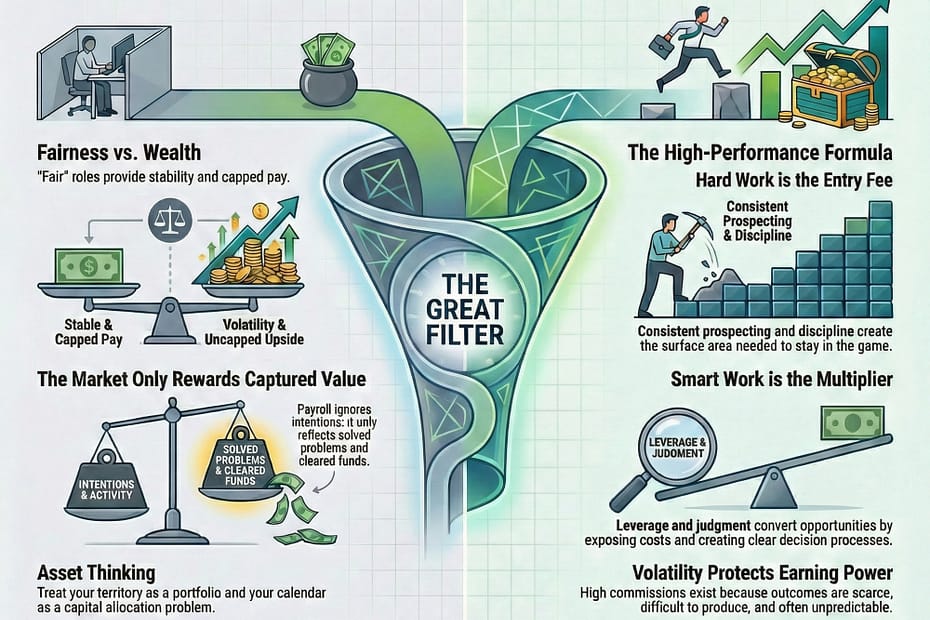
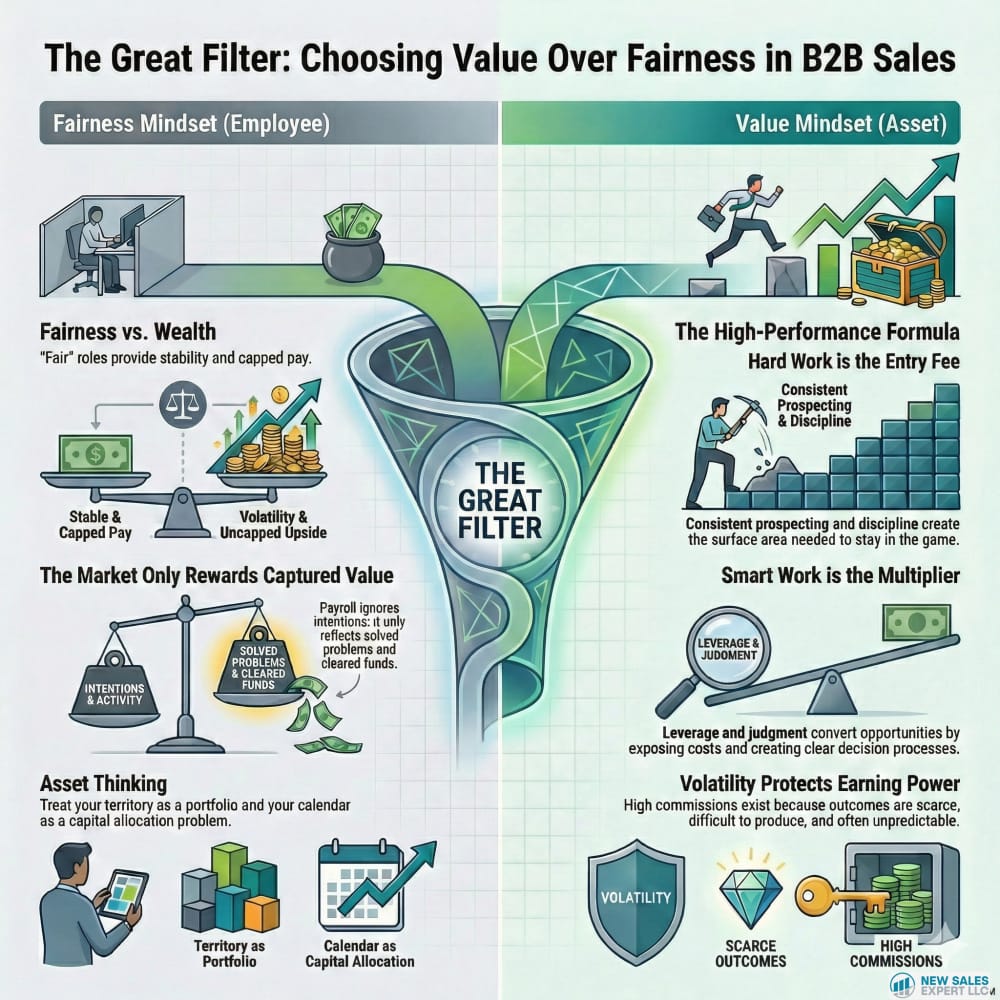
The Great Filter – Why Most People Should Quit B2B Sales Today

If you want fairness, choose a role where performance is measured by compliance and consistency. If you want wealth, stay in sales and accept the only rule that matters: compensation follows captured value.

Walk into any growth-stage B2B sales organization, and you see two populations immediately:

  • One group is stuck in grievance. They stare at the CRM, explain shortfalls with lead quality, territory math, product gaps, or “unrealistic quota.” They want a manager to prescribe the playbook and then validate the effort. Their mindset is hourly, even when they’re paid a salary plus commission.
  • The other group is operating a different model. They talk about leverage, pipeline physics, conversion rates, deal control, and enterprise value. They create their own opportunities. They build customer confidence and earn the right to ask for a decision. They are not looking for comfort. They are looking for the wire.

If you identify with the first group, here’s the most respectful advice I can give you: exit sales on purpose. Move into HR, operations, finance, project management, enablement, customer success, analytics, or any role where the exchange is stable and the scorecard is predictable. Those functions matter. They are important and critical to most companies. They keep companies alive. They are also structurally designed to be fairer.

Sales is designed to be variable, value-based, and exposed. That’s the point.

The safety-net trap

Most people walk into sales carrying the wrong conditioning. School teaches that effort should correlate with reward. Show up, do the work, get the grade. Many corporate functions reinforce it. Do the tasks, hit the process metrics, stay inside the lines, and get the raise.

That conditioning becomes a trap the moment you step into a quota role.

In “fair” roles, compensation tracks your cost and your consistency. Your output is capped by your time, so your income is capped by a band. It’s stable, and it’s a ceiling.

Sales is different because it’s one of the few places left where pay can scale with impact. You are not paid for effort. You are paid for outcomes. That makes it feel brutal to people who want certainty, and it feels like freedom to people who want upside.

The moment you need the world to be fair, sales will punish you. The moment you accept the model, sales becomes one of the most rational games in business.

B2B Sales is rewarding because it isn’t easy or fair
Read the rest of the article…