
Skip to content

Discounts

What An MBA Didn’t Teach You About Sales

The sales profession is challenging. You need to work hard at it to succeed. You need to learn from the best. You need to improve your skills continuously. If you think you can sell since you are a hit at parties and have a lot of friends, you may soon find that you are a failure as a salesperson. Blunt truth:

because the sales profession is so hard, you have to focus on doing everything in sales very well, or you will be considered a failure.

I call this blog, Skinned Knees because I try to relate all of the learning that I have done over the past 4+ decades (while skinning my knees in the learning process).

I hope that you learn from my mistakes so that your business will grow!


Stop Betting on Superstars: How Operating Standards Turn Sellers into Predictable Producers

Many teams grow, but few truly scale revenue beyond individual hero efforts. That difference changes everything for leaders today and in the future. Growth relies on hustle; scaling depends on repeatability across segments and individuals. Your strategy must reflect that hard truth in practice.

Are you relying on one standout to win deals month after month? That looks strong until risk turns visible and costly. One resignation can cripple momentum and expose brittle systems that you had previously ignored.

Scalable sales replaces heroics with defined, teachable operating rhythms that everyone follows. It turns chaos into predictable pipeline progress and results. It clarifies markets, messages, motions, and measurable expectations for every seller on a weekly basis. It builds leverage into onboarding and coaching for consistency. It protects margins while systematically accelerating win rates and velocity across territories.

The foundation begins with a clear picture of your ideal customer, including any disqualifying factors. Having an accurate Ideal Client Profile (ICP) helps minimize waste and reduce uncertainty in your efforts. Take time to define firmographics, pain points, triggers, and buying behaviors using consistent language based on shared evidence. Understand who cares about these issues and why it matters to them now. Also, identify negative personas to sharpen your focus and qualification processes in marketing and sales. A well-defined ICP can significantly boost your conversion rates and shorten the sales cycle.

Next, turn your ICP into straightforward messaging and discovery frameworks tailored for each stage. Consider what unique problems you solve for your customers. What outcomes are most important to them, and who are the key stakeholders by role and priority?

Build talk tracks that lead buyers, not chase buyers with purpose always. Anchor questions to the business metrics and risks they feel. Teach a qualification that tests mutual commitment and outlines next steps with attached dates. Avoid fluffy demos; design relevant proofs using their data. Process specificity turns B players into consistent producers without copying another personality.

I suggest you establish a practical, stage-based operating rhythm that everyone can easily understand and follow. By sharing clear definitions and expectations, managing the pipeline becomes a consistent and smooth process each week. Define each stage with specific exit criteria—avoiding vague intentions or subjective feelings. For example, discovery is considered complete when stakeholders confirm the consequences and impact, and solution fit is achieved when success criteria and ownership are clearly aligned. The commit stage should be backed by a shared plan with clear dates and assigned owners. During weekly reviews, focus on assessing quality rather than just quantity or activity counts. Ask yourself:

  • Does evidence from buyers’ backstage moves have a direct impact on their purchasing decisions?
  • Are the next steps specific, mutually agreed upon, and already scheduled on both calendars?
Read the rest of the article…

The Three Pillars of Sales Success: Ideal Client Profiles, Effective Messaging, and Aspirational Offers

Let’s start this article with a rhetorical question to the sales professionals, sales managers, or CEOs: Have you ever found yourself guilty of sending messages to prospects without fully considering their specific needs or how your offer aligns with them?

If so, you’re not alone—this is a common pitfall in sales. The good news is, it’s entirely fixable by developing a straightforward, strategic approach.

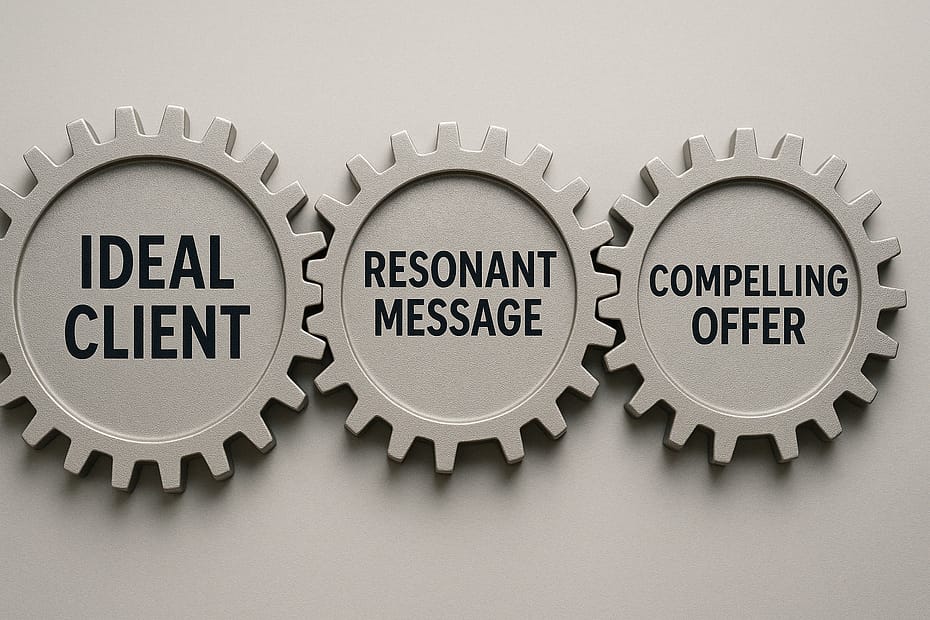
An effective sales strategy hinges on three core components: defining your ideal client profile (ICP), crafting a resonant message, and presenting a compelling offer. These elements are interconnected. Mastering their alignment will significantly enhance your sales effectiveness.

Ideal Client Profile

Let’s start with the ideal client profile. How well do you know the companies you’re targeting? Identifying your ideal customer is foundational to your entire sales approach. It’s not enough to say that your market is “small businesses” or “tech companies.” Instead, think about your best clients—the ones you genuinely enjoy working with, who value your product, and who generate profitable, sustainable business. Think about companies that rarely devalue your product or service by asking for a discount. What do these clients have in common?

Now that you have your favorite customers from above, reflect on your top five or ten accounts. Are they in the same industry? Do they share similar challenges or company structures? Perhaps they all have common goals that your product consistently solves. Pinpoint these commonalities. This process will help you create a precise and actionable ideal client profile.

But don’t stop at company-level characteristics. Remember, even in B2B sales, you’re ultimately selling to individuals. Identify the specific roles or buyers within these organizations that are responsible for making buying decisions. Who are these decision-makers? What motivates them personally and professionally? Do they all have the same kind of college education? Do they all have similar career paths? Understanding the people behind the logo makes your outreach more personal, targeted, and effective.

What is your message?

Once you’ve developed a clear picture of your ideal client and the people within those companies, the next step is crafting a message that reflects your value-selling message. This message is how you communicate your value proposition—it’s the bridge between your product and your prospect’s needs. Too often, sales messaging falls flat because it focuses heavily on the seller rather than the buyer. Statements that emphasize “we,” “I,” or “our product” rarely resonate deeply. Instead, effective messaging highlights the customer’s perspective, clearly communicating the benefits they will experience.

Read the rest of the article…