Skip to content

Finance

What An MBA Didn’t Teach You About Sales

The sales profession is challenging. You need to work hard at it to succeed. You need to learn from the best. You need to improve your skills continuously. If you think you can sell since you are a hit at parties and have a lot of friends, you may soon find that you are a failure as a salesperson. Blunt truth:

because the sales profession is so hard, you have to focus on doing everything in sales very well, or you will be considered a failure.

I call this blog, Skinned Knees because I try to relate all of the learning that I have done over the past 4+ decades (while skinning my knees in the learning process).

I hope that you learn from my mistakes so that your business will grow!


Two Tall Guys Talking Sales – The First 90 Days as a Sales Leader: Proven Strategies for Sales Management Success – Episode 157

When a company hires or promotes its first sales manager, expectations run high, but clarity can be low. In this episode of Two Tall Guys Talking Sales, hosts Sean O’Shaughnessey and Kevin Lawson unpack what the first 90 days should look like for a new sales leader. Whether you’re a CEO onboarding a new manager or that manager stepping into the role themselves, this discussion provides practical guidance on setting realistic expectations, building trust, and establishing the foundation for long-term sales success and revenue growth.

Key Topics Discussed

  • Setting Realistic Expectations as an Owner (02:00)
    Kevin explores how CEOs should frame success during the first 90 days, emphasizing the importance of patience, trust-building, and understanding that sales management transformation takes time.
  • Avoiding the “Fix This First” Trap (06:30)
    Sean cautions business owners against dumping old personnel problems on new leaders, explaining why cleaning up someone else’s mess undermines early business acumen and trust.
  • Building Relationships and Learning the Business (08:30)
    Sean shares tactical advice for new sales managers: conduct one-on-ones, ride along with reps, and build rapport across departments, marketing, operations, and finance, to master internal sales processes and interdepartmental alignment.
  • Understanding Internal and External Tools (11:12)
    Kevin discusses discovering hidden tools and levers, people, systems, vendor programs, or product configurations that can immediately improve team performance and value-selling opportunities.
  • Repackaging and Aligning Offers to the Market (12:30)
    The hosts outline how sales leaders can rethink product structures and messaging to better serve customer needs, thereby improving revenue management and profitability.

Key Quotes

  • “Trust is a currency. It has to be earned by customers, by salespeople, by peers, and you can’t buy it in the first 30 days.”,  Kevin Lawson (03:00)
  • “Don’t make your new sales leader the bad guy. If there’s a tough personnel decision, handle it before they start.”,  Sean O’Shaughnessey (07:00)
  • “Learn your company inside and out. If you don’t know who runs manufacturing or how the supply chain works, you can’t lead your salespeople effectively.”,  Sean O’Shaughnessey (10:00)
  • “You might have 20 products, but 100 possible solutions. The smart leader finds ways to repackage and sell in ways the customer actually values.”,  Kevin Lawson (13:00)

Additional Resources

  • Episodes on sales onboarding, marketing alignment, and ideal customer profiling (ICP) were referenced throughout the conversation.
  • Explore more insights and tools for sales leaders at b2b-sales-lab.com.

A Significant Actionable Item from this Podcast

Create a 90-Day Integration Plan.
If you’re a new sales manager, spend your first month listening and learning. Conduct one-on-ones with every salesperson, schedule cross-department meetings, and document what each function needs from sales. In the second month, identify process gaps and start designing improvements. By the third month, implement one or two visible wins, such as improving forecasting accuracy or clarifying sales messaging, to demonstrate value and build momentum.

Read the rest of the article…

Transforming Quota-Setting: Strategies for Sales Leaders to Optimize Performance and Revenue

Quota-setting is one of the most misunderstood elements of sales leadership. Too often, it’s treated as a spreadsheet exercise or a top-down directive, rather than a strategic lever that drives behavior, performance, and growth.

Whether you’re leading a team of 20 or you’re the founder managing three reps, how you define quotas has a direct impact on your revenue trajectory and your team’s motivation.

So, where do you start?

With timing. If you’re not delivering quotas to your team until February or March, you’re already behind. Salespeople need clarity by December. That gives them runway to plan, prioritize, and hit the ground running in January. Delayed quotas create confusion and stall momentum. To achieve a strong Q1, you need to equip your team early.

Quota-setting varies depending on the size of your company. Larger teams offer more flexibility. With 10 or more reps, you can spread risk, balance performance, and model averages. You’ll have top performers who consistently overdeliver, alongside newer reps who are still ramping up. The law of averages works in your favor. You can afford some variance. Smaller teams don’t have that luxury.

When you’re running a small team, maybe two or three reps or founder-led sales, every individual matters. One person missing quota can tank your number.

You can’t rely on averages. You need precision.

That means tying quotas to actual relationships, known opportunities, and real probability. It’s not about slicing up a target evenly. It’s about assigning numbers based on what’s realistically achievable in each territory or account list.

Territory design plays a big role here. Whether it’s geographic, vertical, or named accounts, quota must reflect the market potential. You can’t expect equal performance from unequal opportunity. If Rep A has 500 viable accounts and Rep B has 50, their quotas shouldn’t look the same unless you have data that says Rep B’s accounts are closer to your Ideal Client Profile. Use available market data to inform the number. Don’t assign quotas in a vacuum. 

In larger organizations, quotas often originate from the top down, typically from finance. The CEO and CFO commit a growth number to the board, investors, or in public filings to the SEC. They have no choice but to pass it down. It’s not uncommon for the sales team to receive the number without context. That’s a problem. If you’re in a leadership role, you need to pressure test that number. Can your team realistically hit it? If not, what additional resources are required?

  • More headcount?
  • Better enablement?
  • Marketing support?

In large organizations where the quota is driven by investor expectations, the VP of Sales must establish an organization well before the new year that achieves this year’s goal, while also meeting the expectation of growth for the next year. Planning ahead, sometimes years in advance, is part of the job.

Read the rest of the article…

The Three Pillars of Sales Success: Ideal Client Profiles, Effective Messaging, and Aspirational Offers

Let’s start this article with a rhetorical question to the sales professionals, sales managers, or CEOs: Have you ever found yourself guilty of sending messages to prospects without fully considering their specific needs or how your offer aligns with them?

If so, you’re not alone—this is a common pitfall in sales. The good news is, it’s entirely fixable by developing a straightforward, strategic approach.

An effective sales strategy hinges on three core components: defining your ideal client profile (ICP), crafting a resonant message, and presenting a compelling offer. These elements are interconnected. Mastering their alignment will significantly enhance your sales effectiveness.

Ideal Client Profile

Let’s start with the ideal client profile. How well do you know the companies you’re targeting? Identifying your ideal customer is foundational to your entire sales approach. It’s not enough to say that your market is “small businesses” or “tech companies.” Instead, think about your best clients—the ones you genuinely enjoy working with, who value your product, and who generate profitable, sustainable business. Think about companies that rarely devalue your product or service by asking for a discount. What do these clients have in common?

Now that you have your favorite customers from above, reflect on your top five or ten accounts. Are they in the same industry? Do they share similar challenges or company structures? Perhaps they all have common goals that your product consistently solves. Pinpoint these commonalities. This process will help you create a precise and actionable ideal client profile.

But don’t stop at company-level characteristics. Remember, even in B2B sales, you’re ultimately selling to individuals. Identify the specific roles or buyers within these organizations that are responsible for making buying decisions. Who are these decision-makers? What motivates them personally and professionally? Do they all have the same kind of college education? Do they all have similar career paths? Understanding the people behind the logo makes your outreach more personal, targeted, and effective.

What is your message?

Once you’ve developed a clear picture of your ideal client and the people within those companies, the next step is crafting a message that reflects your value-selling message. This message is how you communicate your value proposition—it’s the bridge between your product and your prospect’s needs. Too often, sales messaging falls flat because it focuses heavily on the seller rather than the buyer. Statements that emphasize “we,” “I,” or “our product” rarely resonate deeply. Instead, effective messaging highlights the customer’s perspective, clearly communicating the benefits they will experience.

Read the rest of the article…

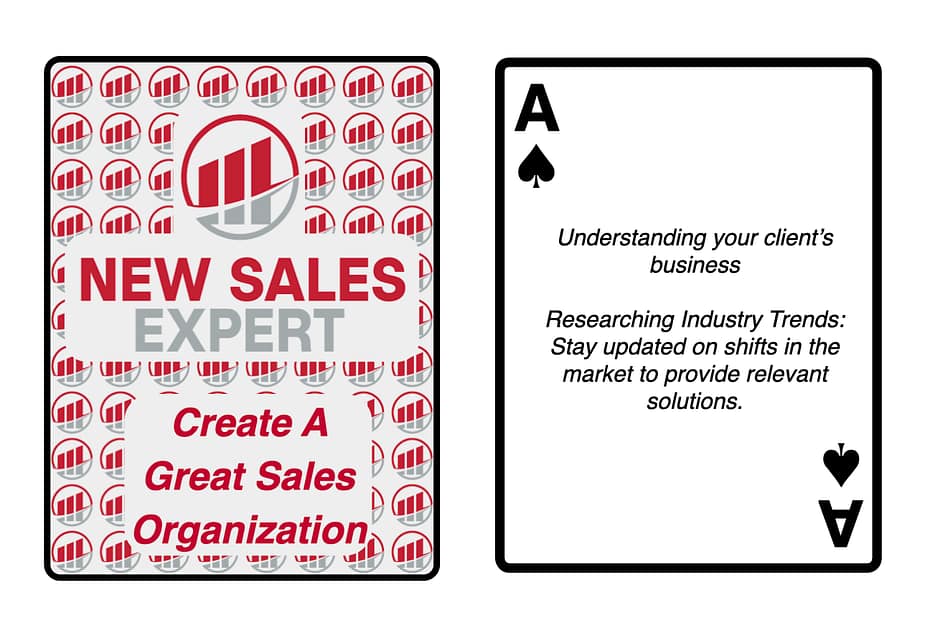
Ace of Spades: Understanding your client’s business: Researching Industry Trends: Stay updated on shifts in the market to provide relevant solutions.

Sailing Through the Business Sea: The Imperative of Understanding Client Industries In the intricate dance of sales management, salespeople often become profoundly attuned to their own products, services, and performance metrics. However, they sometimes lose sight of an elemental cornerstone: genuinely understanding the client’s business. This omission is akin to a sailor venturing into the sea without comprehending its currents and tides. A lack of this depth of knowledge can lead one astray, making the… Ace of Spades: Understanding your client’s business: Researching Industry Trends: Stay updated on shifts in the market to provide relevant solutions.