
Skip to content

Sales Process Optimization

What An MBA Didn’t Teach You About Sales

The sales profession is challenging. You need to work hard at it to succeed. You need to learn from the best. You need to improve your skills continuously. If you think you can sell since you are a hit at parties and have a lot of friends, you may soon find that you are a failure as a salesperson. Blunt truth:

because the sales profession is so hard, you have to focus on doing everything in sales very well, or you will be considered a failure.

I call this blog, Skinned Knees because I try to relate all of the learning that I have done over the past 4+ decades (while skinning my knees in the learning process).

I hope that you learn from my mistakes so that your business will grow!


How to Build a Sales Organization That Survives a Founder Exit

Navigating the complexities of business transitions can be quite a journey, especially for those in sales and leadership roles. When a founder chooses to pass the baton, whether through selling to someone outside the company, passing it within the family, or setting up an employee stock ownership plan, each option comes with its own unique challenges and chances for growth. For salespeople, sales managers, and CEOs of small companies, understanding these dynamics is really important.

When a business owner considers selling to an external buyer, they often experience a surprising realization: the valuation shock. It’s common for owners to overestimate their company’s worth, only to encounter a reality check during the valuation process. This moment is so important because it influences all future negotiations and strategies. Buyers don’t just look at the numbers; they also carefully examine the business’s sales processes and the owner’s involvement. Here, the owner’s role as the main salesperson can be both a strength and a challenge. If the owner accounts for a large share of sales, such as 30%, it can worry potential buyers. 

The key is to build a business that can thrive even when the owner isn’t around, supported by a solid sales system and a talented team eager to keep everything running smoothly.

For the owner contemplating a sale, preparation is key. 

The question to ponder is: what if you were suddenly unavailable? 
Read the rest of the article…

Choosing the Right AI Stack for Your Sales Organization

A VP of Sales recently confided in me: “We have six different AI tools, but our reps are still doing manual work. What went wrong?”

This is the AI tool proliferation problem. Sales leaders often collect tools without a strategy, mistaking a pile of features for a cohesive system. It’s like buying a hammer, screwdriver, saw, and drill without realizing you’re actually trying to build a house. An effective AI stack means integration. When tools work together, they amplify each other’s value. When they don’t, they add complexity, confusion, and wasted money.

Why Strategy Beats Random Adoption

Random tool adoption is rampant across sales organizations. Teams chase shiny new software, often ending up with overlapping features, siloed data, and productivity lost to tool-switching. Instead of solving problems, the stack itself becomes the problem.

But when built strategically, the benefits are profound. Integrated systems reduce manual data entry, accelerate response times, and deliver actionable insights for reps. Three well-chosen, well-connected tools can outperform six isolated ones. Integrated stacks also improve adoption rates by providing consistent interfaces and reducing training overhead.

The Five-Layer AI Stack Framework

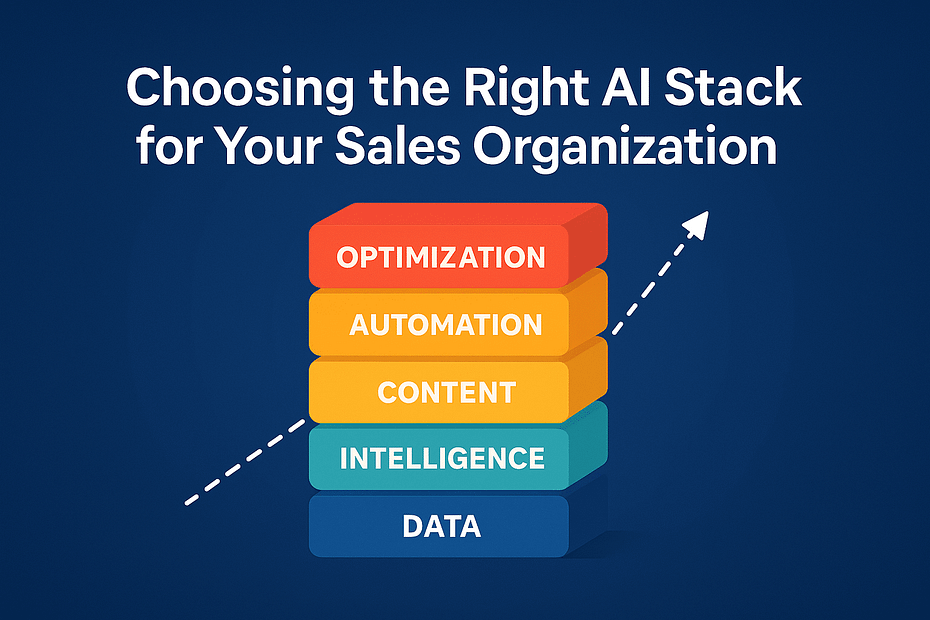
To avoid the chaos of random adoption, I use a five-layer framework for structuring sales AI tools:

  1. Data Foundation – Your CRM and data management system, enriched and maintained for accuracy.
  2. Intelligence & Analytics – AI-driven insights, lead scoring, forecasting, and market intelligence.
  3. Automation & Workflow – Sequences, task automation, and cross-platform orchestration.
  4. Content & Communication – AI writing, proposal generation, and customer-facing tools.
  5. Optimization & Learning – Conversation analysis, performance tracking, and continuous improvement.
Read the rest of the article…

The Dashboard Difference: Transforming B2B Sales with Data-Driven Insights

A sales dashboard in business-to-business sales is pivotal for guiding sales teams toward success. This methodical approach to tracking and interpreting data illuminates the path to revenue scaling and fosters a culture of achievement and recognition within an organization. At its core, a sales dashboard transforms raw data into actionable insights. For salespeople, sales managers, and CEOs of small companies, understanding the nuances of the dashboard can be the difference between stagnation and growth. The…